
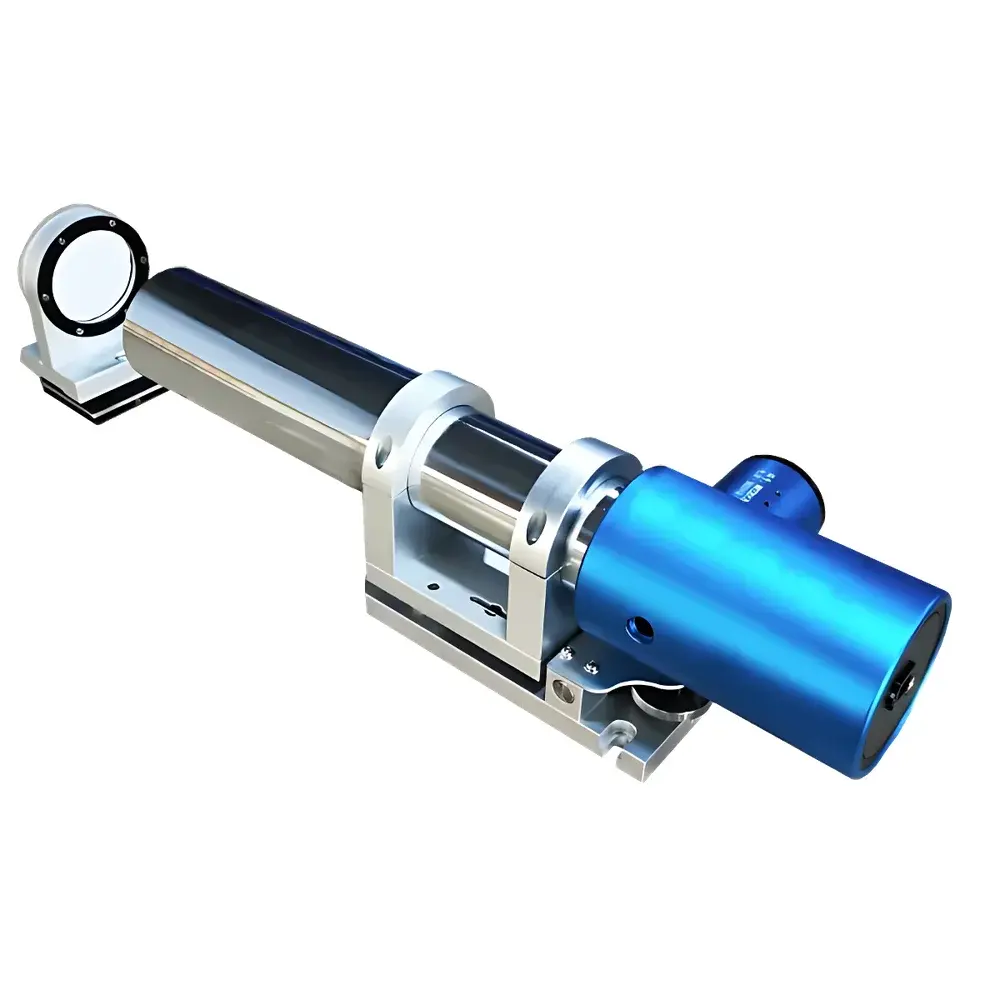
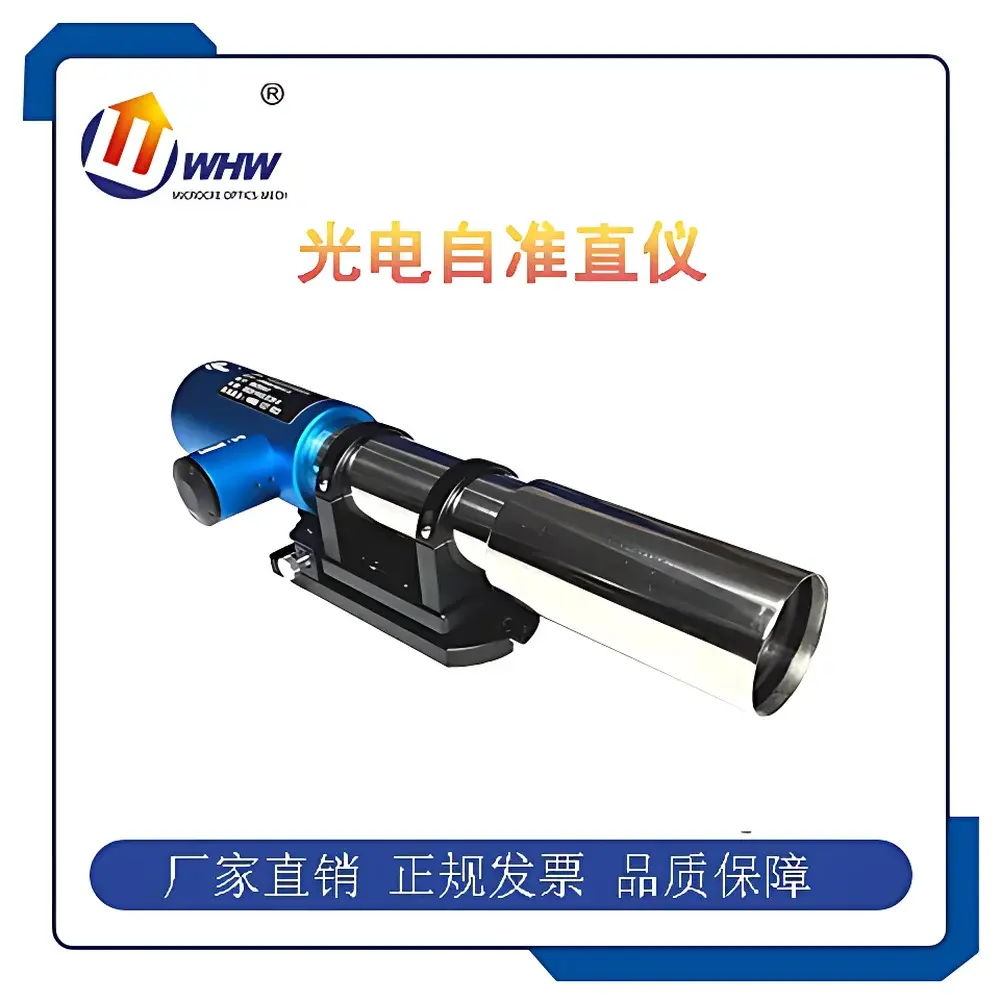
YANRUN MC030-YRMBT350/60/0.5 Dual-Axis Photoelectric Autocollimator
| Brand | YANRUN |
|---|---|
| Origin | Shanghai, China |
| Manufacturer Type | Manufacturer |
| Product Origin | Domestic (China) |
| Model | MC030-YRMBT350/60/0.5 |
| Quotation | Upon Request |
| Focal Length | 350 mm |
| Aperture | 60 mm |
| Light Source | Imported Semiconductor LED |
| Measurement Range | 0–40 m |
| Detector | High-Precision Photodetector |
| Display Resolution | Adjustable from 1″ to 0.0001″ (arc sec) |
| Field of View (X/Y) | 1800″ × 1500″ (arc sec) |
| Accuracy (Center) | ±0.5″ (0–±100″), ±1″ (0–±600″) |
| Frequency Response | ≤30 Hz |
| Interface | USB 2.0 |
| OS Requirement | Windows 7 or later, 64-bit |
| Dimensions | 445 × 135 × 125 mm (L×W×H) |
| Weight | 6.2 kg |
Overview
The YANRUN MC030-YRMBT350/60/0.5 Dual-Axis Photoelectric Autocollimator is a precision angular metrology instrument engineered for high-accuracy, non-contact measurement of angular deviations in two orthogonal axes (X and Y) simultaneously. It operates on the classical optical autocollimation principle—where collimated light emitted from a focal-plane reticle passes through a high-aperture objective lens, reflects off a plane mirror under test, and reimages the reticle onto a co-located photodetector array. A mirror tilt α induces a linear displacement ΔS on the detector surface, corresponding to 2α (in radians); this relationship enables traceable angular quantification with sub-arcsecond resolution. Designed for laboratory-grade calibration, machine tool alignment, optical assembly verification, and aerospace component inspection, the system integrates a 350 mm focal length f/5.8 objective (60 mm clear aperture), low-drift semiconductor LED illumination, and real-time centroid-based image processing to eliminate observer-dependent parallax and human aiming errors inherent in traditional visual autocollimators.
Key Features
- Dual-axis synchronous angular measurement capability with independent X/Y readouts and real-time vector summation.
- Electronically stabilized LED light source with >50,000-hour operational lifetime and minimal thermal drift, eliminating filament aging and intensity fluctuation.
- High-resolution CMOS photodetector array coupled with centroid-fitting algorithms enabling display resolution down to 0.0001 arc seconds (adjustable).
- USB 2.0 interface compliant with Windows 7+ (64-bit), supporting plug-and-play operation without external power supplies or frame grabbers.
- Modular mechanical architecture including precision 2D tilt-adjustable base, interchangeable mirrors, and standardized mounting interfaces (M6 threaded holes, kinematic grooves).
- Auto-curve generation and error calculation per ISO 230-2 Annex B for straightness, flatness, perpendicularity, and parallelism evaluation.
- Multi-language UI support (English, Chinese, Russian, Korean) with configurable report templates compliant with GLP documentation requirements.
- Compact form factor (445 × 135 × 125 mm, 6.2 kg) optimized for field deployment and integration into automated metrology workstations.
Sample Compatibility & Compliance
The MC030-YRMBT350/60/0.5 is compatible with standard optical flats (λ/20 or better), kinematic mirror mounts, and retroreflective targets used in coordinate measuring machine (CMM) verification, laser tracker alignment, and multi-axis stage characterization. Its measurement methodology aligns with ISO 10360-1 (CMM acceptance testing), ISO 230-1 (machine tool geometric accuracy), and ASTM E1316 (non-destructive testing terminology). While not certified to FDA 21 CFR Part 11, the software supports audit-trail logging, user-access controls, and electronic signature-ready Excel export—facilitating compliance with internal QA/QC protocols in regulated environments. Calibration traceability is maintained via NIST-traceable angle standards; periodic verification against certified wedges or rotary tables is recommended per ISO/IEC 17025 guidelines.
Software & Data Management
The included Windows-based control software provides real-time imaging of the reflected crosshair, dynamic offset tracking, and time-synchronized data acquisition at up to 30 Hz. Raw pixel coordinates, calculated angular values (in arc seconds or microradians), and statistical summaries (mean, SD, min/max, trend lines) are stored in structured binary logs (.yrd) with embedded metadata (timestamp, operator ID, environmental notes). Export options include CSV, TXT, and native Excel (.xlsx) with preformatted sheets conforming to ISO 5725 repeatability reporting conventions. Optional modules extend functionality to rotary table calibration (harmonic error decomposition), multi-point planarity mapping (least-squares best-fit plane), and GD&T-compliant tolerance analysis (ASME Y14.5–2018). All software updates are delivered via secure HTTPS download with version-controlled release notes.
Applications
- Precision alignment of CNC machine tool spindles, guideways, and rotary tables during installation and preventive maintenance.
- Verification of optical element orientation in interferometer cavities, laser resonators, and beam steering assemblies.
- Flatness and straightness assessment of granite surface plates, air-bearing stages, and hydrostatic slideways.
- Dynamic angular stability monitoring of inertial sensors, gimbal platforms, and satellite pointing mechanisms.
- Educational use in university optics laboratories for teaching wavefront analysis, optical lever principles, and error budgeting in metrology chains.
- Support for ISO 10791-6 volumetric accuracy verification of five-axis machining centers using sequential angular measurements across multiple positions.
FAQ
What is the minimum required warm-up time before high-accuracy measurements?
For measurements within ±0.5″ specification, the instrument must be powered on for ≥15 minutes to achieve thermal equilibrium. For metrological calibration (e.g., against national standards), a 24-hour temperature-stabilized environment (±0.5°C) and ≥24-hour instrument soak time are mandatory.
Is the system compatible with Linux or macOS operating systems?
No. The current software stack requires Windows 7 or newer (64-bit) with .NET Framework 4.8 and DirectX 11. Virtual machine emulation is not supported due to USB timing constraints and real-time imaging latency requirements.
Can the device measure absolute angles, or only relative deviations?
It measures relative angular changes with respect to an initial reference position. Absolute angular calibration requires external traceable artifacts (e.g., calibrated wedge prisms or rotary encoders) and is performed offline during system validation.
What accessories are available for extended measurement configurations?
Optional accessories include long-range retroreflector kits (up to 40 m), motorized mirror mounts for automated scanning, thermal drift compensation modules, and DIN-rail mounting brackets for industrial integration.
Does the instrument meet any international electromagnetic compatibility (EMC) standards?
Yes—it complies with EN 61326-1:2013 for laboratory-use electrical equipment, including radiated emission limits (Class B) and immunity to electrostatic discharge (IEC 61000-4-2, Level 3). Test reports are available upon request.



