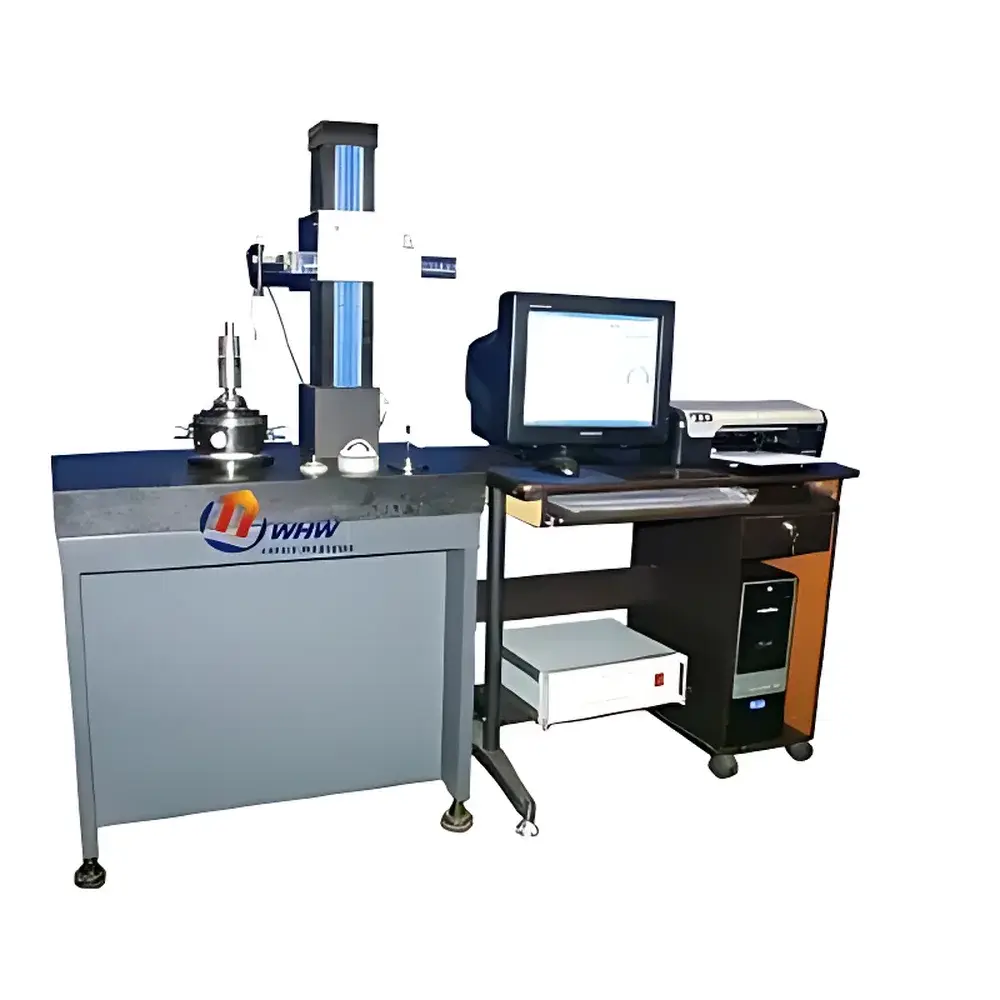
Roundness and Waviness Measuring Instrument MC012-Y9025D
| Origin | China |
|---|---|
| Manufacturer Type | Authorized Distributor |
| Model | MC012-Y9025D |
| Spindle Radial Error | ±0.02 µm |
| System Accuracy | 0.06 µm |
| Maximum External Diameter | Ø200 mm (expandable) |
| Minimum Internal Diameter | Ø3 mm |
| Maximum Height | 300 mm (extendable) |
| Measurement Range | ≤400 µm (radial deviation) |
| Sensor Resolution | 0.01 µm |
| Maximum Load Capacity | 15 kg |
| Rotational Speed | 6 rpm |
| Power Supply | 220 V, 50 Hz, 250 W |
| Air Supply Pressure | ≥0.45 MPa |
| Encoder | Imported HEIDENHAIN precision rotary encoder |
Overview
The MC012-Y9025D Roundness and Waviness Measuring Instrument is a high-precision, air-bearing-based geometric metrology system engineered for traceable, repeatable assessment of rotational symmetry and surface texture harmonics in cylindrical and annular components. Operating on the principle of precise axis-of-rotation referencing, the instrument measures radial deviations from ideal circularity by rotating the workpiece on a hydrostatically levitated spindle while a contact probe traverses its surface. Simultaneously, it quantifies waviness—periodic surface undulations typically arising from machining processes—by applying digital band-pass filtering to separate roughness, waviness, and form error according to ISO 1101, ISO 12181 (Roundness), and ISO 12780 (Straightness/Flatness) standards. Its dual-capability architecture supports both full-circle and partial-arc evaluation, enabling robust analysis of discontinuous features such as commutator segments, gear teeth, bearing races, and stepped shafts.
Key Features
- Air-bearing main spindle with ≤±0.02 µm radial motion error, ensuring long-term stability and zero mechanical wear under continuous operation.
- HEIDENHAIN high-resolution optical rotary encoder integrated into the rotation feedback loop, delivering angular positioning accuracy better than 0.001° and enabling sub-micron harmonic decomposition.
- Windows-based proprietary metrology software with real-time graphical display of polar plots, harmonic spectra, and filtered waviness bands (e.g., 0.1–1 mm, 1–10 mm, 10–100 mm wavelength ranges).
- Motorized or manual Z-axis column with adjustable height (up to 300 mm standard; customizable extension available), supporting vertical scanning for cylindricity, coaxiality, and perpendicularity evaluation.
- Universal leveling table with fine-tuning micrometers allows rapid, repeatable part alignment without requiring external fixtures or shimming.
- Modular probe system featuring ruby-tipped styli (standard lengths: 3 mm, 10 mm, 25 mm) and optional nylon-tipped probes for low-force measurement of soft or coated surfaces (e.g., plastic commutators, anodized aluminum).
- Commutator-specific analysis module providing concurrent calculation of roundness, total indicator reading (TIR), segment-to-segment runout, adjacent-segment differential runout, eccentricity magnitude, and phase angle—all within a single acquisition cycle.
Sample Compatibility & Compliance
The MC012-Y9025D accommodates a broad range of rotational parts: solid and hollow cylinders, rings, flanges, turbine blades, hydraulic valve bodies, and segmented electrical commutators. Internal diameters as small as Ø3 mm and external diameters up to Ø200 mm (with optional extension kits) are supported. The system complies with international geometric tolerance frameworks including ISO GPS (Geometrical Product Specifications), ASME Y14.5, and DIN EN ISO 1101. All measurement algorithms adhere to the mathematical definitions specified in ISO 12181-1 for least-squares, minimum-zone, minimum-circumscribed, and maximum-inscribed circle evaluation methods. Data audit trails, user access logs, and calibration certificate traceability support GLP and GMP environments where regulatory documentation is required.
Software & Data Management
The embedded Windows application provides full control over acquisition parameters—including sampling density (up to 10,000 points per revolution), filter selection (Gaussian, 2CR, phase-corrected), and harmonic order cutoff (up to 50th order). Raw and processed data are stored in vendor-neutral CSV and XML formats compatible with third-party statistical process control (SPC) platforms. Reports include annotated polar graphs, Cartesian cross-sections, spectral amplitude bar charts, and tabular summaries with pass/fail status against user-defined tolerances. Optional FDA 21 CFR Part 11 compliance package enables electronic signatures, audit trail recording, and role-based permission management for regulated manufacturing settings.
Applications
This instrument serves quality assurance laboratories and production engineering teams across aerospace (bearing race inspection), automotive (crankshaft journals, brake drums), electric motor manufacturing (commutator roundness and segment consistency), precision optics (lens cell alignment verification), and medical device production (implant-grade titanium sleeves). It is routinely deployed for incoming material inspection, in-process verification, and final product release testing—particularly where compliance with tight GD&T callouts (e.g., circularity ≤0.5 µm, waviness λc = 2.5 mm) is mandatory. Its ability to isolate and quantify individual harmonic components supports root-cause analysis of machine tool vibration, chucking errors, or grinding wheel dressing anomalies.
FAQ
What standards does the MC012-Y9025D comply with for roundness evaluation?
It implements all four roundness assessment methods defined in ISO 12181-1: least-squares circle (LSC), minimum-zone circle (MZC), minimum-circumscribed circle (MCC), and maximum-inscribed circle (MIC).
Can the system measure non-continuous surfaces such as motor commutators?
Yes—the instrument includes automatic gap detection, manual and algorithmic notch removal, and dedicated commutator analysis mode that reports segment-level runout metrics alongside global form error.
Is environmental conditioning required for stable operation?
No special temperature-controlled rooms are needed; the system operates reliably in ambient workshop conditions (15–30 °C, <70% RH) thanks to thermal drift compensation built into the air-bearing and encoder subsystems.
How is calibration maintained and verified?
Calibration is performed using NIST-traceable master rings and step gauges. The software includes built-in calibration verification routines with documented uncertainty budgets compliant with ISO/IEC 17025 requirements.
What probe options are available for delicate or soft materials?
Standard ruby-tipped probes (2 µm tip radius) are supplied; optional nylon-tipped probes (5 µm radius, 5 mN nominal force) minimize surface deformation during measurement of polymers, composites, or plated components.