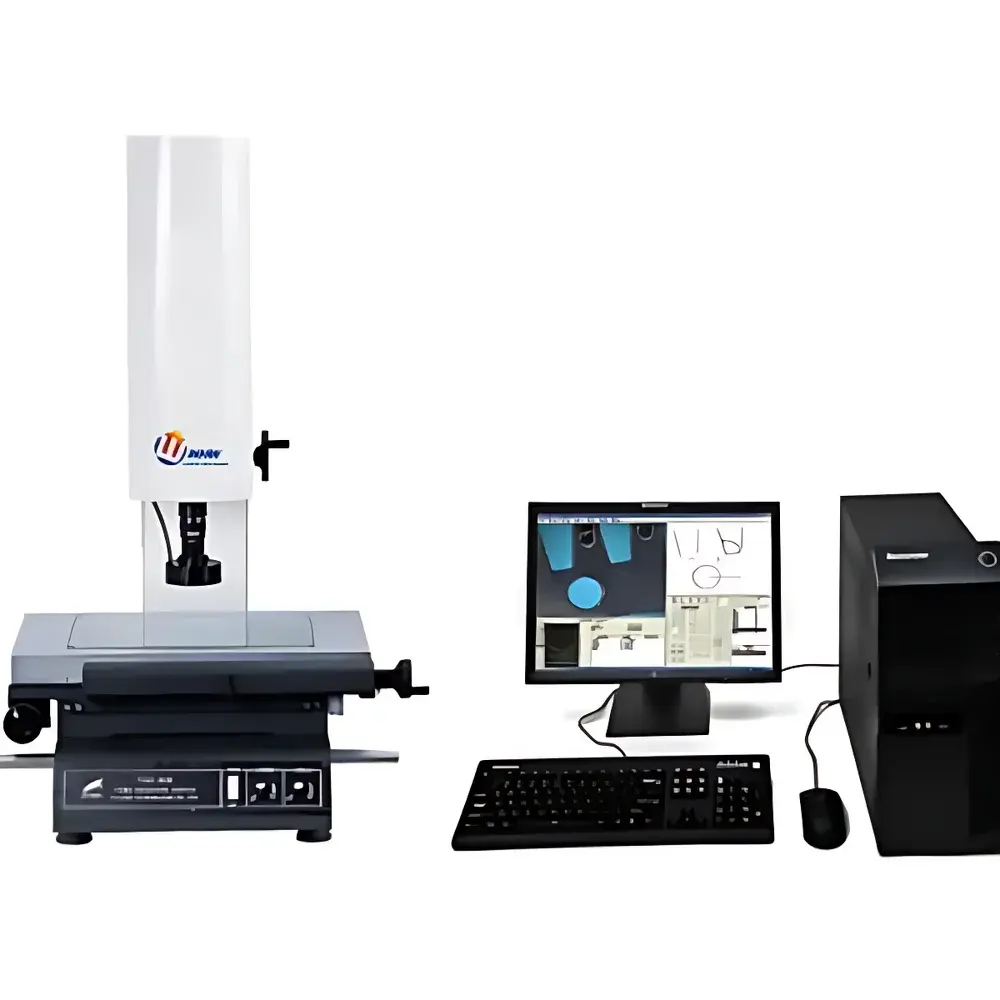
YANRUN YR-T1510 Economical Vision Measuring Machine
| Brand | YANRUN |
|---|---|
| Origin | Shanghai, China |
| Manufacturer Type | Direct Manufacturer |
| Region of Origin | Domestic (China) |
| Model | YR-T1510 |
| Price | USD 1 (Base Unit Reference Only) |
| Table Surface (Metal) | 354 × 228 mm |
| Glass Stage Size | 210 × 160 mm |
| X-Y Travel Range | 150 × 100 mm |
| Z-Axis Vertical Travel | 200 mm |
| Working Distance | 92 mm |
| Display Resolution (X/Y/Z) | 0.0005 mm |
| Positioning Accuracy (X/Y) | ≤(3 + L/200) μm |
| Camera | Color 1/3" CCD |
| Zoom Objective Magnification | 0.7× to 4.5× |
| Total Video Magnification | 30× to 230× |
| Field of View (Object Side) | 7.0 mm to 1.1 mm |
| Illumination | Dual LED (Top Surface & Bottom Transmission), Adjustable Brightness |
| Power Supply | AC 180–260 V, 50 Hz |
| Standard Software | Automated Edge Detection, Deburring Algorithm, Geometric Feature Measurement (Points, Lines, Circles, Circle-to-Circle Distance, Part Alignment), Coordinate System Registration |
| Optional Heavy-Duty Stage (for YR-T1510 series) | Load Capacity ≥300 kg, Dimensions (L×W×H): 1120 × 730 × 780 mm |
Overview
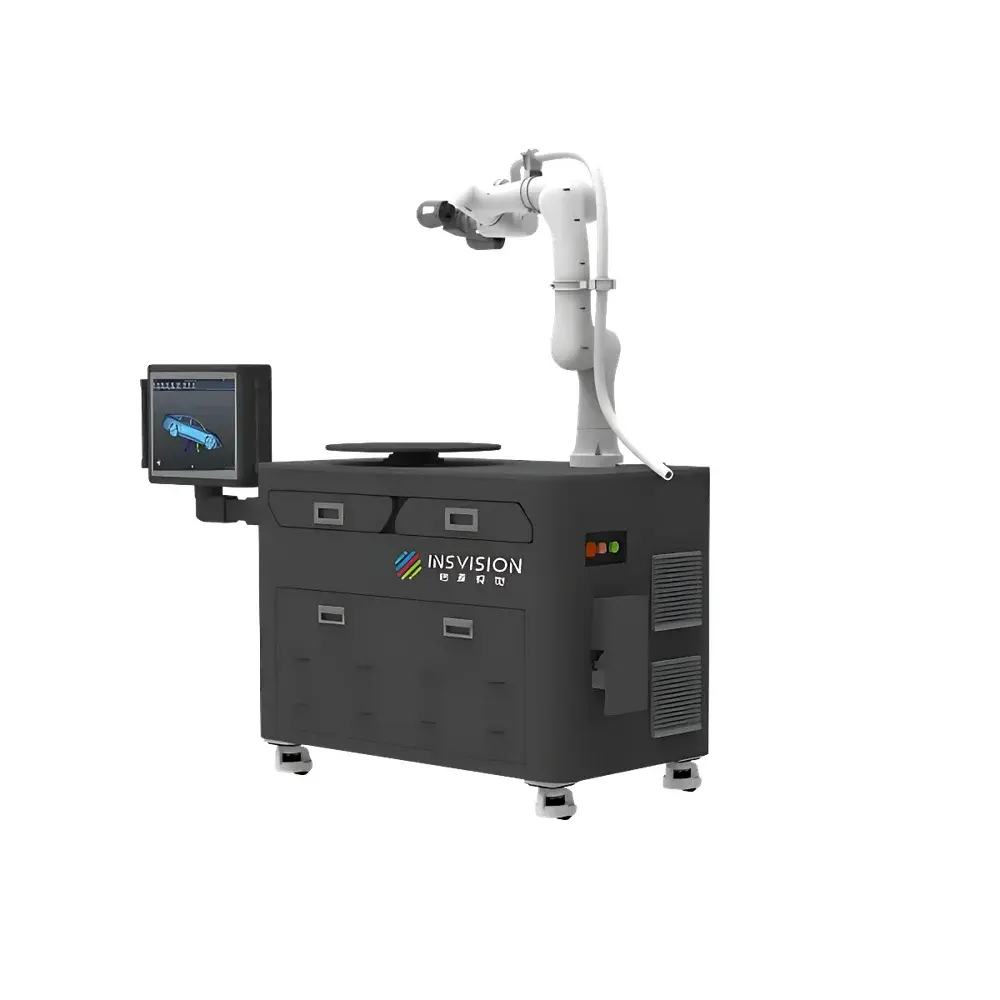
The YANRUN YR-T1510 Economical Vision Measuring Machine is a benchtop coordinate measuring system engineered for high-reproducibility 2D geometric metrology in quality control laboratories, precision machining workshops, and R&D environments. It operates on the principle of optical magnification and digital image analysis—capturing high-contrast silhouette or surface-reflected images via a telecentric zoom lens and color CCD sensor, then applying sub-pixel edge detection algorithms to determine feature coordinates with micron-level repeatability. Designed for ISO/IEC 17025-aligned dimensional verification workflows, the YR-T1510 delivers traceable measurements compliant with foundational standards including ISO 1101 (Geometrical Product Specifications), ISO 5725 (Accuracy of Measurement Methods), and ASTM E29 (Standard Practice for Using Significant Digits in Test Data). Its rigid granite base, thermally stable aluminum frame, and motorized Z-axis enable consistent focus maintenance across varying part heights—critical for repeatable profile and positional assessments of stamped metal components, PCBs, injection-molded plastic housings, and micro-machined mechanical parts.
Key Features
- High-resolution optical path: 0.7×–4.5× manual zoom objective paired with 1/3″ color CCD camera, delivering real-time video magnification from 30× to 230× with calibrated field-of-view ranging from 7.0 mm down to 1.1 mm
- Precision motion platform: Manual X-Y translation stage with 150 mm × 100 mm travel range and 0.0005 mm digital readout resolution; Z-axis lift mechanism with 200 mm vertical clearance and fixed 92 mm working distance optimized for standard lens geometry
- Dual-mode illumination system: Independently controllable top-surface LED ring light and bottom-transmission LED backlight, both intensity-adjustable to enhance contrast for opaque, translucent, or reflective samples
- Automated measurement engine: Embedded software includes adaptive threshold-based edge detection, morphological filtering for burr suppression, and iterative least-squares fitting for circles, lines, and arcs
- Traceable metrological architecture: X-Y axis error compensation per ISO 230-2 Annex B; coordinate reporting includes uncertainty estimation based on machine kinematics and environmental influence factors
- Modular staging support: Compatible with optional heavy-duty granite mounting tables (≥300 kg load capacity, 1120 × 730 × 780 mm) for vibration isolation and long-term thermal stability in production-floor deployment
Sample Compatibility & Compliance
The YR-T1510 accommodates flat or low-relief parts up to 200 mm in height and 300 mm in diagonal footprint. Typical applications include dimensional validation of sheet metal stampings, connector pins, gaskets, ceramic substrates, and thin-film coated wafers. All measurement routines adhere to documented procedures required under GLP (Good Laboratory Practice) and GMP (Good Manufacturing Practice) frameworks. While the base system does not include full 21 CFR Part 11 audit trail functionality, its software architecture supports export of raw coordinate data (CSV, DXF) and annotated measurement reports compatible with external LIMS or QMS platforms. Calibration certificates issued by accredited third-party labs (e.g., CNAS-accredited providers in China) are available upon request to satisfy ISO 9001 clause 7.1.5 requirements.
Software & Data Management
The included vision measurement software provides a Windows-based GUI with intuitive icon-driven workflow navigation. Core functions include automatic feature recognition (points, lines, circles, slots, distances, angles, parallelism), batch measurement scripting, GD&T evaluation (position, concentricity, symmetry), and report generation with customizable templates. All measurement sessions log timestamp, operator ID, calibration status, and environmental notes (temperature/humidity if integrated sensors are added). Data exports conform to ASTM E572-22 (Standard Guide for Digital Data Exchange in Metrology) and support direct integration with statistical process control (SPC) tools via ODBC or API interface. Firmware updates are delivered via secure USB media to maintain integrity without network exposure.
Applications
- Dimensional inspection of automotive brake pads, clutch plates, and sensor housings
- PCB solder mask alignment verification and pad-to-pad spacing checks
- Medical device component verification (e.g., syringe barrels, catheter hubs, orthodontic brackets)
- Tooling validation for injection molds and progressive dies
- Educational use in metrology training labs for hands-on understanding of coordinate geometry and uncertainty propagation
- Supplier quality audits requiring rapid, non-contact verification of drawing tolerances (±0.01 mm typical)
FAQ
Is the YR-T1510 suitable for measuring parts with complex 3D contours?
No—the YR-T1510 is strictly a 2D vision measurement system. It measures projected features in the X-Y plane at a fixed focal plane; Z-height variations must be assessed manually via focus adjustment and are not quantified with metrological traceability.
Can the system be calibrated to NIST-traceable standards?
Yes—certified step gauges, ball bars, and optical gratings traceable to national metrology institutes (e.g., NIM China, NIST USA) may be used for periodic verification. Full calibration services are offered through YANRUN’s authorized service centers.
Does the software support multi-language UI or custom report localization?
The default interface is English; localized versions (German, Japanese, Spanish) are available upon OEM agreement. Report templates accept user-defined fields and corporate branding elements.
What environmental conditions are recommended for optimal performance?
Operating temperature: 20 ± 2 °C; relative humidity: 40–60% RH; vibration class: ISO 230-2 Class 3; ambient lighting: diffused, non-directional, with no direct sunlight on the stage or optics.