
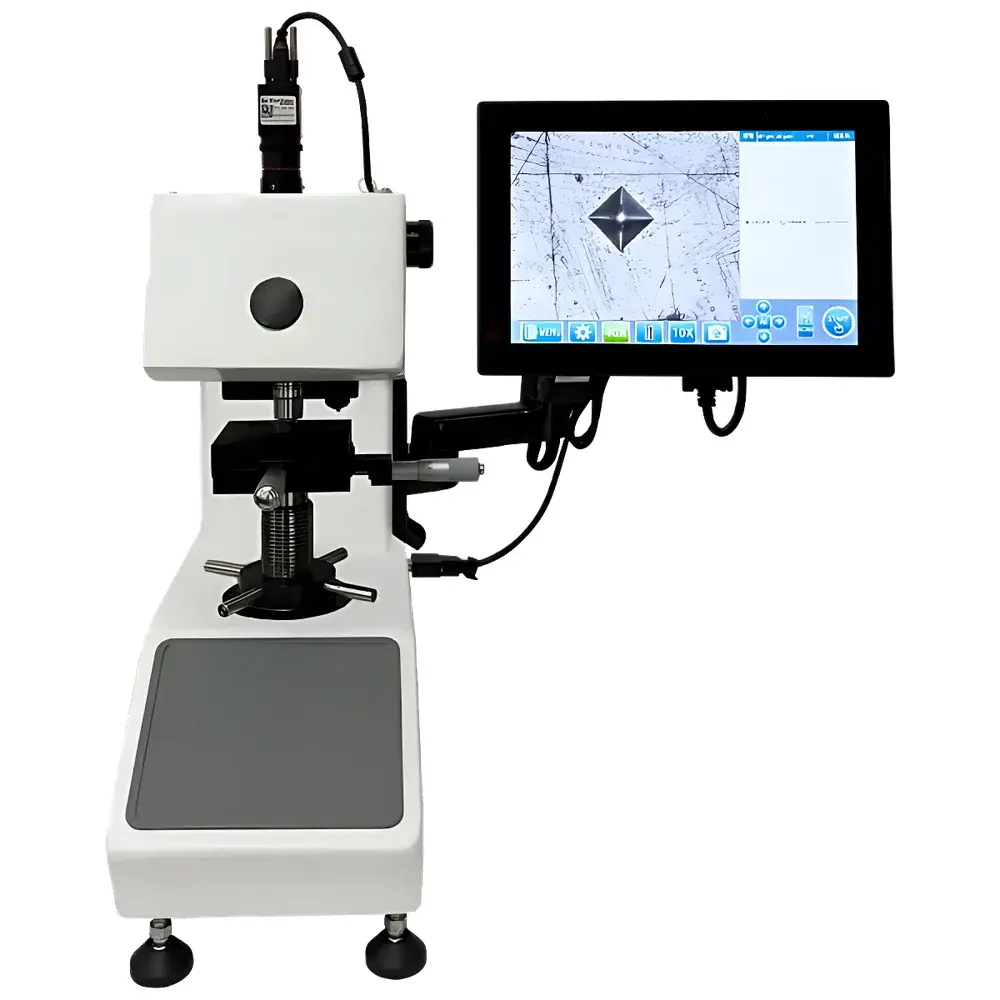
YANRUN HV-5/10/30/50VE10 Advanced Vision-Based Vickers Hardness Tester
| Brand | YANRUN |
|---|---|
| Origin | Shanghai, China |
| Manufacturer Type | Direct Manufacturer |
| Product Category | Domestic |
| Model | HV-5/10/30/50VE10 |
| Instrument Type | Vickers Hardness Tester |
| Measuring Range | 8–3000 HV |
| Test Force Options | 0.2–50 kgf (with multiple selectable loads across 5/10/30/50 kgf capacity tiers) |
| Objective Lenses | 10× (observation), 20× (measurement for 5/10 kgf) |
| Total Magnification | 100× / 200× (5/10 kgf), 100× (30/50 kgf) |
| Minimum Detectable Indentation Resolution | 0.16 µm (10×), 0.08 µm (20×) |
| Indentation Dwell Time | 0–60 s (1 s increments) |
| Max Specimen Height | 230 mm |
| Distance from Indenter Center to Chamber Wall | 130 mm |
| Power Supply | AC 220 V / 50 Hz |
| Dimensions (L×W×H) | 580 × 375 × 800 mm |
| Net Weight | 47.0 kg |
| Compliance | GB/T 4340, ISO 6507 |
Overview
The YANRUN HV-5/10/30/50VE10 is a fully automated, vision-based Vickers hardness tester engineered for precision metrology in metallurgical laboratories, quality control departments, and R&D facilities. It operates on the fundamental principle of Vickers micro- and macro-hardness testing—applying a precisely calibrated diamond pyramid indenter under controlled load to produce a geometrically defined impression on the sample surface; hardness is then calculated from the two orthogonal diagonal measurements of the residual indentation using the standard formula: HV = 0.1891·F/d², where F is the applied test force in kgf and d is the arithmetic mean of the diagonals in millimeters. Designed for compliance with ISO 6507-1 and GB/T 4340.1, the instrument supports both microhardness (0.2–1 kgf) and macrohardness (up to 50 kgf) regimes within a single platform, enabling seamless transition between thin coatings, case-hardened layers, bulk alloys, and brittle ceramics.
Key Features
- Triple-objective turret system: Accommodates up to three objective lenses (10× observation, 20× measurement, and optional 40× or 50× high-magnification lens) on a single motorized turret—enhancing optical versatility and eliminating manual lens swapping.
- Automated turret positioning: Controlled via capacitive touchscreen interface; stepper motor-driven actuation ensures repeatable, sub-micron positional accuracy of the optical axis relative to the indenter centerline.
- Optimized optical path: Large-bore trinocular optical design achieves near 100% light throughput efficiency, minimizing photon loss and maximizing contrast for reliable edge detection of Vickers impressions—even on low-reflectivity or oxidized surfaces.
- Full-cycle automation: Integrated electromechanical loading system executes indentation sequence—load application, dwell period (0–60 s, adjustable in 1 s steps), and unloading—without operator intervention, ensuring strict adherence to ASTM E384 and ISO 6507 timing protocols.
- Advanced floating-point calculation engine: Replaces legacy fixed-point algorithms to reduce rounding errors during diagonal averaging and HV conversion, improving consistency between repeated measurements and certified reference values.
- Modular expandability: Supports optional motorized XY stage (custom-configurable), USB-connected industrial tablet, and PC-based hardness analysis software—enabling full GLP-compliant data capture, statistical reporting, and audit-trail generation.
Sample Compatibility & Compliance
The HV-5/10/30/50VE10 accommodates specimens up to 230 mm in height and 130 mm clearance from indenter center to chamber interior wall—suitable for forged components, heat-treated gears, turbine blades, and large-section weldments. Its multi-tier test force architecture (0.2–50 kgf) satisfies requirements across diverse material classes: thin-film coatings (e.g., TiN, DLC), case-hardened steels (carburized, nitrided), aluminum alloys, copper composites, and sintered carbides. All mechanical and optical subsystems conform to ISO 6507-2 (verification of hardness testers) and GB/T 4340.2 (calibration of reference blocks). The system supports traceable calibration using NIST-traceable or CNAS-accredited Vickers reference blocks (e.g., HBW 10/3000, HV 10/1000).
Software & Data Management
Equipped with embedded Android-based tablet interface and optional Windows-compatible desktop software, the system delivers real-time image acquisition, automatic indentation detection (via Sobel edge enhancement and adaptive thresholding), and ISO-compliant hardness value computation. All measurement events—including timestamp, operator ID, test force, dwell time, diagonal lengths, HV result, and raw image—are stored in encrypted SQLite databases with configurable export to CSV, PDF, or XML formats. Software modules support statistical process control (SPC) charting, batch report generation, and 21 CFR Part 11–ready electronic signatures when deployed in regulated GMP/GLP environments. Audit trails record all user actions, parameter modifications, and calibration events with immutable timestamps.
Applications
- Metallurgical QC: Verification of through-hardness profiles in quenched-and-tempered steels per ASTM A370.
- Surface engineering: Quantification of nitride layer hardness gradients in AISI 4140 shafts using step-load indentation arrays.
- Aerospace materials: Microhardness mapping of thermal barrier coating (TBC) bond coats (NiCrAlY) and topcoats (YSZ) at 0.3–1 kgf loads.
- Electronics packaging: Hardness evaluation of solder bump intermetallic compounds (IMCs) and Cu pillar underfills.
- Academic research: Correlation studies between nanoindentation modulus and Vickers hardness in additively manufactured Inconel 718.
- Failure analysis: Cross-sectional hardness profiling across weld fusion zones, HAZ, and base metal in API 5L X70 pipeline joints.
FAQ
What standards does the HV-5/10/30/50VE10 comply with for calibration and verification?
It meets ISO 6507-2, GB/T 4340.2, and ASTM E92 requirements for hardness tester verification, including repeatability, force accuracy, indenter geometry, and optical measurement uncertainty.
Can the system perform sequential multi-point hardness mapping without manual repositioning?
Yes—when equipped with the optional motorized XY stage and software module, it executes programmable grid-based indentation sequences with auto-focus and auto-measurement at each location.
Is the indentation imaging system compatible with third-party image analysis platforms?
Raw TIFF images and coordinate metadata are exportable via USB or network share, supporting integration with MATLAB, ImageJ, or custom Python-based analysis pipelines.
What maintenance intervals are recommended for long-term measurement stability?
Annual verification of test force accuracy (±1.0% tolerance), indenter alignment (≤0.5 µm offset), and optical calibration using certified reference blocks is advised per ISO 6507-3 guidelines.
Does the instrument support remote diagnostics or firmware updates?
Firmware updates are performed locally via USB drive; remote diagnostic access requires optional Ethernet-enabled controller module and secure VPN configuration per IT security policies.



