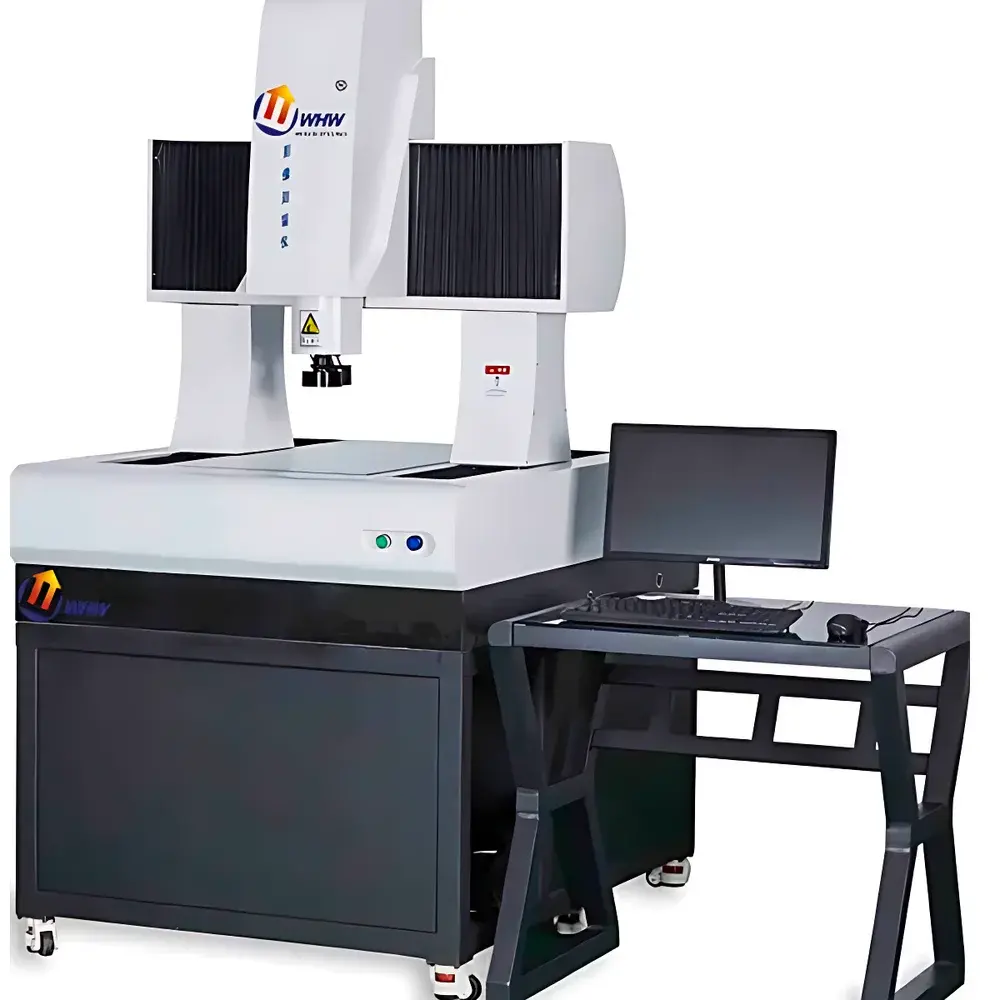
YANRUN YR6050-M Bridge-Type Fully Automatic 3D Vision Measuring Machine
| Brand | YANRUN |
|---|---|
| Origin | Shanghai, China |
| Manufacturer Type | OEM Manufacturer |
| Country of Origin | China |
| Model | YR6050-M |
| Operation Mode | Fully Automatic |
| XY Measurement Accuracy | (2.8 + L/200) µm |
| Z-Axis Measurement Accuracy | (5 + L/200) µm |
| Encoded Linear Scale Resolution | 1 µm (closed-loop) |
| XY Axis Speed | 280 mm/s |
| Z-Axis Speed | 100 mm/s |
| Optical Magnification | 0.7×–4.5× |
| System Magnification | 21×–200× |
| Camera | Hikvision GigE Color Industrial Digital Camera |
| Surface Illumination | 5-Ring 8-Zone LED Cold Light Source, 256-Level Brightness Adjustment |
| Edge Illumination | LED Cold Light Source, 256-Level Brightness Adjustment |
Overview
The YANRUN YR6050-M is a high-precision bridge-type fully automatic 3D vision measuring machine engineered for metrological-grade dimensional inspection in quality control laboratories, precision machining facilities, and R&D environments. It employs non-contact optical measurement based on high-resolution digital imaging, calibrated geometric projection, and sub-pixel edge detection algorithms to quantify linear dimensions, geometric features, and form tolerances of manufactured parts. The system integrates a rigid granite base (Grade 00, flatness ≤3 µm), precision linear motion stages with Mitsubishi servo drives, and closed-loop 1 µm resolution optical encoders on all three axes—ensuring mechanical stability and thermal drift compensation across extended measurement cycles. Designed for compliance with ISO 10360-7 (coordinate measuring machines) and aligned with GD&T evaluation principles per ASME Y14.5 and ISO 1101, the YR6050-M supports traceable, repeatable, and auditable measurements under controlled environmental conditions (20°C ±2°C, humidity 30–80%, vibration <0.002 g below 15 Hz).
Key Features
- Bridge architecture with 600 mm × 500 mm × 300 mm (XYZ) measurement volume and 80 kg maximum load capacity
- High-stability granite structure (00-grade, surface flatness ≤3 µm) and Taiwan-made HITIN precision linear guideways
- 6.5:1 motorized zoom lens with manual magnification adjustment (0.7×–4.5× optical, 21×–200× system magnification); no recalibration required after zoom changes
- Hikvision GigE color industrial camera delivering high signal-to-noise ratio imaging at up to 5 MP resolution
- Dual independent illumination systems: 5-ring 8-zone surface LED light source and adjustable edge LED backlight, each with 256-level brightness control for optimal contrast on diverse material surfaces
- Auto-focus functionality enabling rapid Z-height determination via contrast-based focus peak detection
- Temperature compensation algorithm integrating real-time ambient temperature input to correct for thermal expansion of workpiece and machine structure
- Integrated CNC4000 motion controller and CNC Smart Metrology software platform supporting full G-code compatibility and programmable measurement sequences
Sample Compatibility & Compliance
The YR6050-M accommodates a broad range of metallic, plastic, ceramic, and composite components—including machined housings, stamped sheet metal, PCBs, precision molds, and medical device substrates—within its 600 × 500 mm field of view. Its non-destructive optical methodology eliminates part deformation risks associated with tactile probing. The system meets essential requirements for ISO/IEC 17025-accredited laboratories, including documented calibration procedures, uncertainty budgeting support, and audit-ready measurement records. Software logs include timestamped operator ID, environmental parameters, calibration status, and full revision history—facilitating GLP/GMP alignment and FDA 21 CFR Part 11 readiness when deployed with electronic signature modules and secure user access controls.
Software & Data Management
The proprietary CNC Smart Metrology software provides comprehensive GD&T analysis, automated report generation, and multi-format data exchange. It supports direct import/export of DXF, CAD drawings (AutoCAD-compatible), and measurement results in CSV, Excel (.xlsx), Word (.docx), PDF, and native .rst task files. SPC modules enable statistical process control using imported .rst datasets, calculating Cp/Cpk, X-bar/R charts, and outlier detection per ANSI/ASQ B119. Full audit trail functionality records every user action—including coordinate system definition, feature construction, tolerance assignment, and report export—with immutable timestamps. Multi-language UI (English, Simplified/Traditional Chinese, Japanese, Korean) and customizable report templates ensure seamless integration into global manufacturing workflows.
Applications
This system is routinely deployed for first-article inspection of aerospace brackets, positional verification of automotive transmission components, contour analysis of injection-molded connectors, GD&T validation of semiconductor packaging carriers, and dimensional screening of precision optics mounts. Its panoramic scanning mode enables stitching of large-area images for macro-scale defect mapping or full-part coverage. Optional Renishaw MCP 3D touch probe integration extends capability to hybrid measurement—combining optical edge detection with tactile point-cloud acquisition for complex freeform surfaces or features inaccessible to line-of-sight imaging.
FAQ
What is the maximum workpiece size supported by the YR6050-M?
The standard measurement envelope is 600 mm (X) × 500 mm (Y) × 300 mm (Z), with a maximum payload of 80 kg.
Does the system support automated GD&T evaluation?
Yes—it calculates straightness, roundness, position, parallelism, perpendicularity, angularity, concentricity, and profile tolerances in accordance with ASME Y14.5 and ISO 1101 standards.
Can CAD models be imported for comparison against measured data?
Yes—the software accepts DXF files and overlays nominal geometry onto captured images for deviation mapping and pass/fail color-coded reporting.
Is temperature compensation implemented automatically?
Yes—users input ambient temperature, and the system applies material-specific thermal expansion coefficients to adjust dimensional outputs relative to 20°C reference conditions.
What data export formats are available for SPC integration?
Measurement results can be exported as CSV, Excel (.xlsx), or native .rst files compatible with common SPC platforms such as Minitab, JMP, and InfinityQS.