
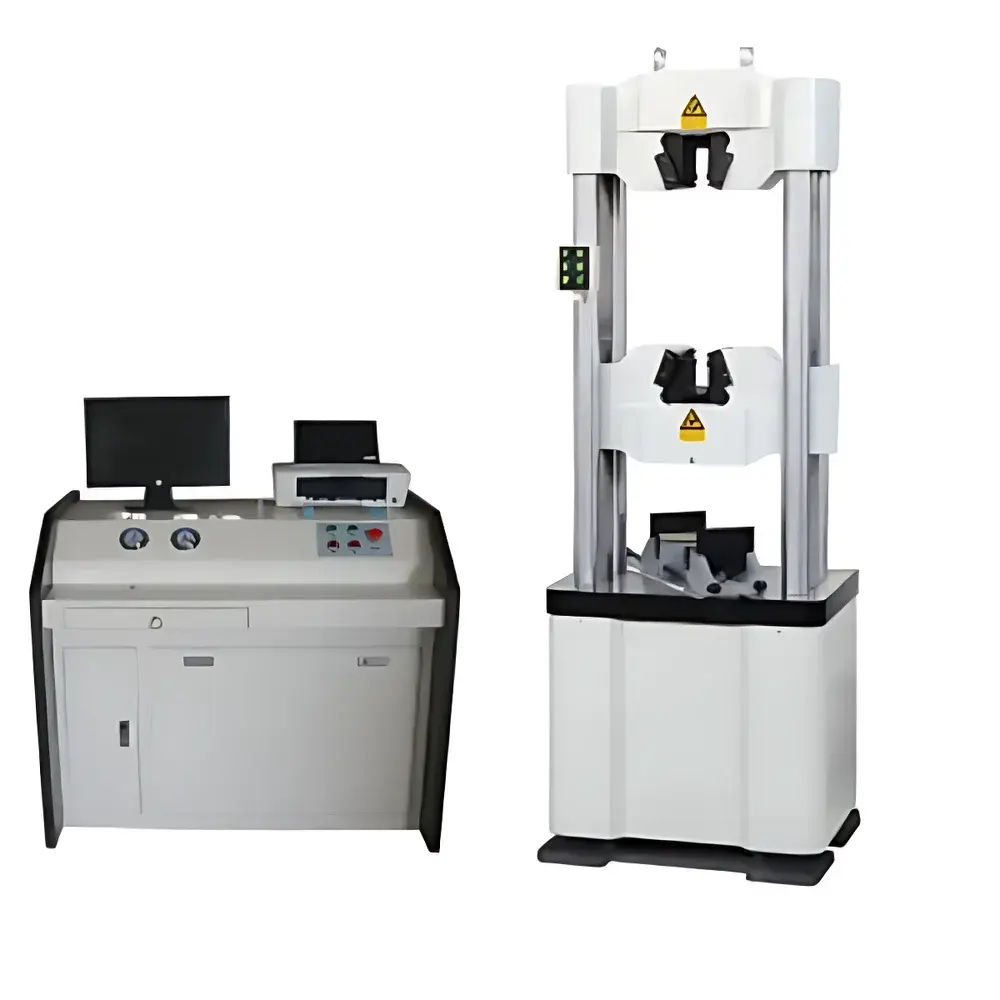
YANRUN WAW-300D Microcomputer-Controlled Electro-Hydraulic Servo Universal Testing Machine
| Brand | YANRUN |
|---|---|
| Origin | Shanghai, China |
| Manufacturer Type | Direct Manufacturer |
| Model | WAW-300D |
| Instrument Type | Electro-Hydraulic Servo Testing Machine |
| Load Capacity Range | 3 kN to 300 kN |
| Load Measurement Accuracy | ±0.5% FS |
| Displacement Resolution | 0.01 mm |
| Strain Measurement | Standard 50 mm gauge length, max deformation 10 mm |
| Strain Accuracy | ±0.5% FS |
| Control Modes | Constant Load / Constant Deformation / Constant Displacement (0.4–100% FS) |
| Control Accuracy | ±1.0% FS (setpoint <10% FS) |
| Strain Rate Accuracy | ±2.0% (rate <0.05% FS) |
| Crosshead Speed (Max) | 80 mm/min |
| Max Tensile Test Space | 600 mm |
| Max Compressive Test Space | 550 mm |
| Flat Specimen Clamping Thickness | 0–15 mm |
| Round Specimen Clamping Diameter | φ6–φ26 mm (including deformed bar testing) |
| Compression Platen Diameter | φ160 mm |
| Bend Support Span | 400 mm |
| Piston Stroke | 150 mm |
| Clamping Method | Hydraulic |
| Transducer | Integrated Hydraulic Load Cell |
| Signal Conditioning | PC-Embedded Programmable Amplifier with Auto-Zero & Auto-Calibration |
| Dimensions (Host) | 730 × 570 × 1845 mm |
| Dimensions (Power Unit) | 1020 × 620 × 810 mm |
| Total Weight | 1800 kg |
Overview
The YANRUN WAW-300D is a microcomputer-controlled electro-hydraulic servo universal testing machine engineered for high-precision mechanical property evaluation of metallic, polymeric, composite, and civil engineering materials under tension, compression, bending, and shear loading conditions. It operates on the principle of closed-loop hydraulic force actuation, where a servo-controlled high-pressure oil system drives the crosshead via a precision piston-cylinder assembly, while real-time feedback from load cells, extensometers, and displacement transducers enables dynamic regulation of test parameters per ISO 7500-1, ASTM E4, and EN 10002-2 standards. Designed for laboratory and quality control environments requiring traceable, repeatable, and auditable test data, the WAW-300D delivers full-scale capacity up to 300 kN with verified linearity and hysteresis performance across its operational range.
Key Features
- Electro-hydraulic servo architecture with integrated high-response proportional valve control for smooth, low-noise actuation and minimal overshoot during load ramping.
- Dual-range hydraulic load cell calibrated to ±0.5% of full scale, compliant with Class 1 accuracy per ISO 7500-1 for static force measurement.
- High-resolution displacement sensing (0.01 mm resolution) coupled with optional clip-on or contact extensometry (50 mm gauge length, ±0.5% strain accuracy) for standardized tensile modulus and yield point determination.
- Hydraulic wedge-type clamping system with automatic pressure regulation ensures uniform gripping force across flat specimens (0–15 mm thick) and round bars (φ6–φ26 mm), including ribbed reinforcing steel per ISO 6892-1 Annex B.
- Modular software-configurable control modes: constant load, constant strain rate, constant crosshead speed, and closed-loop displacement control — all programmable within 0.4% to 100% of full scale.
- Robust structural frame with reinforced C-frame geometry and 1800 kg total mass minimizes vibrational coupling and enhances stiffness during high-load cyclic testing.
Sample Compatibility & Compliance
The WAW-300D accommodates standard and non-standard specimens per ASTM E8/E8M (tension), ASTM C39/C39M (concrete compression), ASTM D695 (rigid plastics), and ISO 6892-1 (metallic tensile). Its 600 mm tensile gap and 550 mm compression height support long-gauge-length tests and large-diameter concrete cylinders. The φ160 mm compression platen and 400 mm adjustable bend supports meet requirements for flexural strength testing of beams and ceramics. All hardware and firmware comply with CE machinery directive 2006/42/EC, and the control system supports audit-ready operation in GLP/GMP-regulated labs when paired with validated software configurations.
Software & Data Management
The embedded Windows-based control interface provides real-time graphical display of load–displacement, stress–strain, and time-history curves. Test sequences are defined via intuitive step-based scripting, supporting multi-stage protocols (e.g., preloading → creep hold → ramp → unload). Raw data is exported in CSV and XML formats with embedded metadata (operator ID, timestamp, calibration certificate ID, environmental conditions). Optional software modules enable 21 CFR Part 11 compliance through electronic signatures, role-based access control, and immutable audit trails for all parameter changes and test executions.
Applications
- Mechanical characterization of structural steels, aluminum alloys, and stainless grades per ISO 6892-1 and ASTM A370.
- Quality assurance of hot-rolled deformed bars (rebar) in construction materials testing labs.
- Compression testing of concrete cubes, mortar prisms, and geopolymer composites per ASTM C39 and EN 12390-3.
- Flexural strength and modulus of rupture evaluation for ceramic tiles, cementitious panels, and fiber-reinforced polymers.
- Calibration verification of secondary force standards and reference load cells in metrology laboratories.
- Research-grade cyclic fatigue pre-conditioning and monotonic failure analysis in university materials science departments.
FAQ
What standards does the WAW-300D comply with for force calibration?
It conforms to ISO 7500-1 Class 1 requirements for static force measurement systems, with traceable calibration certificates issued against national metrology institute standards.
Can the system perform strain-controlled tests with an extensometer?
Yes — the machine accepts analog or digital extensometers with 50 mm gauge length; closed-loop strain control is supported with accuracy of ±0.5% FS above 10% of full scale.
Is remote monitoring or integration with LIMS possible?
The system provides TCP/IP and RS-232 interfaces; API documentation and OPC UA support are available for seamless LIMS or MES integration.
What maintenance is required for the hydraulic power unit?
Scheduled oil filtration every 1,000 operating hours and annual replacement of hydraulic fluid and filter elements are recommended to maintain servo valve responsiveness and system longevity.
Does the machine support automated test report generation?
Yes — customizable report templates include specimen geometry, test parameters, raw curve plots, key result annotations (yield strength, UTS, elongation, modulus), and digital signature fields for QA sign-off.



