
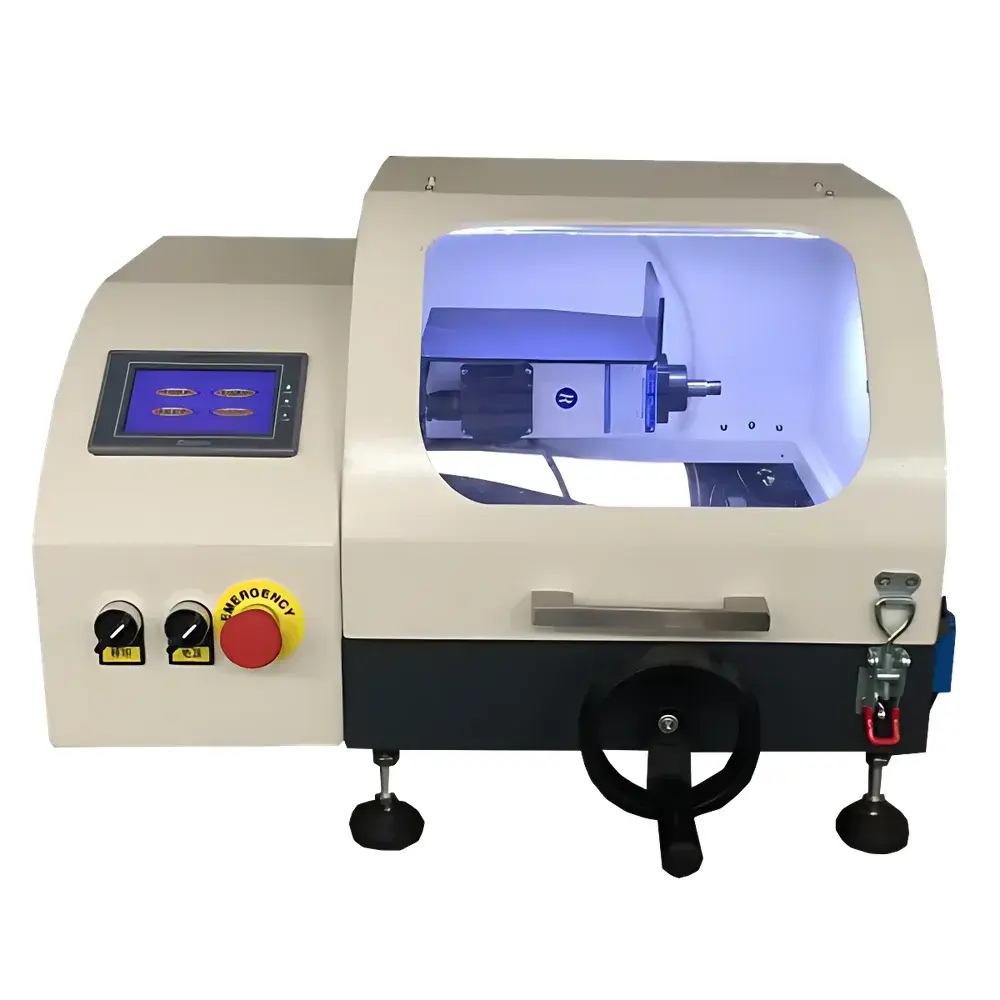
YANRUN ZQ-540E Precision Automatic Cutting Machine
| Brand | YANRUN |
|---|---|
| Origin | Shanghai, China |
| Manufacturer Type | Direct Manufacturer |
| Region of Origin | Domestic (China) |
| Model | ZQ-540E |
| Instrument Type | Precision Cutting Machine |
| Spindle Speed | 1000–12000 rpm (infinitely variable) |
| Y-Axis Travel | 200 mm |
| Y-Axis Movement | Motorized |
| Max. Cutting Diameter | 40 mm |
| Cutting Orientation | Horizontal |
| Blade Dimensions | (100–200) × (0.3–0.5) × 25.4 mm |
| Cooling Method | Automated Recirculating Water Cooling |
| Water Tank Capacity | 40 L |
| Motor Power | 0.75 kW |
| Power Supply | 220 V AC |
| Approx. Weight | 60 kg |
Overview
The YANRUN ZQ-540E Precision Automatic Cutting Machine is an engineered solution for high-accuracy sectioning of brittle, hard, and heterogeneous materials in laboratory and quality control environments. Designed around a horizontal, motor-driven cutting architecture with infinitely variable spindle speed control (1000–12000 rpm), the system enables reproducible, low-damage cross-sectioning via controlled abrasive wheel feed. Its core principle relies on precise kinematic coordination between the motorized Y-axis translation stage and the rotating diamond or silicon-carbide blade—minimizing thermal stress, edge chipping, and subsurface deformation during sample preparation. This makes it especially suitable for metallurgical specimen preparation, geological thin-sectioning, semiconductor wafer dicing pre-polishing, and failure analysis of electronic components where dimensional fidelity and surface integrity are critical to downstream microscopy (SEM, optical metallography) or microstructural characterization.
Key Features
- Touchscreen-based human-machine interface (HMI) with intuitive parameter programming for cutting speed, feed rate, dwell time, and multi-step automated cycles.
- Motorized Y-axis translation (200 mm travel range) ensures repeatable positioning accuracy within ±5 µm per cycle, supporting serial sectioning protocols.
- Horizontally oriented cutting geometry accommodates tall or irregularly shaped specimens while maintaining stable clamping and consistent blade engagement angle.
- Integrated recirculating water cooling system (40 L reservoir) with flow monitoring and temperature stabilization prevents localized overheating and extends blade service life.
- Rigid cast-iron frame and precision-ground linear guides provide mechanical stability under load, reducing vibration-induced kerf deviation and improving cut straightness.
- Modular tooling design supports rapid blade change and interchangeable fixture sets—including vise-type, vacuum chuck, and custom jig adapters—for diverse sample geometries and material classes.
Sample Compatibility & Compliance
The ZQ-540E accommodates a broad spectrum of rigid, non-ductile materials including ferrous and non-ferrous metals, cemented carbides, technical ceramics (Al₂O₃, SiC, ZrO₂), optical glasses, geological specimens (granite, basalt, quartzite), single crystals (Si, GaAs), and packaged IC substrates. It complies with general laboratory safety standards for rotating equipment (IEC 61000-6-2/6-4 for EMC; EN 60204-1 for electrical safety). While not certified to ISO/IEC 17025 as a testing instrument, its mechanical repeatability and traceable operational parameters support GLP-compliant documentation when integrated into validated sample preparation workflows. Blade selection and cutting parameters may be aligned with ASTM E3–22 (Standard Guide for Preparation of Metallographic Specimens) and ISO 14577–1 (Metallic materials — Instrumented indentation test).
Software & Data Management
The embedded HMI firmware logs all executed cutting sequences—including date/time stamp, spindle speed, Y-axis position profile, coolant flow status, and operator ID—into internal non-volatile memory. Data export is supported via USB 2.0 port in CSV format for integration into LIMS or QA documentation systems. Optional RS-232 or Ethernet connectivity (upon request) enables remote monitoring and centralized protocol management across multi-instrument labs. Audit trail functionality meets baseline requirements for FDA 21 CFR Part 11–aligned environments when paired with user-access controls and electronic signature validation (configured at system deployment level).
Applications
- Preparation of metallographic mounts for optical and electron microscopy analysis.
- Cutting of rock and mineral samples for petrographic thin-section fabrication.
- Sectioning of sintered ceramic components prior to porosity or phase-distribution analysis.
- Isolation of functional layers from multilayer electronic packages for delamination or solder-joint inspection.
- Controlled slicing of optical crystals and laser gain media for facet polishing and cavity alignment.
- High-reproducibility trimming of additive-manufactured metal parts for microstructure correlation studies.
FAQ
What types of cutting blades are compatible with the ZQ-540E?
Standard blade dimensions range from 100–200 mm outer diameter, 0.3–0.5 mm thickness, and 25.4 mm arbor hole. Diamond-impregnated, resin-bonded, and metal-bonded abrasive wheels are supported based on material hardness and required surface finish.
Does the machine support programmable multi-pass cutting?
Yes—the touchscreen interface allows users to define up to 99 sequential cutting steps with independent speed, feed depth, and dwell settings per pass.
Is the water cooling system closed-loop and filter-equipped?
The 40 L recirculating system includes a dual-stage particulate filter and optional temperature sensor module to maintain coolant purity and thermal consistency across extended operation.
Can the ZQ-540E be integrated into an automated lab workflow?
With optional I/O expansion modules and industrial communication protocols (Modbus RTU/TCP), the unit supports external PLC triggering and status feedback for inline sample prep lines.
What maintenance intervals are recommended for long-term reliability?
Daily coolant level and filter inspection; monthly spindle bearing lubrication and guide rail cleaning; annual calibration of Y-axis encoder and torque verification of clamping fixtures.



