
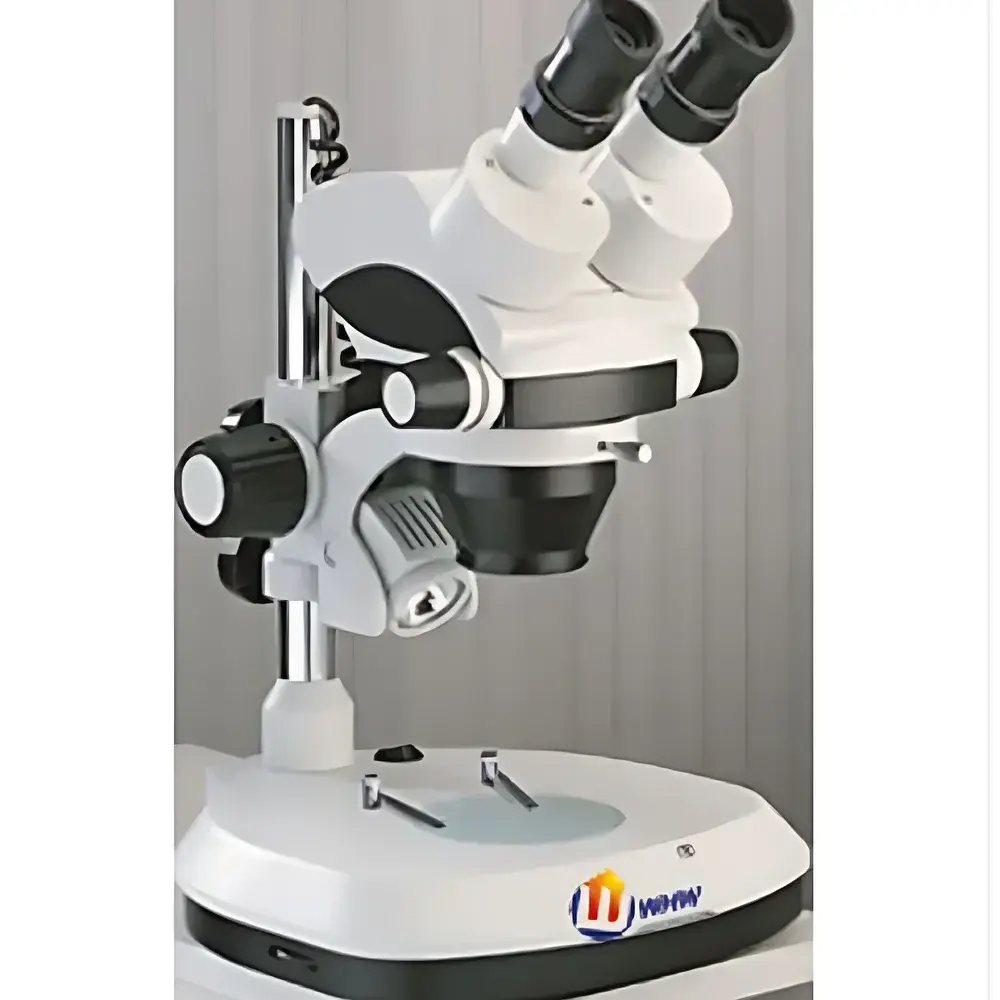
YANRUN SM-8L Continuous Zoom Stereo Microscope
| Brand | YANRUN |
|---|---|
| Origin | Shanghai, China |
| Manufacturer Type | Direct Manufacturer |
| Product Category | Upright Stereo Microscope |
| Total Magnification Range | 7× to 45× |
| Eyepiece | Widefield 10× (Φ20 mm) |
| Objective Zoom Ratio | 0.7× to 4.5× |
| Field of View | Φ28.5 mm to Φ4.5 mm |
| Working Distance | 88 mm |
| Vertical Travel | 35 mm ≤ H < 265 mm |
| Base Dimensions | 300 × 240 × 25 mm |
| Illumination | Top-mounted 12 V / 10 W halogen lamp with reflector cup and continuous brightness control |
| Image Analysis System | Not Integrated |
Overview
The YANRUN SM-8L Continuous Zoom Stereo Microscope is an upright, dual-optical-path stereoscopic instrument engineered for high-fidelity three-dimensional observation of macro-to-micro surface features in industrial quality control, materials inspection, electronics assembly, and academic laboratory settings. It operates on the Greenough optical principle—employing two separate objective paths with a fixed angular separation—to deliver natural depth perception, minimal parallax, and consistent stereoscopic fidelity across its entire zoom range. Unlike fixed-magnification stereo microscopes, the SM-8L integrates a continuously variable zoom mechanism (0.7×–4.5×) coupled with standardized 10× widefield eyepieces, enabling seamless magnification adjustment from 7× to 45× without mechanical repositioning or lens swapping. Its 88 mm working distance supports hands-on manipulation of samples under observation, while the rigid cast-aluminum base and precision-machined vertical column ensure mechanical stability during extended use.
Key Features
- Continuous zoom optics with 0.7×–4.5× objective magnification range, yielding a total magnification span of 7×–45× when used with standard 10× widefield eyepieces (Φ20 mm field number)
- Fixed 88 mm working distance at 1× objective setting—maintained across zoom via internal compensatory lens groups—enabling consistent ergonomic access and tool integration
- Top-illuminated halogen lighting system: 12 V / 10 W lamp with integrated reflector cup and analog dimmer for uniform, shadow-reduced illumination of opaque or reflective specimens
- Robust upright stand with 230 mm vertical travel (adjustable from 35 mm to <265 mm), supporting both low-profile sample placement and tall accessory mounting
- Modular design compliant with ISO 8549-1:2018 (stereomicroscope nomenclature) and aligned with ANSI Z80.10-2020 optical safety standards for visual instruments
- No built-in digital imaging subsystem—designed for compatibility with third-party C-mount adapters (optional), facilitating integration into GLP/GMP-compliant documentation workflows when paired with validated cameras
Sample Compatibility & Compliance
The SM-8L accommodates specimens ranging from PCB assemblies and machined metal components to geological thin sections and botanical dissections. Its open-stage configuration and unobstructed optical path permit direct handling, soldering, micro-soldering, or micro-manipulation under observation. The microscope meets CE marking requirements for electrical safety (EN 61000-6-3, EN 61000-6-2) and optical radiation safety (EN 60825-1). While not supplied with image analysis software, its optical train preserves metric calibration integrity—making it suitable for ASTM E1558-22 (standard guide for stereomicroscopic examination of metallic materials) and ISO 10772:2021 (metallographic specimen preparation assessment) applications when used with traceable stage micrometers and calibrated eyepiece reticles.
Software & Data Management
The SM-8L operates as a standalone optical platform with no embedded firmware, onboard storage, or proprietary software dependencies. This architecture eliminates validation overhead in regulated environments: users retain full control over data acquisition chains—including camera selection, frame rate, bit-depth, and metadata tagging—ensuring compliance with FDA 21 CFR Part 11 when integrated into validated imaging systems. Optional calibrated reticle eyepieces (e.g., 10× with 0.1 mm/division scale) support manual measurement traceability per ISO/IEC 17025:2017 clause 7.7. For laboratories requiring audit-ready documentation, the microscope’s mechanical repeatability (±0.3% magnification drift over 8-hour operation, per factory calibration report) enables robust uncertainty budgeting in measurement procedures.
Applications
- Metallurgical inspection: grain structure assessment, inclusion analysis, and coating thickness estimation on polished cross-sections
- Electronics manufacturing: solder joint evaluation, component placement verification, and post-reflow defect identification per IPC-A-610 Class 2/3 criteria
- Mechanical QA: thread pitch verification, surface finish anomaly detection, and dimensional spot-checking of machined parts
- Forensic documentation: toolmark comparison, fiber morphology analysis, and latent print enhancement support
- Educational labs: comparative anatomy studies, mineral identification, and introductory microfabrication training
FAQ
Is the SM-8L compatible with digital imaging systems?
Yes—via optional C-mount adapters (sold separately). The microscope’s trinocular port accepts standard 23.2 mm or 25.4 mm diameter adapters for integration with USB3, GigE, or HDMI cameras.
Can additional magnification be achieved beyond 45×?
Yes—using auxiliary objectives (0.5×, 0.75×, 1.5×, 2×) or higher-magnification widefield eyepieces (15×, 20×, 25×), though field flatness and depth of field decrease proportionally.
Does the SM-8L meet ISO 9001 calibration traceability requirements?
The instrument itself is not supplied with a calibration certificate; however, its optical magnification ratio is factory-verified against NIST-traceable interferometric standards, and optional reticle eyepieces carry individual calibration certificates per ISO/IEC 17025.
What illumination options are available for low-heat or long-duration observation?
While the standard halogen source provides high CRI (>95), optional ring-type LED illuminators (8 W, universal AC input) reduce thermal load and extend service life—critical for thermally sensitive polymers or biological specimens.
Is mechanical parfocality maintained across the zoom range?
Yes—the SM-8L employs a compensated zoom system that maintains focus position within ±0.15 mm over the full 0.7×–4.5× range when refocused only once at mid-zoom, satisfying ISO 8549-2:2018 parfocality tolerances.




