
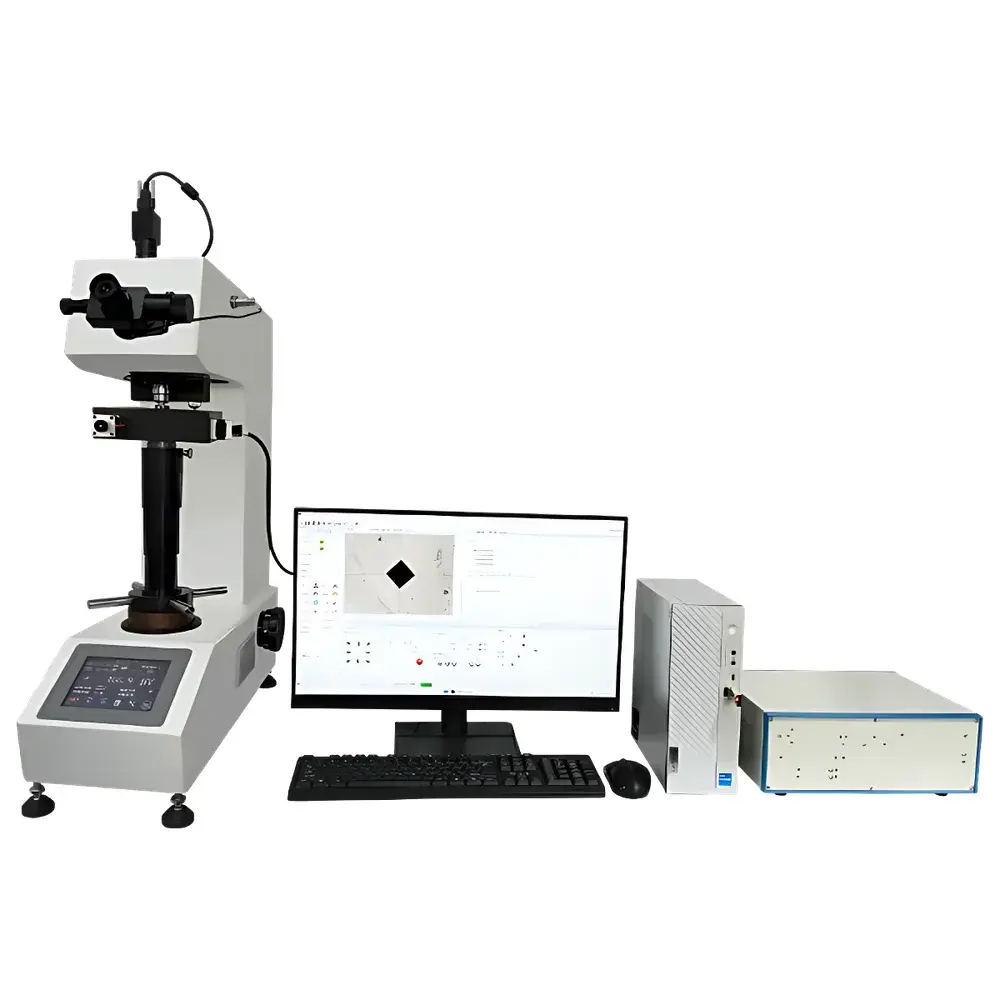
YANRUN HMAS-C5/10/30/50MZA Intelligent Vickers Hardness Testing and Analysis System
| Brand | YANRUN |
|---|---|
| Origin | Shanghai, China |
| Manufacturer Type | Manufacturer |
| Country of Origin | China |
| Model | HMAS-C5/10/30/50MZA |
| Instrument Type | Vickers Hardness Tester |
| Measuring Range | 8–3000 HV |
| Turret Control | Motorized, PC-controlled |
| Test Force Options | 0.2–50 kgf (6–12 selectable loads per capacity tier) |
| Loading Mode | Fully Automatic (Loading–Dwell–Unloading) |
| Standards Compliance | GB/T 4340, ISO 6507 |
| XY Stage Travel | 25 × 25 mm (optional 50 × 50 mm) |
| Minimum Detection Unit | 0.12 µm (10× objective), 0.06 µm (20× objective) |
| Dwell Time | 1–60 s (1 s increments) |
| Max Specimen Height | 60 mm |
| Depth from Indenter Center to Chamber Wall | 130 mm |
| Power Supply | AC 220 V / 50 Hz |
| Dimensions (L×W×H) | 570 × 220 × 680 mm |
| Net Weight | 50.0 kg |
| Gross Weight | 67.0 kg |
Overview
The YANRUN HMAS-C5/10/30/50MZA is an intelligent, fully automated Vickers hardness testing and analysis system engineered for precision metrology in metallurgical laboratories, quality control departments, and R&D facilities. It operates on the fundamental principle of Vickers micro- and macro-hardness measurement—applying a precisely calibrated diamond pyramid indenter under controlled static load to produce a geometrically defined impression on the specimen surface. The diagonal lengths of the resulting indentation are measured optically and converted into hardness values (HV) using standardized formulas defined in ISO 6507 and GB/T 4340. Unlike conventional manual or semi-automated systems, the HMAS-C5/10/30/50MZA integrates high-resolution digital imaging, motorized turret positioning, programmable XY stage motion, and dual-path measurement capability (onboard touchscreen + PC-based software), enabling traceable, repeatable, and auditable hardness evaluation across diverse material classes—including steels, alloys, ceramics, thin films, and case-hardened components.
Key Features
- Fully motorized, PC-controlled turret with automatic selection of indenter and objective lens—eliminating manual intervention and reducing operator-induced variability.
- Multi-tier test force architecture supporting four capacity variants (5 kgf, 10 kgf, 30 kgf, 50 kgf), each offering up to 12 discrete load options—from 0.2 kgf to 50 kgf—ensuring compliance with both microhardness (e.g., thin coatings, heat-affected zones) and macrohardness (bulk material) testing requirements.
- Motorized XY stage with 25 × 25 mm travel (expandable to 50 × 50 mm), programmable velocity profiles, and pixel-accurate mouse-driven navigation—enabling precise positioning for multi-point hardness mapping, cross-sectional gradient analysis, and coordinated metallographic correlation.
- Dual measurement pathway: real-time hardness calculation via integrated 10× digital eyepiece (with on-screen diagonal readout) and high-accuracy image-based analysis using calibrated 10×/20× objectives (100×/200× total magnification for 5/10 kgf; 100× for 30/50 kgf).
- Automated loading sequence with adjustable dwell time (1–60 s in 1 s steps), ensuring full compliance with standardized indentation protocols and minimizing thermal drift effects during extended testing cycles.
- Sub-micron resolution imaging: minimum detectable feature size of 0.06 µm at 20× objective magnification—critical for evaluating fine-grained microstructures, diffusion layers, and nanoscale surface treatments.
Sample Compatibility & Compliance
The HMAS-C5/10/30/50MZA accommodates specimens up to 60 mm in height and 130 mm laterally from the indenter axis—supporting standard metallographic mounts, as-received coupons, and coated substrates without modification. Its mechanical architecture meets ISO 6507-1:2018 requirements for indenter geometry, force application accuracy, and optical measurement uncertainty. All hardness calculations adhere to the mathematical definition of HV = 1.8544 × F / d² (where F is applied load in kgf and d is mean diagonal length in mm). The system supports audit-ready documentation through timestamped test logs, operator ID tagging, and configurable report templates aligned with GLP/GMP expectations. While not FDA 21 CFR Part 11 certified out-of-the-box, its software architecture allows integration with validated LIMS environments where electronic signature and data integrity controls are implemented externally.
Software & Data Management
The proprietary HMAS analysis software provides a unified interface for instrument control, image acquisition, indentation detection, statistical reporting, and spatial data visualization. It supports batch processing of multi-point arrays, automatic hardness profile generation along user-defined lines or grids, and overlay of hardness contours onto optical micrographs. Raw image files (TIFF/RAW) and metadata—including load, dwell time, objective used, stage coordinates, and environmental timestamps—are stored in structured directories with SHA-256 checksum validation. Export formats include CSV (for statistical process control), PDF (for QA documentation), and XML (for enterprise-level data exchange). Software updates are delivered via secure HTTPS channels with versioned release notes and backward-compatible file handling.
Applications
- Heat treatment verification: case depth profiling, carburized/nitrided layer characterization, and tempering uniformity assessment.
- Coating and thin-film evaluation: PVD/CVD adhesion layer hardness, DLC film integrity, and electroplated deposit consistency.
- Failure analysis: crack tip hardness mapping, weld fusion zone gradients, and intergranular embrittlement screening.
- Materials development: comparative hardness screening of alloy variants, additive manufacturing build layers, and composite phase distribution.
- Calibration laboratory use: reference block verification, inter-laboratory comparison studies, and proficiency testing under ISO/IEC 17025 frameworks.
FAQ
Does the system support ASTM E384 for microhardness testing?
Yes—the 0.2–5 kgf load range, 20× objective option (0.06 µm resolution), and automated dwell control meet all essential requirements of ASTM E384-22 for microindentation hardness testing.
Can hardness data be exported directly to Excel or SPC software?
Yes—CSV export includes all raw measurements, calculated HV values, statistical summaries (mean, SD, CV%), and positional metadata, compatible with Minitab, JMP, and industry-standard SPC platforms.
Is remote operation supported over LAN or VPN?
The system operates on a Windows-based host PC with standard TCP/IP networking; remote desktop access is permitted per institutional IT policy, though direct web-based control is not implemented.
What maintenance intervals are recommended for the indenter and optical path?
Indenter calibration verification is advised every 6 months or after 5,000 impressions; objective cleaning and alignment checks should occur quarterly or following any mechanical shock event.
Are third-party calibration services available for this model?
YANRUN maintains partnerships with ISO/IEC 17025-accredited calibration providers in APAC and EU regions; NIST-traceable reference blocks and certificate packages can be ordered separately.



