
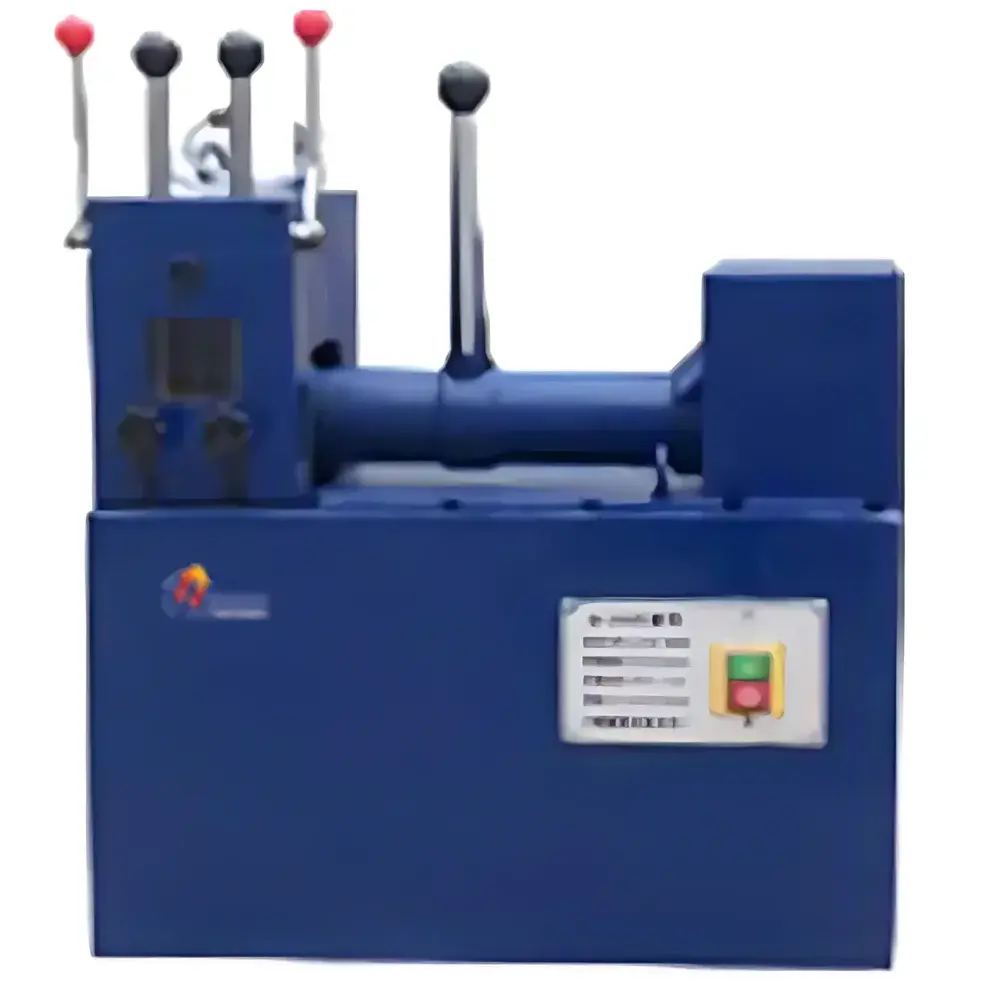
YANRUN Q-3 Manual Metallographic Cutting Machine
| Brand | YANRUN |
|---|---|
| Origin | Shanghai, China |
| Manufacturer Type | Direct Manufacturer |
| Country of Origin | China |
| Model | Q-3 |
| Instrument Category | Metallographic Cutting Machine |
| Maximum Cutting Diameter | 50 mm |
| Blade Specification | 250 × 1.5 × 32 mm |
| Cutting Method | Manual |
| Cooling System | Integrated Water Circulation System with 65 L Reservoir |
| Spindle Speed | 3500 rpm |
| Motor Power | 2.2 kW |
| Configuration | Benchtop |
| Power Supply | 380 V AC, 3-phase |
| Net Weight | 150 kg |
| Standard Accessories | Main Unit (1), Precision Cutting Blades (2 pcs), Tool Kit (1 set) |
Overview
The YANRUN Q-3 Manual Metallographic Cutting Machine is a benchtop precision sample preparation instrument engineered for controlled, low-distortion sectioning of metallic and composite specimens prior to metallographic analysis. It operates on a manual feed principle—where the operator advances the specimen into a rotating abrasive or diamond-impregnated blade under consistent downward force—enabling full tactile control over cut rate, orientation, and thermal management. This mechanical simplicity ensures high repeatability in specimen geometry and minimizes heat-affected zone (HAZ) formation, critical for preserving microstructural integrity during cross-sectioning of ferrous alloys, aluminum, titanium, cast iron, sintered metals, and hardened tool steels. Designed for laboratories requiring cost-effective, reliable, and operator-guided sectioning without automated motion control, the Q-3 conforms to foundational principles outlined in ASTM E3-22 (“Standard Guide for Preparation of Metallographic Specimens”) and ISO 14797:2022 (“Metallographic sampling and sectioning”).
Key Features
- Benchtop rigid cast-iron frame with vibration-damping base, ensuring dimensional stability during prolonged cutting cycles.
- 3500 rpm spindle speed optimized for compatibility with standard 250 mm diameter cutting wheels (1.5 mm thickness, 32 mm bore), supporting both resin-bonded silicon carbide and metal-bonded diamond blades.
- Integrated 65 L water reservoir with adjustable flow nozzle and recirculating pump, enabling continuous coolant delivery directly to the cut interface—reducing thermal degradation and extending blade life.
- Manual vertical feed mechanism with calibrated depth scale and fine-adjustment knob, allowing incremental advancement from 0.05 mm to 2.0 mm per pass based on material hardness and desired surface finish.
- 2.2 kW three-phase induction motor (380 V AC) delivering consistent torque across load variations, compliant with IEC 60034 efficiency standards.
- Ergonomic specimen clamping system featuring dual T-slot vise with quick-release lever and adjustable stop block for repeatable positioning of cylindrical, rectangular, or irregularly shaped samples up to 50 mm in maximum cross-sectional dimension.
Sample Compatibility & Compliance
The Q-3 accommodates a broad spectrum of conductive and non-conductive solid materials, including but not limited to carbon steels, stainless steels, aluminum alloys, copper-based alloys, titanium alloys, cemented carbides, sintered ceramics, and polymer-matrix composites. Its manual operation allows skilled technicians to adapt feed rate and coolant application dynamically—essential when sectioning brittle intermetallics, layered coatings, or heat-sensitive near-net-shape components. The system meets mechanical safety requirements per EN 61000-6-2 (EMC immunity) and EN 61000-6-4 (EMC emission), and its enclosed blade guard complies with EN ISO 13857 for safeguarding against access to hazardous moving parts. While not inherently GLP/GMP-certified, the machine supports audit-ready documentation when integrated into validated workflows aligned with ISO/IEC 17025-accredited laboratories.
Software & Data Management
As a manually operated instrument, the Q-3 does not incorporate embedded firmware, touchscreen interface, or digital data logging capabilities. All operational parameters—including cut sequence, blade type, coolant flow setting, and specimen identification—are recorded externally via laboratory notebook entries or LIMS-integrated sample tracking forms. This analog architecture eliminates cybersecurity vulnerabilities associated with networked instruments and simplifies qualification under FDA 21 CFR Part 11 when paired with procedural controls (e.g., dual-operator verification logs, version-controlled SOPs, and dated signature fields). Optional accessories include calibrated depth gauges and digital micrometers for post-cut dimensional validation, facilitating traceability to NIST-traceable standards.
Applications
- Preparation of transverse and longitudinal sections for ASTM E112 grain size analysis and ASTM E1268 inclusion rating.
- Cutting of turbine blade root sections, weld joint coupons, and fatigue-tested specimens in aerospace QA/QC labs.
- Sectioning of automotive engine blocks, brake calipers, and gear train components for porosity mapping and phase distribution studies.
- Sampling of pipeline welds, pressure vessel nozzles, and offshore structural steel for failure analysis per API RP 571.
- Generation of thin slices from additively manufactured (AM) metal parts to assess layer bonding quality and internal defect morphology.
- Controlled sectioning of dental alloys, orthopedic implants, and medical-grade stainless steels for biocompatibility assessment per ISO 10993-12.
FAQ
Is the Q-3 suitable for cutting non-metallic materials such as ceramics or PCB substrates?
Yes—the machine’s mechanical feed control and adjustable coolant flow support sectioning of brittle non-metals; however, diamond-blade selection and reduced feed rates are recommended to prevent chipping.
Does the unit include blade balancing or runout correction features?
No—the Q-3 relies on factory-balanced spindles and precision-machined flanges; users must verify blade concentricity using a dial indicator before installation.
Can the water tank be retrofitted with filtration or temperature control?
The 65 L reservoir is compatible with third-party inline particulate filters and external chillers, though YANRUN does not supply these as standard options.
What maintenance intervals are recommended for long-term reliability?
Lubrication of the vertical feed screw every 200 operating hours and annual inspection of motor bearings and coolant pump seals are advised per the technical manual.
Is CE marking available for export to EU markets?
CE certification documentation can be provided upon request for units configured with EU-compliant power input modules and safety labeling.



