
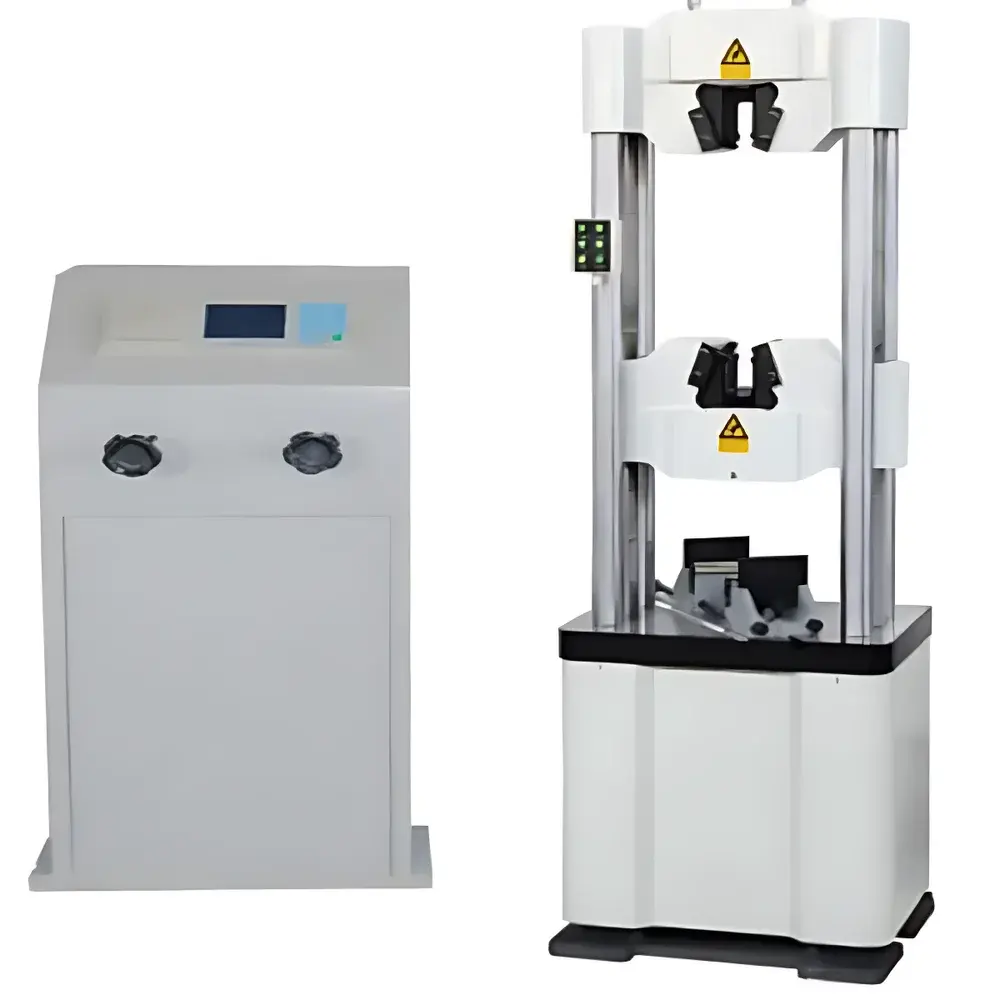
YANRUN WES-300D Electro-Hydraulic Servo Universal Testing Machine
| Brand | YANRUN |
|---|---|
| Origin | Shanghai, China |
| Manufacturer Type | Direct Manufacturer |
| Country of Origin | China |
| Model | WES-300D |
| Instrument Type | Electro-Hydraulic Servo Testing Machine |
| Max Test Load | 300 kN |
| Max Tensile Jaw Spacing | 600 mm |
| Flat Specimen Clamping Range | 0–15 mm |
| Round Specimen Clamping Range | Ø6–Ø26 mm |
| Compression Test Height | 550 mm |
| Piston Stroke | 150 mm |
| Load Indication Accuracy | ±1% FS |
| Bending Support Roller Spacing | 30–400 mm |
| Column Spacing | 460 mm |
| Motor Power | 3 kW |
| Dimensions (W×D×H) | 730 × 570 × 1845 mm |
| Weight | 2100 kg |
Overview
The YANRUN WES-300D Electro-Hydraulic Servo Universal Testing Machine is a high-stiffness, load-frame-based mechanical testing system engineered for precision static mechanical characterization of metallic, polymeric, composite, and ceramic materials under tension, compression, bending, and shear loading conditions. It operates on the principle of closed-loop electro-hydraulic servo control, where a digitally regulated hydraulic actuator—driven by a high-response servo valve and monitored via a calibrated load cell and displacement transducer—applies and maintains programmed force or displacement profiles in accordance with ISO 7500-1, ASTM E4, and ASTM E8/E9 standards. The machine’s rigid four-column frame, reinforced crosshead guidance, and optimized hydraulic power unit ensure minimal deflection and high reproducibility during high-load testing up to 300 kN. Designed for integration into quality control laboratories, R&D facilities, and accredited testing centers, the WES-300D meets structural requirements for GLP-compliant mechanical testing workflows and supports traceable calibration per ISO/IEC 17025.
Key Features
- Robust four-column load frame with 460 mm column spacing and high axial stiffness, minimizing parasitic bending moments during off-center loading.
- Electro-hydraulic servo actuation system delivering smooth, low-noise force application with dynamic response suitable for quasi-static and slow-rate monotonic tests.
- Dual-mode control architecture: force-controlled and displacement-controlled modes, both with real-time feedback and adjustable ramp rates per ASTM E2309 guidelines.
- Integrated hydraulic power unit featuring a 3 kW motor, pressure-regulated oil circuit, and thermal management for stable long-duration operation.
- Adjustable crosshead travel (150 mm stroke) and vertical test space (550 mm compression height), enabling compliance with standard specimen geometries defined in ISO 6892-1 and ASTM E8.
- Modular gripping system including self-aligning wedge-action jaws for round specimens (Ø6–Ø26 mm) and flat specimens (0–15 mm thickness), each equipped with hardened serrated inserts for enhanced grip retention.
- Standard accessory set includes compression platens with spherical seat assembly (for ASTM C39/C109 alignment), three-point bending fixtures (adjustable roller span from 30 to 400 mm), and mounting hardware for ISO-standardized test setups.
Sample Compatibility & Compliance
The WES-300D accommodates standardized tensile bars (e.g., ASTM E8 dog-bone, ISO 6892-1 type 2), flat sheet coupons, cylindrical compression specimens (e.g., concrete cylinders per ASTM C39, mortar prisms per ASTM C109), and beam specimens for flexural analysis. Its jaw geometry and alignment mechanisms comply with ISO 20807 requirements for gripping system coaxiality. All mechanical measurements adhere to the uncertainty budgeting principles outlined in ISO/IEC Guide 98-3 (GUM). The system supports calibration verification using certified reference load cells traceable to NIM (China National Institute of Metrology) or equivalent national metrology institutes. Documentation packages include as-built drawings, factory calibration reports, and conformity statements aligned with GB/T 16825.1–2008 (equivalent to ISO 7500-1:2018).
Software & Data Management
The WES-300D is supplied with embedded Windows-based test control software supporting real-time acquisition of load, displacement, and strain (when extensometer-integrated). Data logging occurs at configurable sampling rates up to 100 Hz, with timestamped CSV export compliant with LIMS interoperability requirements. The software implements audit-trail functionality—including user login tracking, method versioning, and electronic signature support—to facilitate adherence to FDA 21 CFR Part 11 and ISO 17025 documentation integrity mandates. Test methods can be preconfigured and locked down per material standard (e.g., “ASTM E8 Tensile – Aluminum Alloy”), ensuring procedural consistency across operators. Raw data files retain full metadata (machine ID, operator, environmental conditions if logged externally), enabling retrospective analysis and regulatory review.
Applications
- Tensile property determination: yield strength (Rp0.2), ultimate tensile strength (Rm), elongation at break (A50mm), and Young’s modulus for structural steels, aluminum alloys, and engineering plastics.
- Compressive strength evaluation of concrete, mortar, ceramics, and polymer composites per ASTM C39, C109, and ISO 13003.
- Flexural performance assessment of beams and laminates using three-point or four-point bending configurations per ASTM D790 and ISO 178.
- Proof and load-holding tests for fasteners, weldments, and structural assemblies under sustained loading protocols.
- Quality assurance screening in metal fabrication, aerospace component manufacturing, and construction materials certification labs.
FAQ
What standards does the WES-300D comply with for calibration and verification?
The system conforms to ISO 7500-1:2018 (static calibration of force-proving instruments) and GB/T 16825.1–2008. Factory calibration uses NIM-traceable deadweight standards.
Is an extensometer supported for strain measurement?
Yes—the control system provides analog and digital interfaces for clip-on, video, or laser extensometers (sold separately), enabling automated strain-controlled testing per ISO 6892-2.
Can the machine be integrated into a centralized laboratory network?
It supports TCP/IP communication and OPC UA-compatible data export, allowing seamless connection to enterprise LIMS or MES platforms.
What maintenance intervals are recommended for the hydraulic system?
Hydraulic oil replacement and filter inspection are advised every 2,000 operating hours or annually, whichever occurs first, per OEM service manual guidelines.
Does the system meet requirements for accredited testing laboratories?
When operated with documented procedures, trained personnel, and periodic third-party verification, it satisfies ISO/IEC 17025 clause 6.4 (equipment) and clause 7.7 (results reporting).



