
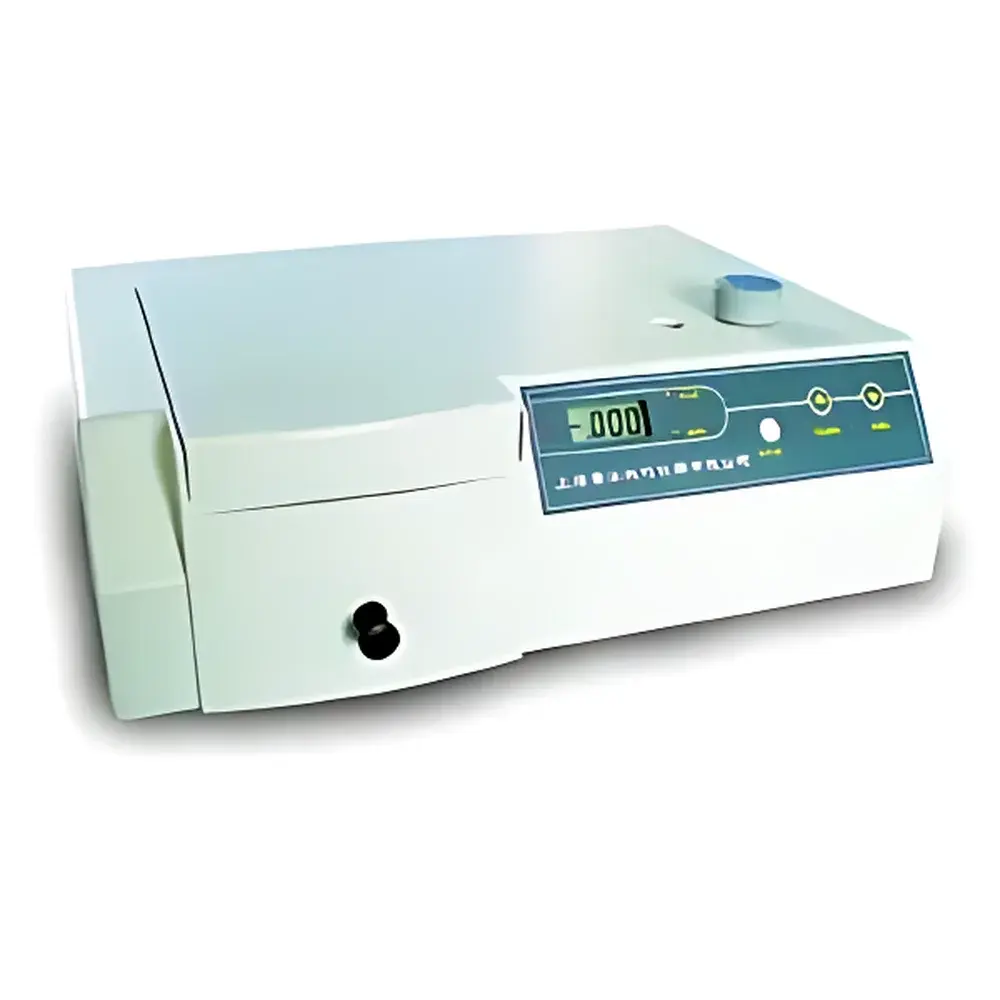
MC016-722 Visible Spectrophotometer
| Origin | Shanghai, China |
|---|---|
| Manufacturer Type | Authorized Distributor |
| Origin Category | Domestic (China) |
| Model | MC016-722 |
| Pricing | Available Upon Request |
| Wavelength Range | 330–1000 nm |
| Wavelength Accuracy | ±2 nm |
| Wavelength Repeatability | 1 nm |
| Spectral Bandwidth | 4 nm |
| Transmittance Accuracy | ±0.5%T |
| Transmittance Repeatability | 0.2%T |
| Transmittance Range | 0.0–125%T |
| Absorbance Range | −0.301 to 1.999 A |
| Concentration Display Range | 0–1999 units |
| Stray Light | ≤0.5%T at 360 nm |
| Photometric Stability | ±0.003 A/h |
| Interface | RS-232 bidirectional serial port |
| Software Compatibility | SPD application software (Windows OS) |
| Data Functions | Photometric (T/A), Quantitative (C/F), Time Scan |
| Printer Support | Yes |
Overview
The MC016-722 Visible Spectrophotometer is a precision single-beam optical instrument engineered for reliable quantitative and qualitative analysis in the visible spectral region (330–1000 nm). It operates on the fundamental principle of Beer–Lambert law-based absorption spectroscopy: when monochromatic light passes through a sample solution, the extent of attenuation correlates linearly with analyte concentration—provided path length and molar absorptivity remain constant. The instrument employs a high-efficiency holographic grating monochromator to isolate narrow spectral bands, delivering a fixed 4 nm spectral bandwidth optimized for routine laboratory applications requiring robust photometric performance without ultraviolet extension. Its single-beam optical architecture—featuring low-stray-light design (≤0.5%T at 360 nm) and thermally stabilized optics—ensures long-term baseline stability (±0.003 A/h) and measurement reproducibility critical for comparative analysis across batches or time-series experiments.
Key Features
- Single-beam optical path with holographic grating monochromator for consistent wavelength isolation and minimized stray light
- Manual wavelength selection over 330–1000 nm range with ±2 nm accuracy and 1 nm repeatability
- Digital LED display showing transmittance (%T), absorbance (A), concentration (C), and factor (F) simultaneously
- Integrated microprocessor control enabling automatic 0%T and 100%T calibration routines
- RS-232 bidirectional interface compliant with standard serial communication protocols for external device integration
- Support for SPD application software under Windows OS, enabling data acquisition, storage, recall, and export in CSV or ASCII formats
- Photometric modes: Transmittance (T), Absorbance (A), Fixed-Wavelength Quantitative (C), and Factor-Based Quantitative (F)
- Time-scan functionality for kinetic studies requiring sequential absorbance monitoring at fixed wavelength
Sample Compatibility & Compliance
The MC016-722 accommodates standard 10 mm square cuvettes (glass or quartz) and supports liquid-phase samples in aqueous or organic solvents. Its optical design excludes UV-range operation; therefore, it is not intended for nucleic acid or aromatic compound quantification below 330 nm. The instrument meets essential performance criteria aligned with ISO 8579-1:2021 (spectrophotometers — Part 1: General requirements) and ASTM E275-22 (standard practices for describing and measuring performance of ultraviolet, visible, and near-infrared spectrophotometers). While not certified for GMP/GLP environments out-of-the-box, its RS-232 interface and software audit trail capabilities enable integration into validated workflows where electronic record retention and user-access logging are configured externally per FDA 21 CFR Part 11 requirements.
Software & Data Management
The SPD application software provides a modular interface for instrument control and data handling. Users may define calibration curves using up to ten standard points, apply polynomial or linear regression models, and store multiple methods with unique identifiers. All measurements—including raw %T values, calculated A, derived C, and timestamped scan logs—are saved with metadata (operator ID, date/time, wavelength setting, cuvette position). Export functions support interoperability with LIMS platforms and spreadsheet-based QA/QC reporting. No proprietary file locking or DRM mechanisms restrict data ownership; all exported files retain full editability and traceability. Firmware updates are delivered via serial download and require no hardware modification.
Applications
This spectrophotometer serves as a foundational tool in academic and industrial laboratories performing routine colorimetric assays, enzyme kinetics, dye concentration monitoring, and quality assurance testing. Typical use cases include iron(II) phenanthroline complex determination (510 nm), phosphate quantification via molybdenum blue method (880 nm), chlorophyll-a extraction analysis (663 nm), and protein estimation using Bradford reagent (595 nm). It is widely deployed in pharmaceutical QC labs for excipient purity checks, in food safety labs for nitrate/nitrite detection, and in environmental testing for COD and phosphate screening. Its mechanical simplicity and thermal resilience make it suitable for teaching laboratories emphasizing first-principles spectroscopic methodology and method validation exercises.
FAQ
Is the MC016-722 capable of UV-range measurements?
No. Its optical components and detector response are optimized for 330–1000 nm only. For measurements below 330 nm, a dedicated UV-Vis spectrophotometer is required.
Does the instrument support GLP-compliant data archiving?
The hardware includes RS-232 output and time-stamped data logging. Full GLP compliance depends on external configuration of the host PC—such as user authentication, electronic signatures, and immutable audit trails—as defined in your organization’s SOPs.
Can custom wavelengths be programmed into the instrument firmware?
Wavelength selection is manual and continuous across the specified range; discrete wavelength presets are not stored in firmware. All wavelength-specific calibrations and method parameters are managed exclusively within the SPD software.
What cuvette materials are compatible?
Standard 10 mm pathlength glass cuvettes are recommended for visible-range work. Quartz cuvettes may be used but offer no performance benefit in this spectral window and are not necessary for routine operation.
Is printer driver support included with the SPD software?
Yes—the software includes native drivers for common ESC/P and PCL-compatible serial printers. Direct printing of spectra, calibration reports, and quantitative results is supported without third-party middleware.




