
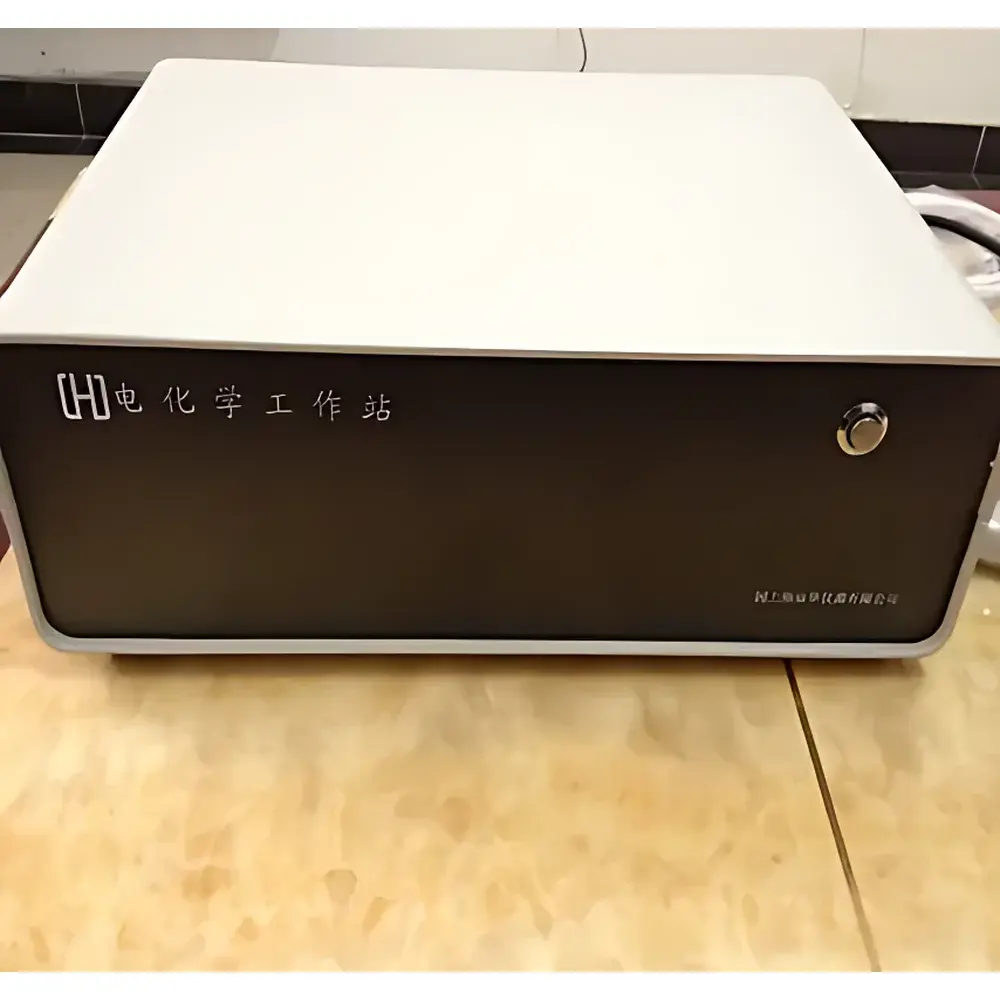
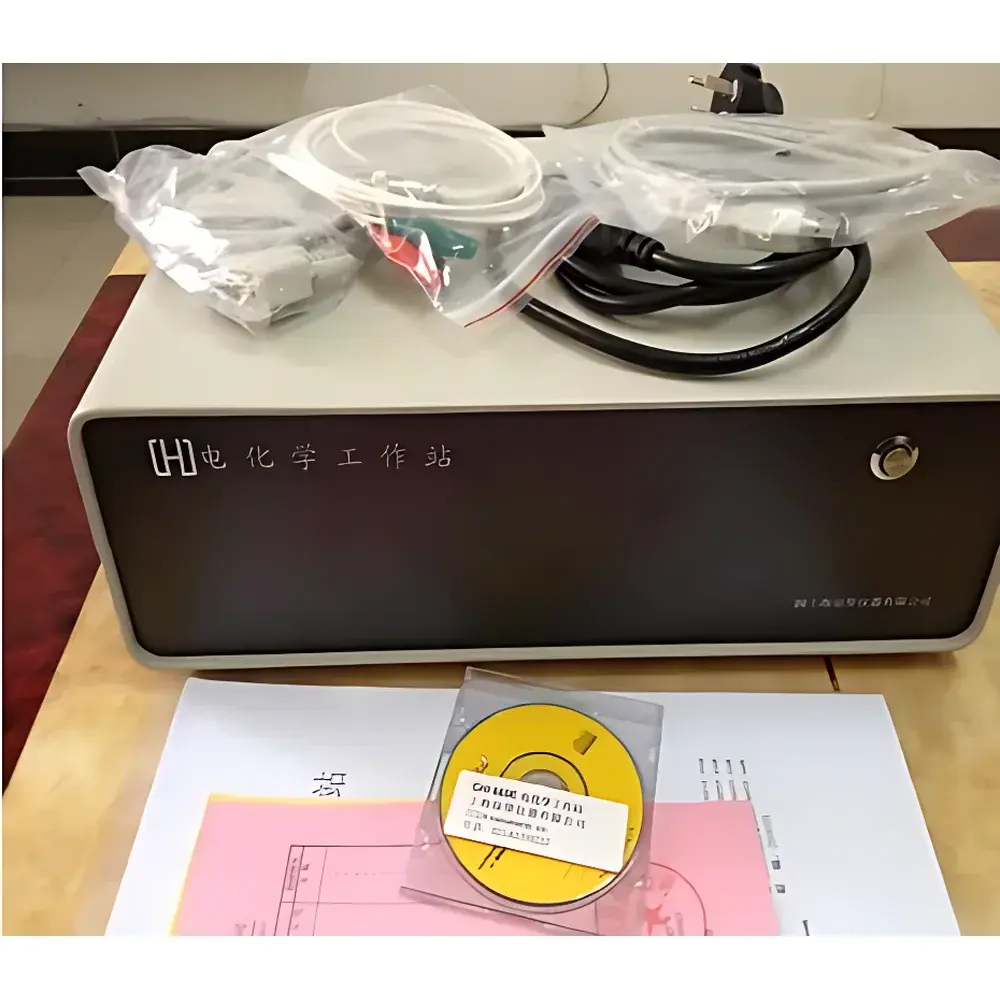
CHI600E Series Electrochemical Analyzer / Workstation
| Origin | Shanghai, China |
|---|---|
| Manufacturer Type | Authorized Distributor |
| Origin Category | Domestic (PRC) |
| Model | CHI600E |
| Price Range | USD 1,400–4,200 |
| Instrument Type | Potentiostat/Galvanostat Workstation |
| Current Range | ±10 pA to ±250 mA (12 decades, 12 programmable ranges) |
| Current Accuracy | ±0.2% (≥1 µA), ±1% (<1 µA) |
| Potential Accuracy | ±1 mV or ±0.01% of full scale |
| Applied Potential Range | ±10 V |
| IR Compensation | Automatic & Manual iR Drop Compensation |
| EIS Frequency Range | 10 µHz – 1 MHz |
| Sampling Rate | Dual-channel synchronized up to 1 MS/s |
| Signal Generator Update Rate | 10 MHz |
| ADC/DAC Resolution | 16-bit |
| Electrode Configuration | 2-, 3-, or 4-electrode mode |
| Input Bias Current | <20 pA |
| Reference Electrode Input Impedance | ≥1 × 10¹² Ω |
| External Trigger & Analog Inputs | Yes, 16-bit @ 1 MS/s |
Overview
The CHI600E Series Electrochemical Analyzer/Workstation is a high-performance, modular potentiostat/galvanostat system engineered for precision electrochemical research and routine analysis across academic, industrial, and quality control laboratories. Built on a robust digital architecture featuring dual 16-bit synchronized analog-to-digital converters (ADCs), a 10 MHz direct digital synthesis (DDS) signal generator, and a high-speed ARM-based controller, the platform delivers exceptional temporal resolution and dynamic range. Its core measurement principle relies on controlled-potential (potentiostatic) and controlled-current (galvanostatic) techniques grounded in Faraday’s laws and Ohm’s law, enabling quantitative interrogation of interfacial electron transfer kinetics, mass transport behavior, and electrode reaction mechanisms. The system supports standard three-electrode configurations (working, reference, counter) and extends to four-electrode operation—critical for eliminating uncompensated solution resistance (Ru) errors in low-impedance systems such as battery electrodes, fuel cells, or conductive polymer films. With a potential window of ±10 V, current sensitivity down to ±10 pA (extendable to ±1 pA with optional CHI200B microcurrent amplifier), and EIS capability spanning 10 µHz to 1 MHz, the CHI600E Series meets the demanding requirements of fundamental electrokinetic studies, corrosion science, sensor development, and electrocatalysis.
Key Features
- High-fidelity dual-channel data acquisition: Simultaneous, synchronized sampling at up to 1 million points per second (1 MS/s) with 16-bit resolution and <20 pA input bias current.
- Ultra-wide dynamic current range: 12 programmable decades (±10 pA to ±250 mA); optional amplifiers extend range to ±2 A (CHI680C) or sub-picoampere detection (CHI200B + shielded enclosure).
- Advanced impedance spectroscopy: Full-frequency EIS from 10 µHz to 1 MHz with RMS amplitude control (0.01 mV–700 mV), Kramers–Kronig validation support, and built-in stability diagnostics.
- Multi-mode electrode configuration: Native support for 2-, 3-, and 4-electrode setups; 4-electrode mode enables accurate measurements in high-conductivity media and eliminates lead resistance artifacts.
- Integrated real-time IR compensation: Both automatic (based on current step response) and manual (user-defined Ru) correction algorithms compliant with ASTM G102 and ISO 16773-2 guidelines for corrosion testing.
- Programmable analog I/O: Dedicated external voltage input channel (16-bit, 1 MS/s) for concurrent acquisition of auxiliary signals—e.g., optical absorbance in spectroelectrochemistry or temperature in kinetic studies.
- Firmware-upgradable architecture: Onboard Flash memory enables secure, over-the-air software updates without hardware replacement—ensuring long-term compliance with evolving analytical standards.
Sample Compatibility & Compliance
The CHI600E Series accommodates a broad spectrum of electrochemical cells and sample types—including aqueous and non-aqueous electrolytes, solid-state batteries, coated metals, enzymatic biosensors, and liquid|liquid interfaces. Its 4-electrode capability and low-noise front-end design make it suitable for low-resistance systems (e.g., Li-ion battery half-cells per ASTM D7282) and ultra-low-current applications (e.g., single-molecule electron transfer per IUPAC recommendations). Hardware and firmware conform to electromagnetic compatibility (EMC) standards EN 61326-1 and safety standard EN 61010-1. While not pre-certified for FDA 21 CFR Part 11, the system supports audit-trail-ready operation when used with validated third-party LIMS or ELN platforms—enabling alignment with GLP and GMP documentation requirements for regulated QC environments.
Software & Data Management
CHI Software (v13.x and later) provides an intuitive, experiment-driven interface with over 40 built-in electrochemical techniques—including CV, LSV, DPV, SWV, ACV, FTACV, CA, CC, CPCR, IMP, IMPE, and ECN. All methods support customizable parameter scripting, real-time data preview, and post-acquisition modeling. The platform includes embedded simulation engines: CVFit (for user-defined or pre-set reaction mechanisms) and EISFit (for equivalent circuit modeling using Randles, transmission-line, or custom topologies). Raw data are stored in ASCII-compatible .txt format with metadata headers, ensuring interoperability with MATLAB, Python (via pandas), OriginLab, and commercial chemometrics suites. Data export supports CSV, Excel (.xlsx), and binary formats; maximum trace length is configurable from 256 kpoints to 16 Mpoints per scan.
Applications
- Corrosion Science: Tafel extrapolation, polarization resistance (Rp), electrochemical noise analysis (ECN), and zero-resistance ammeter (ZRA) coupling per ASTM G59, G102, and ISO 9223.
- Battery & Energy Storage: Cyclic voltammetry of cathode/anode materials, galvanostatic intermittent titration technique (GITT), differential capacity analysis (dQ/dV), and EIS-based state-of-health (SoH) assessment.
- Biosensor Development: Amperometric detection of glucose, dopamine, or H2O2; enzyme kinetics via mediated electron transfer; DNA hybridization monitoring using redox-active labels.
- Electrocatalysis: Oxygen reduction reaction (ORR) activity mapping, hydrogen evolution reaction (HER) Tafel slope analysis, and CO-stripping charge quantification on Pt-group catalysts.
- Materials Characterization: Conducting polymer redox switching, metal oxide charge storage mechanisms, and semiconductor photoelectrochemistry under potentiostatic illumination control.
FAQ
What electrode configurations does the CHI600E support?
It natively operates in 2-, 3-, and 4-electrode modes. Four-electrode capability is essential for eliminating series resistance errors in low-impedance systems such as batteries or conductive coatings.
Can the CHI600E perform electrochemical impedance spectroscopy (EIS)?
Yes—frequency range spans 10 µHz to 1 MHz with programmable AC amplitude (0.01–700 mV RMS), phase-sensitive detection, and Kramers–Kronig transform validation.
Is sub-picoampere current measurement possible?
Standard sensitivity is ±10 pA; with the optional CHI200B microcurrent amplifier and Faraday cage, stable measurements down to ±1 pA are achievable.
Does the system support external triggering or synchronization?
Yes—dedicated TTL-compatible digital I/O lines allow hardware triggering of experiments and synchronization with external devices (e.g., lasers, potentiostats, or spectrometers).
How is firmware updated?
Via USB connection using CHI Software’s built-in update utility; no EPROM replacement or service visit required—updates are written directly to onboard Flash memory.





