
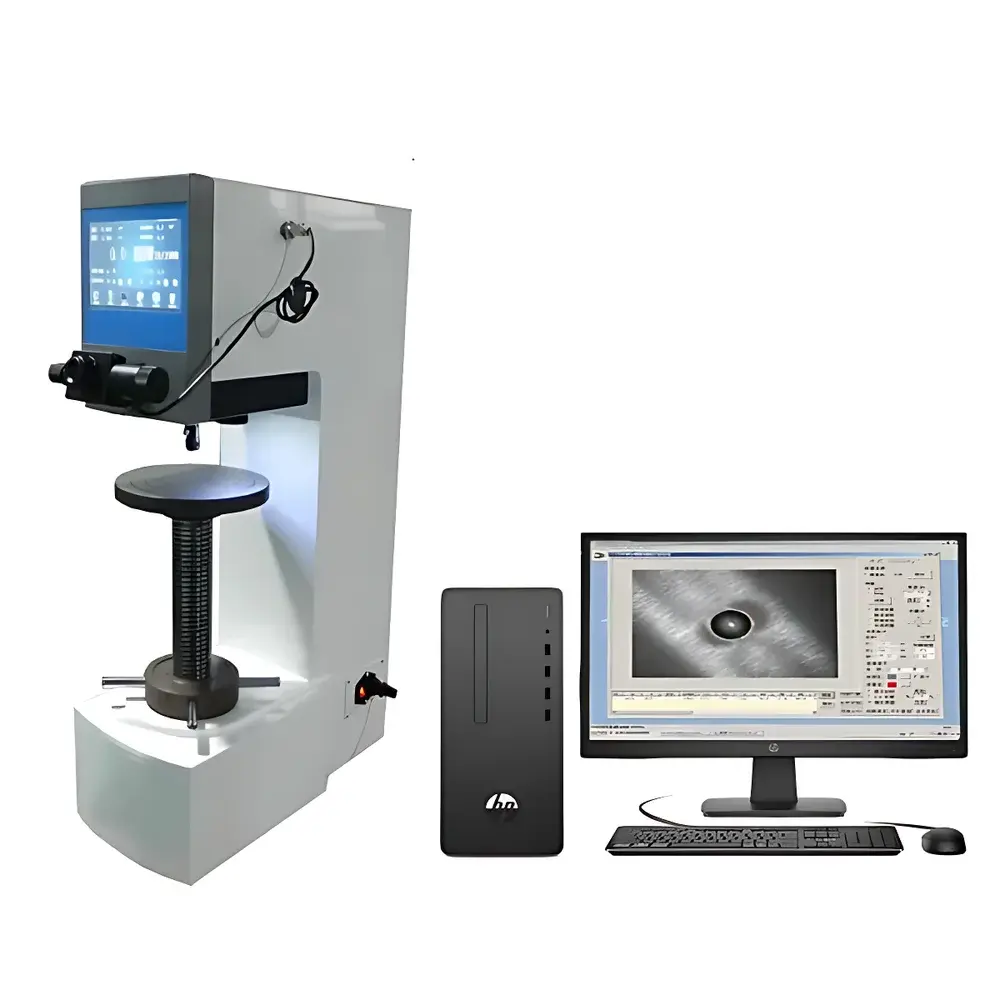
YANRUN HMAS-DHB Brinell Hardness Tester
| Brand | YANRUN |
|---|---|
| Origin | Shanghai, China |
| Manufacturer Type | Direct Manufacturer |
| Country of Origin | China |
| Model | HMAS-DHB |
| Instrument Type | Brinell Hardness Tester |
| Hardness Range | 8–650 HBW |
| Test Forces | 62.5 kgf, 100 kgf, 125 kgf, 187.5 kgf, 250 kgf, 500 kgf, 750 kgf, 1000 kgf, 1500 kgf, 3000 kgf |
| Indentation Ball Diameters | 2.5 mm, 5 mm, 10 mm |
| Measurement Scale Options | 12 standardized Brinell scales (e.g., HBW 2.5/62.5, HBW 10/3000) |
| Digital Eyepiece Magnification | 20× |
| Eyepiece Resolution | 0.5 µm |
| Max Specimen Height | 250 mm |
| Max Distance from Indenter to Column | 150 mm |
| Load Duration Control | 0–60 s (1 s increments) |
| Hardness Scale Conversion | HRA, HRB, HRC, HRD, HEF, HK, HV, HR15N–HR45T, HBW |
| Power Supply | AC 220 V |
| Dimensions (W×D×H) | 520 × 230 × 750 mm |
| Weight | ~130 kg |
Overview
The YANRUN HMAS-DHB Brinell Hardness Tester is a fully automated, image-based hardness measurement system engineered for precision and repeatability in metallurgical laboratories, quality control departments, and R&D facilities. It implements the standardized Brinell indentation method—defined by ISO 6506-1 and ASTM E10—in which a hardened steel or tungsten carbide ball indenter is applied under controlled static load to produce a spherical impression on the test surface. The resulting indentation diameter is measured optically to calculate the Brinell hardness number (HBW), offering high reproducibility for coarse-grained, heterogeneous, or as-cast materials where microstructural variations may compromise other hardness methods. Its large indentation geometry provides an averaged mechanical response across multiple grains, making it especially suitable for cast iron, forged steels, non-ferrous alloys (e.g., aluminum, copper), and annealed or normalized components.
Key Features
- Fully motorized, closed-loop force application with programmable dwell time (0–60 s in 1 s steps) ensures consistent loading profiles compliant with ISO 6506-2 verification requirements.
- Integrated high-resolution CCD imaging system with 20× digital eyepiece (0.5 µm resolution) enables direct capture and real-time display of indentation geometry without ocular observation.
- Proprietary HMAS software suite delivers automated indentation detection, sub-pixel diameter measurement, and real-time HBW calculation—eliminating manual caliper reading and operator subjectivity.
- Smart digital focus simulation algorithm enhances edge contrast and sharpness of low-contrast indentations, significantly improving measurement confidence on polished, oxidized, or lightly etched surfaces.
- Twelve customizable background color options optimize visual contrast for diverse material classes—including dark-colored castings, reflective aluminum alloys, and heat-treated steel parts—ensuring reliable image segmentation.
- Built-in thermal printer supports immediate hardcopy output of test records; all data are timestamped and traceable per GLP/GMP documentation principles.
Sample Compatibility & Compliance
The HMAS-DHB accommodates specimens up to 250 mm in height and 150 mm from column centerline, supporting flat, cylindrical, and irregular geometries via standard flat, medium, and V-shaped anvil plates. It conforms to national and international standards including GB/T 231.1–2018 (Chinese equivalent of ISO 6506-1), JJG 150–2016 (calibration verification protocol), and ASTM E10–23. All test force levels (62.5–3000 kgf) and ball diameters (2.5/5/10 mm) are pre-configured to match defined Brinell scale designations (e.g., HBW 10/3000). Calibration is supported using certified reference blocks traceable to NIM (National Institute of Metrology, China) or equivalent national metrology institutes.
Software & Data Management
The HMAS software platform operates on Windows-based industrial PCs and provides full audit-trail functionality required for regulated environments. It supports SPC analysis (X̄–R charts, Cp/Cpk indices), statistical evaluation of measurement uncertainty, and comparative error assessment against historical datasets. Hardness maps, depth profiles, and distribution histograms can be generated directly from batch measurements. Reports export natively to PDF, Microsoft Word (.docx), and Excel (.xlsx) formats—with embedded metadata (operator ID, timestamp, environmental conditions, calibration status). Image archives retain raw and processed frames with lossless compression. All user actions—including parameter changes, report generation, and calibration events—are logged with timestamps and operator credentials, satisfying FDA 21 CFR Part 11 electronic record requirements when deployed with appropriate system validation protocols.
Applications
This instrument is routinely deployed in foundry QA labs for incoming raw material verification (e.g., gray iron, ductile iron, aluminum-silicon alloys); in forging plants for post-heat-treatment hardness validation of crankshafts, connecting rods, and gear blanks; in academic metallurgy programs for phase transformation studies; and in third-party testing labs accredited to ISO/IEC 17025. Its ability to measure soft metals (e.g., pure Cu, Pb alloys) at low loads (62.5 kgf with 2.5 mm ball) and high-strength steels at 3000 kgf makes it uniquely versatile across hardness ranges inaccessible to Rockwell or Vickers systems without scale conversion artifacts.
FAQ
Does the HMAS-DHB comply with ISO 6506 and ASTM E10?
Yes—it is designed and verified in accordance with ISO 6506-1:2023 and ASTM E10–23 for Brinell hardness testing methodology, force application accuracy, and indenter geometry tolerances.
Can the system measure thin or coated samples?
While optimized for bulk materials, the 2.5 mm ball + 62.5 kgf configuration allows valid Brinell testing of specimens ≥10 mm thick; for thin films or case-hardened layers, Vickers or microhardness methods are recommended.
Is remote software update or calibration support available?
Firmware and HMAS software updates are delivered via secure USB transfer; remote desktop-assisted calibration verification is offered under extended service agreements.
What documentation is provided for regulatory audits?
Each unit ships with factory calibration certificate, traceable reference block certificates, IQ/OQ documentation templates, and electronic log export capability meeting GLP, GMP, and ISO/IEC 17025 record retention requirements.
How is measurement uncertainty estimated in HMAS software?
Uncertainty is calculated per GUM (JCGM 100:2008) using contributions from indenter geometry tolerance, load cell accuracy (±0.5% FS), optical resolution (0.5 µm), and repeatability statistics derived from internal control charting.



