
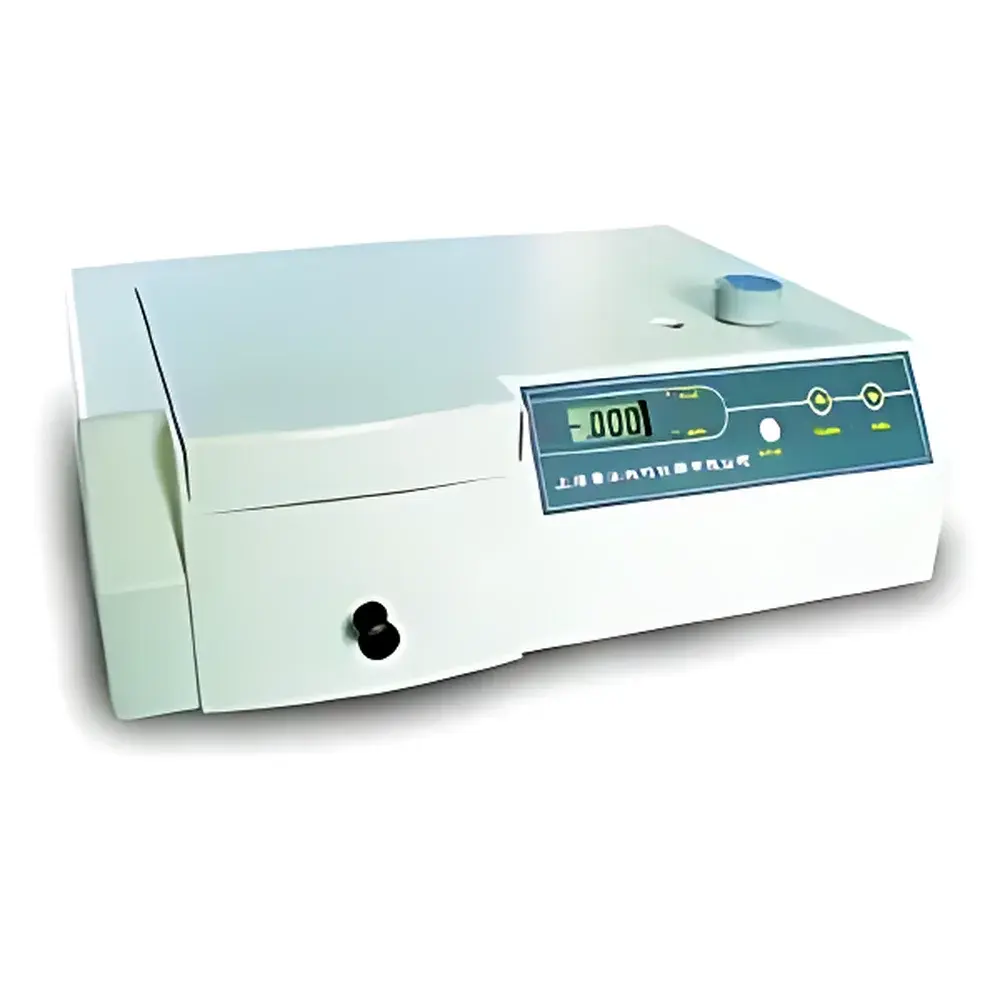
MC016-721 Visible Spectrophotometer
| Origin | Shanghai, China |
|---|---|
| Manufacturer Type | Authorized Distributor |
| Origin Category | Domestic (China) |
| Model | MC016-721 |
| Pricing | Available Upon Request |
Overview
The MC016-721 Visible Spectrophotometer is a precision single-beam optical instrument engineered for quantitative and qualitative analysis in the visible spectrum (340–1000 nm). It operates on the fundamental principle of selective light absorption—where analytes absorb specific wavelengths in proportion to their concentration—enabling measurement via Beer–Lambert Law compliance under controlled conditions. Designed with a high-stability grating monochromator and low-stray-light optical path, the instrument delivers reliable photometric performance for routine laboratory applications requiring robust repeatability and traceable transmittance/absorbance data. Its manual wavelength selection mechanism supports method-driven workflows common in teaching labs, QC environments, and field-deployable analytical settings where simplicity, durability, and regulatory transparency are prioritized over automated scanning.
Key Features
- Single-beam grating-based optical architecture optimized for minimal stray light (≤0.5%T at 360 nm) and consistent spectral resolution (4 nm bandwidth)
- High photometric stability: ±0.004 A/h drift under ambient thermal conditions, ensuring reproducible baseline integrity during extended measurements
- Digital LED display showing transmittance (%T), absorbance (A), and user-calibrated concentration (C) or factor (F) values—enhancing readability and reducing interpretation error
- Integrated microprocessor control enabling automatic 0%T (blank) and 100%T (reference) calibration routines, improving operational efficiency and inter-operator consistency
- Manual wavelength adjustment across 340–1000 nm range with ±2 nm accuracy and 1 nm repeatability—suitable for fixed-wavelength assays and method validation protocols
- RS-232 bidirectional serial interface (standard on MC016 variant; not available on legacy 721 base model) supporting direct connection to Windows-based PCs and compatible printers for audit-ready data export
Sample Compatibility & Compliance
The MC016-721 accommodates standard 10 mm pathlength cuvettes (glass or quartz) and accepts liquid, solution-phase samples compatible with common solvents including water, ethanol, and buffer systems. It complies with foundational photometric standards referenced in ISO 6425 (spectrophotometer performance verification), ASTM E275 (description of ultraviolet, visible, and near-infrared spectrophotometers), and USP (Spectrophotometry and Light-Scattering). While not designed for GLP/GMP 21 CFR Part 11-compliant environments without supplemental software validation, its hardware architecture supports traceable calibration logs and manual record-keeping aligned with basic laboratory quality assurance requirements.
Software & Data Management
The MC016-721 interfaces with SPD User Application Software (Windows-compatible) via RS-232, enabling three core functional modes: photometric measurement (T/A), quantitative analysis (C/F), and time-scan kinetics (for reaction monitoring). Data acquisition includes timestamped readings, batch ID tagging, and CSV-exportable reports. The software maintains local storage of calibration curves, reference spectra, and user-defined methods—facilitating method transfer between instruments and supporting internal SOP documentation. All exported datasets retain full metadata (wavelength, integration time, reference ID), meeting minimum FAIR (Findable, Accessible, Interoperable, Reusable) principles for academic and industrial reporting.
Applications
This spectrophotometer serves as a foundational tool across disciplines requiring validated visible-range absorbance quantification. In pharmaceutical QA/QC, it supports dissolution testing, excipient purity checks, and colorimetric end-point assays per USP monographs. In environmental labs, it enables COD, nitrate, phosphate, and heavy metal (e.g., Fe²⁺/Cr⁶⁺) determinations using standardized colorimetric protocols. Academic users apply it in undergraduate chemistry curricula for Beer’s Law validation, enzyme kinetics (e.g., NADH oxidation), and equilibrium constant determination. Industrial applications span food safety (sulfite, nitrite detection), polymer degradation studies, and dye concentration monitoring in textile QC—all leveraging its linear response from –0.301 to 1.999 A and extended transmittance range (0.0–125%T).
FAQ
What is the maximum pathlength supported by the MC016-721?
Standard operation assumes 10 mm rectangular cuvettes; custom holders for 5 mm or 20 mm cells may be used with recalibration.
Does the instrument support wavelength scanning?
No—it features manual wavelength selection only; continuous scanning requires models with motorized monochromators.
Can the MC016-721 be used for UV-range measurements?
No—its optical components and detector are optimized for 340–1000 nm; UV measurements below 340 nm require quartz optics and deuterium lamp sources not included.
Is firmware upgrade capability available?
Firmware is factory-programmed and non-upgradable; functional enhancements are implemented via updated SPD software versions.
How is photometric accuracy verified?
Users perform periodic verification using NIST-traceable neutral density filters or certified holmium oxide solution at 361.0 nm and 536.3 nm per ISO 9001 calibration procedures.




