
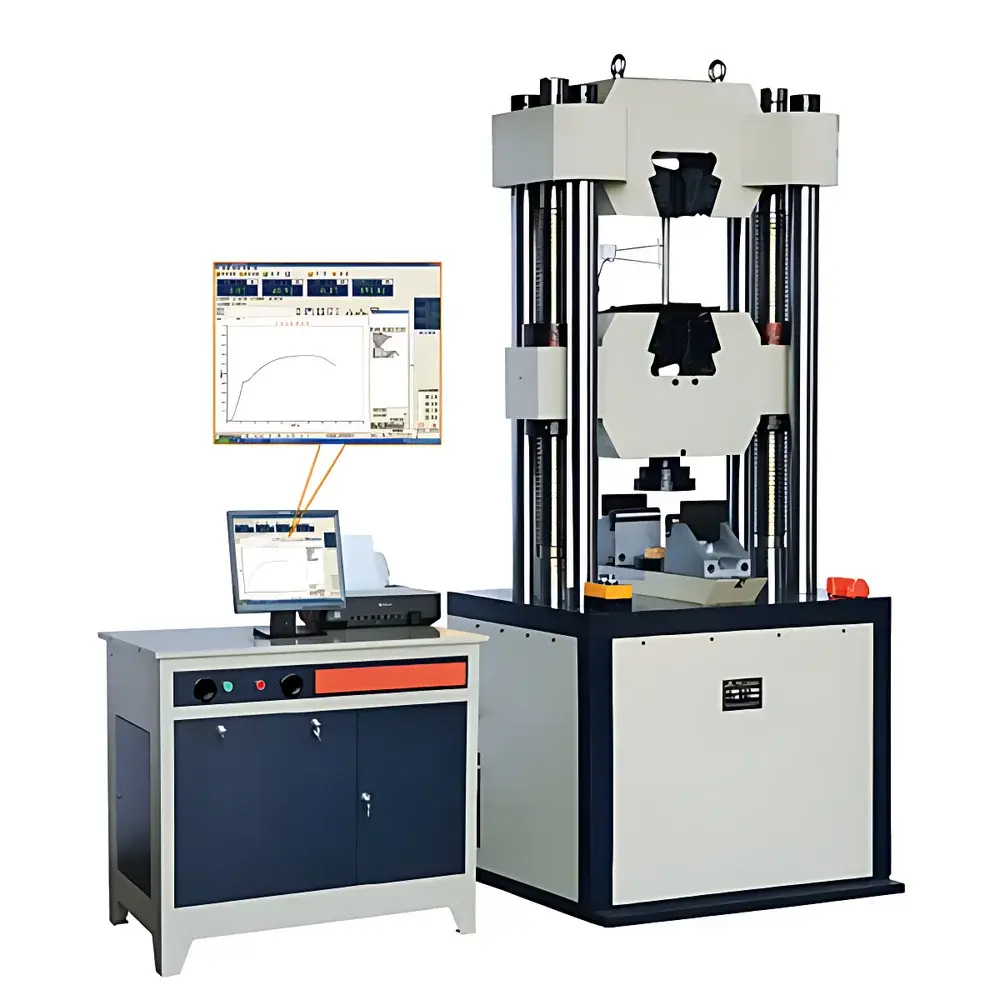
YANRUN WEW-1000B Computer-Controlled Hydraulic Universal Testing Machine
| Brand | YANRUN |
|---|---|
| Origin | Shanghai, China |
| Manufacturer Type | Direct Manufacturer |
| Country of Origin | China |
| Model | WEW-1000B |
| Instrument Category | Universal Testing Machine (UTM) – Hydraulic, Dual-Column, Floor-Mounted |
| Max Test Force | 1000 kN |
| Force Accuracy | ±1% or ±0.5% (per ISO 7500-1 Class 1) |
| Force Resolution | 0.01 kN |
| Displacement Resolution | 0.01 mm |
| Deformation Measurement Accuracy | 0.01 mm |
| Tensile Space | 700 mm |
| Compression Space | 380 mm |
| Piston Stroke | 150 mm |
| Round Specimen Grip Range | Φ13–Φ40 mm |
| Flat Specimen Grip Thickness | 0–15 mm |
| Flat Specimen Max Grip Width | 75 mm |
| Compression Platen Diameter | φ160 mm (optional 204×204 mm square platen) |
| Bend Support Span | Adjustable up to 450 mm |
| Bend Roller Width | 140 mm |
| Bend Roller Diameter | Φ40 mm |
| Max Bending Deflection | 150 mm |
| Max Crosshead Speed | 50 mm/min |
| Gripping Method | Hydraulic Auto-Grip System |
| Power Supply | Main Oil Pump Motor 1.1 kW + Crosshead Motor 0.75 kW |
| Host Dimensions (W×D×H) | 890×660×2250 mm |
| Control Console Dimensions (W×D×H) | 1000×700×1400 mm |
| Net Weight | 2700 kg |
Overview
The YANRUN WEW-1000B is a floor-mounted, computer-controlled hydraulic universal testing machine engineered for high-force static mechanical characterization of metallic, polymeric, composite, and ceramic materials. It operates on the principle of servo-controlled hydraulic actuation, where a high-stability oil pressure system drives the crosshead vertically to apply precisely regulated tensile, compressive, bending, or shear loads. Designed in accordance with ISO 7500-1 (Class 1 accuracy), ASTM E4, and GB/T 228.1–2021 standards, the WEW-1000B delivers traceable force measurement across its full 50–1000 kN range, with dual-level accuracy options (±1% or ±0.5%) validated via certified dead-weight calibration. Its low-profile structural layout—featuring a sub-frame mounted hydraulic cylinder—reduces overall height while maintaining rigidity and minimizing lateral deflection during high-load testing. The system integrates real-time load-displacement-deformation synchronization, enabling compliant stress–strain curve generation for yield strength, ultimate tensile strength, modulus of elasticity, and elongation at break.
Key Features
- Floor-mounted, low-height hydraulic architecture optimized for laboratory space efficiency and operator ergonomics.
- Windows-based control software with dual-user permission hierarchy (Administrator & Tester) supporting role-based access control for GLP/GMP-aligned workflows.
- Open-architecture test method editor: users may define custom test sequences, parameter thresholds, stop conditions, and pass/fail criteria without code modification.
- Native Excel-based reporting engine: fully customizable report templates—including headers, units, statistical summaries, and multi-specimen comparative tables—exportable as .xlsx or PDF.
- Real-time overload protection: automatic shutdown if applied force exceeds 103% of full-scale capacity; integrated stroke limit switch halts piston movement at upper mechanical boundary.
- Hydraulic auto-grip system with dual-range round specimen jaws (Φ13–Φ26 mm and Φ26–Φ40 mm) and flat-specimen clamps (0–15 mm thickness, 75 mm width).
- Modular fixture compatibility: interchangeable compression platens (φ160 mm standard; optional 204×204 mm square), three-point bend assemblies (max 450 mm span), and shear fixtures per ASTM D732.
Sample Compatibility & Compliance
The WEW-1000B accommodates standardized specimens per ISO 6892-1, ASTM E8/E21, ASTM C39, ASTM D695, and GB/T 228.1. Round tensile bars (Φ13–Φ40 mm), flat coupons (up to 15 mm thick × 75 mm wide), cylindrical concrete cores (up to φ150 mm), and beam-type flexure samples (max 450 mm span) are routinely tested. All force transducers are calibrated against NIST-traceable reference standards, and system verification follows ISO 7500-1 procedures. The machine supports audit-ready data integrity through timestamped test logs, electronic signatures, and change history tracking—features aligned with FDA 21 CFR Part 11 requirements when deployed in regulated QC environments.
Software & Data Management
The embedded Windows application provides synchronized acquisition of load (kN), displacement (mm), and extensometer-derived strain (µm/mm) at configurable sampling rates up to 100 Hz. Raw data files (.dat) store unprocessed sensor outputs with metadata (operator ID, date/time, environmental notes). Export functions include CSV for third-party analysis (MATLAB, Python), XML for LIMS integration, and structured PDF reports with embedded graphs and statistical summaries. Audit trails record all parameter modifications, user logins, and calibration events—retained for ≥36 months per internal SOPs. Software updates are delivered via secure HTTPS with SHA-256 signature validation.
Applications
- Tensile testing of structural steel, aluminum alloys, and reinforcing bars per ISO 6892-1 and ASTM A370.
- Compressive strength evaluation of concrete cylinders (ASTM C39), mortar cubes (ASTM C109), and geopolymer composites.
- Flexural property determination of laminated wood, fiber-reinforced polymers, and ceramic tiles using three-point bending (ASTM D790, ISO 178).
- Proof loading and creep monitoring of welded joints and pressure vessel components under sustained load.
- Quality conformance verification in automotive component manufacturing (e.g., suspension arms, chassis brackets) per OEM-specific test protocols.
FAQ
What standards does the WEW-1000B comply with for force calibration and verification?
It conforms to ISO 7500-1 (Class 1), ASTM E4, and GB/T 228.1–2021 for static force measurement accuracy and system verification.
Can the software generate reports compliant with FDA 21 CFR Part 11?
Yes—when configured with electronic signatures, audit trail logging, and secure user authentication, it meets core technical requirements for regulated pharmaceutical and medical device testing.
Is remote diagnostics or firmware update supported?
Firmware updates are performed locally via USB or network connection with cryptographic signature verification; remote desktop support is available under signed service agreement.
What is the recommended maintenance interval for hydraulic oil and filters?
Per manufacturer guidelines: hydraulic oil replacement every 2,000 operating hours or biannually; suction and pressure filter inspection every 500 hours.
Does the system support extensometer integration for high-precision strain measurement?
Yes—it features analog and digital inputs compatible with clip-on, video, and laser extensometers meeting ISO 9513 Class 1 specifications.
Related Products



