
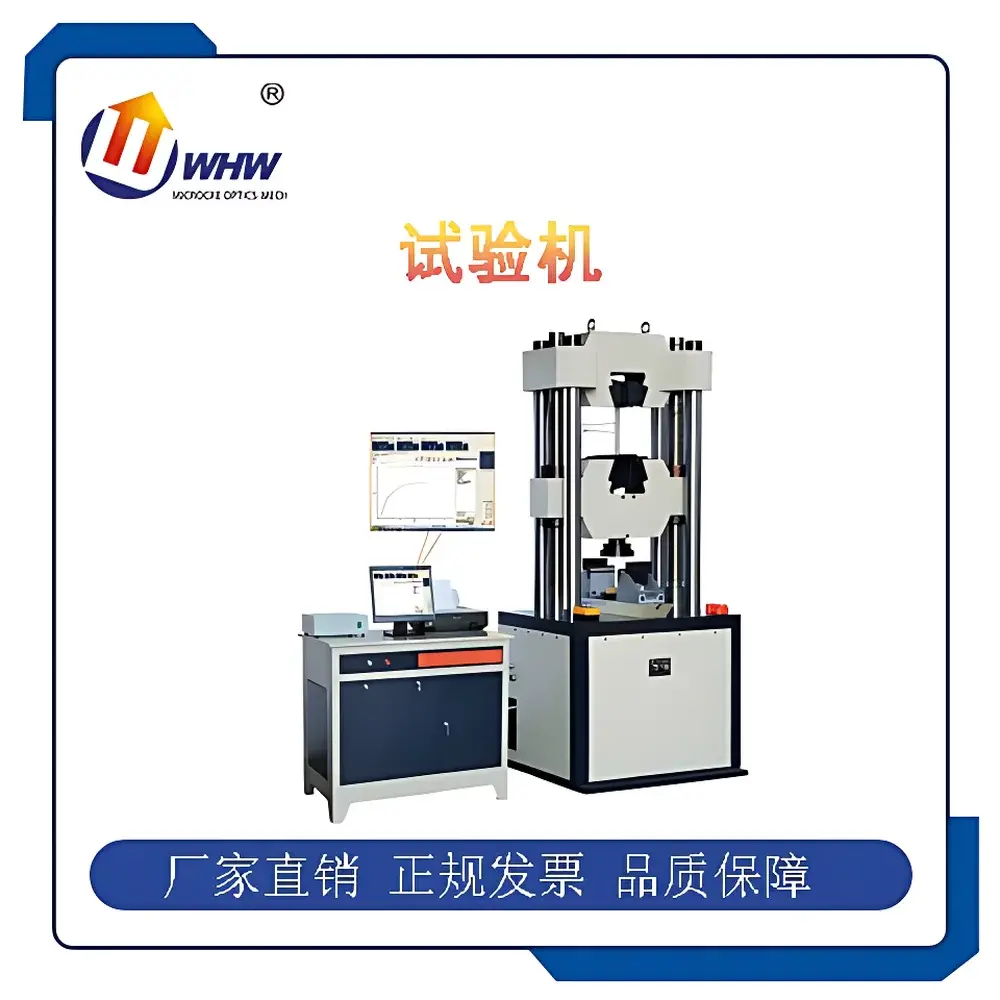
YANRUN MC009 Series Microcomputer-Controlled Electro-Hydraulic Servo Universal Testing Machine WAW-300C
| Brand | YANRUN |
|---|---|
| Origin | Shanghai, China |
| Manufacturer Type | Direct Manufacturer |
| Country of Origin | China |
| Model | MC009-WAW-300C |
| Instrument Type | Electro-Hydraulic Servo Testing Machine |
| Load Capacity Range | 6–300 kN |
| Load Accuracy | ±1% or ±0.5% FS |
Overview
The YANRUN MC009 Series Microcomputer-Controlled Electro-Hydraulic Servo Universal Testing Machine (Model WAW-300C) is an industrial-grade static mechanical testing system engineered for high-fidelity force-controlled and displacement-controlled evaluation of metallic and non-metallic materials under tension, compression, bending, and shear loading conditions. Based on the Couette-type electro-hydraulic servo principle, the system employs a closed-loop controlled hydraulic actuation architecture with real-time feedback from load cells, extensometers, and linear displacement transducers. Its four-column, bottom-mounted frame configuration provides structural rigidity and thermal stability—critical for long-duration creep and relaxation tests per ASTM E139 and ISO 6892-1. Designed to meet Class 1 or optional Class 0.5 accuracy per ISO 7500-1 and GB/T 228.1–2021, the WAW-300C delivers traceable mechanical property data required for quality assurance in aerospace component validation, civil infrastructure material certification, and advanced alloy development.
Key Features
- Four-column, lower crosshead frame with top-mounted tensile zone and bottom-integrated compression/bending workspace—optimized for spatial flexibility and gravitational load alignment.
- Electro-hydraulic servo actuation with high-response proportional servo valve control, enabling precise regulation of oil flow rate and direction to achieve constant-rate force, displacement, or strain control.
- Full-range, unsegmented A/D conversion with 1/500,000 resolution—eliminates range-switching artifacts and ensures consistent sensitivity across the entire 2–100% FS measurement span.
- Dual-stage safety protection: hardware-based overload cutoff (triggered at >103% of full-scale load) and mechanical upper-limit travel stop—both independently disable the hydraulic pump motor to prevent damage to load cell, actuator, or specimen.
- Integrated hydraulic clamping system with internal piston-driven jaw actuation—provides uniform clamping pressure and minimizes slippage during high-strength tensile testing of bars, plates, and rods.
- Modular test space adjustment via AC servo motor, reducer, chain drive, and precision-ground ball screw—enables rapid reconfiguration for specimens up to 800 mm in length, accommodating external accessories such as high-temperature furnaces or environmental chambers.
Sample Compatibility & Compliance
The WAW-300C accommodates cylindrical specimens ranging from Φ6 mm to Φ26 mm and flat specimens up to 15 mm thick, supporting standard test geometries defined in ASTM E8/E8M (tension), ASTM E9 (compression), ASTM E290 (bend), and ISO 7438 (shear). Its bending assembly features 450 mm support span, 140 mm roller width, and Φ30 mm support rollers—compliant with three-point bend configurations per ISO 178. The system meets ISO 7500-1 Class 1 (or optionally Class 0.5) verification requirements and supports GLP-compliant operation through audit-trail-enabled software logging. All force, displacement, and deformation channels are calibrated using NIST-traceable reference standards, with calibration certificates issued per ISO/IEC 17025 requirements.
Software & Data Management
The embedded Windows-based control and analysis platform supports multi-channel synchronous acquisition at up to 100 Hz sampling rate. It implements four independent closed-loop control modes: force, displacement, strain, and programmed ramp-hold sequences. Test protocols can be pre-configured to comply with ASTM D638, ISO 527, or user-defined custom profiles—including cyclic loading, staircase fatigue initiation, and stress-relaxation hold steps. Raw data export is available in CSV, Excel, and universal .UDF formats; all test logs include timestamped operator ID, environmental metadata (optional ambient temperature/humidity input), and digital signature fields for 21 CFR Part 11 compliance when configured with electronic signature modules. Real-time curve overlays, automatic yield point detection (0.2% offset method), and modulus calculation per ASTM E111 are integrated without third-party plug-ins.
Applications
This system serves as a primary mechanical characterization tool in metallurgical QA/QC laboratories verifying tensile strength, yield point, elongation at break, and reduction in area for hot-rolled steels, aluminum alloys, and titanium grades. In civil engineering R&D, it validates compressive performance of concrete cores, grout formulations, and fiber-reinforced polymer (FRP) laminates per ASTM C39 and ISO 10119. Aerospace suppliers utilize its high-accuracy bending mode for evaluating wing spar composite layups, while academic institutions deploy its modular architecture for teaching fundamental mechanics of materials concepts—including Hooke’s law verification, ductile-to-brittle transition studies, and creep parameter extraction via secondary creep rate analysis.
FAQ
What is the maximum allowable specimen height for compression testing?
The compression test space between the lower crosshead and base plate is 700 mm—sufficient for standard concrete cylinders (150 × 300 mm) and large-diameter pipe sections.
Does the system support high-temperature testing?
Yes—the 800 mm tensile clearance allows integration of commercially available split-type furnaces (up to 1200 °C) with thermocouple feedthroughs and vacuum/argon purge options.
Can deformation be measured directly on the specimen gauge length?
Yes—extensometer interfaces conform to ASTM E83 Category B-1 specifications; clip-on and video-based extensometers are supported via analog/digital I/O expansion modules.
Is remote diagnostics and firmware update capability included?
Standard Ethernet connectivity enables secure remote access via SSH or VNC for technical support, calibration verification, and version-controlled firmware updates aligned with IEC 62443 cybersecurity guidelines.
What documentation is provided for regulatory audits?
Each unit ships with Factory Calibration Report, ISO/IEC 17025-accredited Verification Certificate (optional), Electrical Safety Test Record (IEC 61010-1), and comprehensive User Manual including maintenance schedules, torque specifications, and hydraulic fluid change protocols.



