
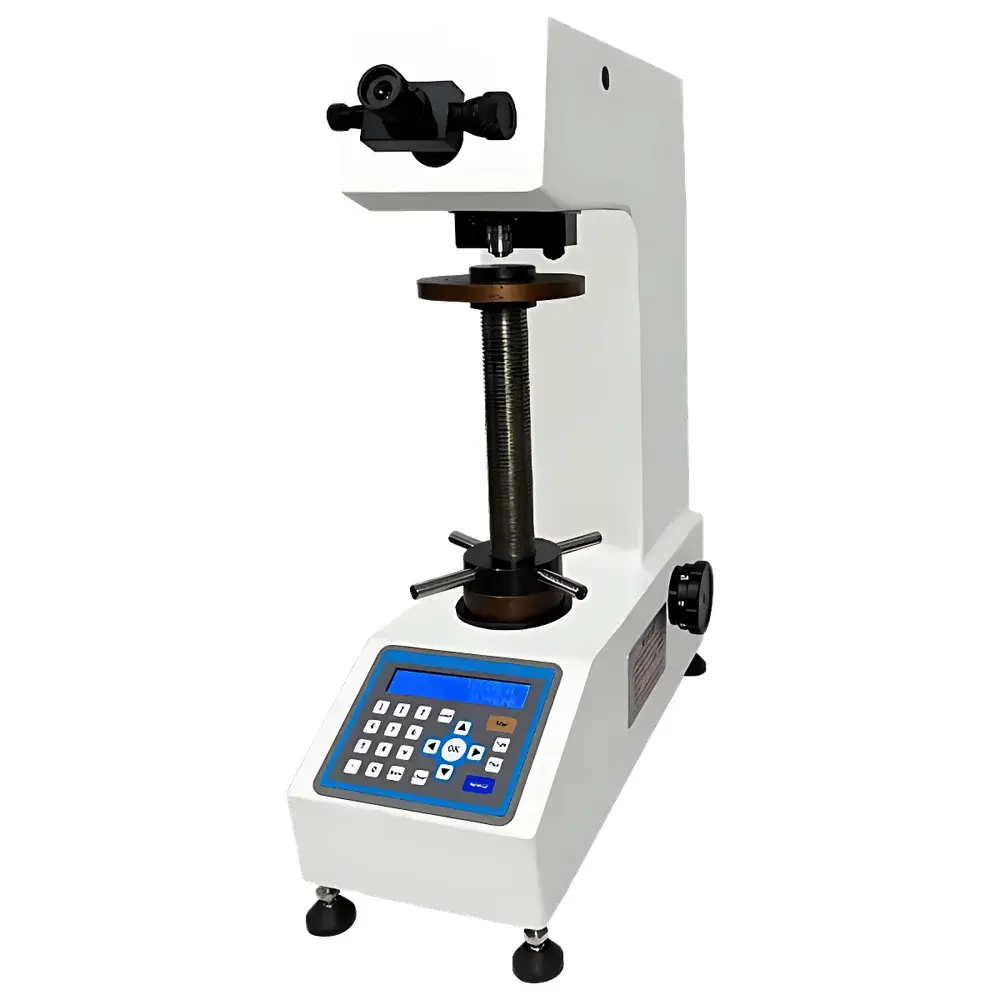
YANRUN HV-50 Vickers Hardness Tester
| Brand | YANRUN |
|---|---|
| Origin | Shanghai, China |
| Manufacturer Type | Direct Manufacturer |
| Country of Origin | China |
| Model | HV-50 |
| Test Force Range | 0.2–50 kgf (1.96–490.3 N) |
| Loading Method | Fully Automatic (Load–Hold–Unload) |
| Standards Compliance | GB/T 4340, ISO 6507 |
| Measuring Resolution | 0.06 µm (with 20× objective), 0.12 µm (with 10× objective) |
| Max Specimen Height | 235 mm |
| Distance from Indenter to Chamber Wall | 130 mm |
| Optical System | Dual-Magnification (10× observation / 20× measurement for 5–10 kgf |
| Total Magnification | 100× (observation), 200× (measurement) |
| Hold Time Range | 0–60 s (1 s increments) |
| Display | LCD with real-time test force and hardness value |
| Hardness Range | 8–3000 HV |
| Power Supply | AC 220 V / 50 Hz |
| Dimensions (L×W×H) | 570 × 220 × 680 mm |
| Net Weight | 46.0 kg |
Overview
The YANRUN HV-50 Vickers Hardness Tester is a precision mechanical-optical instrument engineered for quantitative micro- and macro-hardness evaluation of metallic and non-metallic materials using the Vickers indentation method. Based on ASTM E384 and ISO 6507-1 standards, it applies a precisely controlled diamond pyramid indenter (136° apex angle) under calibrated test forces ranging from 0.2 kgf to 50 kgf. The resulting square-shaped indentation is optically measured via high-magnification microscopy, and hardness is calculated as HV = 1.8544 × F / d², where F is the applied load in kgf and d is the average diagonal length in millimeters. Designed for laboratory, QC, and R&D environments, the HV-50 supports both routine quality control and advanced material characterization—particularly for thin sections, coatings, case-hardened layers, brittle ceramics, and miniaturized components where spatial resolution and repeatability are critical.
Key Features
- Fully automated loading cycle: motor-driven force application, dwell time stabilization (0–60 s adjustable in 1 s increments), and controlled unloading—eliminating operator-dependent variability.
- Dual optical path configuration: 10× objective for specimen positioning and overview imaging; 20× objective (for 5–10 kgf ranges) enables 200× total magnification and sub-0.1 µm measurement resolution (0.06 µm theoretical limit), ensuring traceable accuracy per ISO 6507-2 calibration requirements.
- Manual turret system with six-position tooling station accommodates multiple indenters or objectives—compatible with future upgrades including Knoop (HK) testing capability.
- Robust cast-aluminum monocoque frame with industrial-grade automotive finish provides long-term dimensional stability and resistance to mechanical drift during extended operation.
- Integrated LCD interface displays real-time test force, selected scale (HV/HK), dwell duration, and final hardness value—reducing transcription errors and enabling immediate pass/fail assessment against specification limits.
- Compliance-ready architecture: supports GLP/GMP documentation workflows through optional PC-based software with audit trail, electronic signature, and 21 CFR Part 11–compliant data archiving (available as add-on module).
Sample Compatibility & Compliance
The HV-50 is validated for use across diverse material classes—including ferrous and non-ferrous alloys, sintered metals, IC substrates, PVD/CVD-coated tools, tempered glass, alumina and zirconia ceramics, gemstones, and polymer films ≥20 µm thick. Its 235 mm maximum specimen height and 130 mm indenter-to-chamber-wall clearance accommodate standard metallurgical mounts, large forgings, and irregularly shaped parts. All mechanical and optical subsystems conform to GB/T 4340.1–2012 (equivalent to ISO 6507-1:2018) for hardness testing procedures and uncertainty estimation. Calibration verification follows ISO 6507-3 and is supported by NIST-traceable reference blocks (e.g., HBW 10/3000, HV 10/1000). Optional third-party certification (e.g., CNAS or UKAS) can be arranged upon request.
Software & Data Management
While the HV-50 operates autonomously via its onboard LCD interface, it is fully compatible with YANRUN’s optional HardTest Pro software suite (Windows 10/11, USB 2.0 connection). This platform enables automated image capture, dual-diagonal measurement with edge-detection algorithms, statistical analysis (mean, SD, CPK), hardness conversion tables (HV ↔ HRC, HB, HK), and customizable reporting templates compliant with ISO/IEC 17025 documentation requirements. Raw measurement data—including timestamp, operator ID, load history, and pixel-to-micron calibration coefficients—is stored in encrypted SQLite databases with immutable audit logs. Export formats include CSV, PDF, and XML for integration into LIMS or ERP systems.
Applications
- Case depth profiling of carburized or nitrided steel components using step-load indentation arrays.
- Quality assurance of thin-film coatings (TiN, CrN, DLC) on cutting tools and biomedical implants.
- Mechanical property mapping of weld heat-affected zones (HAZ) and dissimilar metal joints.
- Hardness gradient analysis in additive manufactured (AM) nickel superalloys and titanium alloys.
- Research-grade indentation testing of brittle materials (e.g., silicon wafers, optical crystals) where crack initiation thresholds must be correlated with HV values.
- Education and training labs requiring ISO-aligned methodology for metallurgy and materials science curricula.
FAQ
Does the HV-50 support Knoop hardness testing?
Yes—the instrument accepts standard Knoop indenters and allows manual selection of HK scale via the front-panel interface. Measurement protocol follows ASTM E384 for microhardness applications.
Is calibration verification included with purchase?
A factory calibration certificate (traceable to national metrology institutes) is supplied. Annual recalibration services—including uncertainty budgeting per ISO/IEC 17025—are available through authorized YANRUN service centers.
Can the HV-50 be integrated into an automated production line?
While primarily designed for benchtop lab use, the unit features RS-232 and USB interfaces for external PLC triggering and data streaming. Custom OEM integration kits (including pneumatic stage control and barcode-triggered test sequences) are available upon technical consultation.
What maintenance is required to sustain measurement accuracy?
Recommended quarterly checks include objective lens cleaning, indenter alignment verification using certified reference blocks, and mechanical play inspection of the Z-axis lift mechanism. Full preventive maintenance (PM) kits and service manuals are provided with each unit.




