
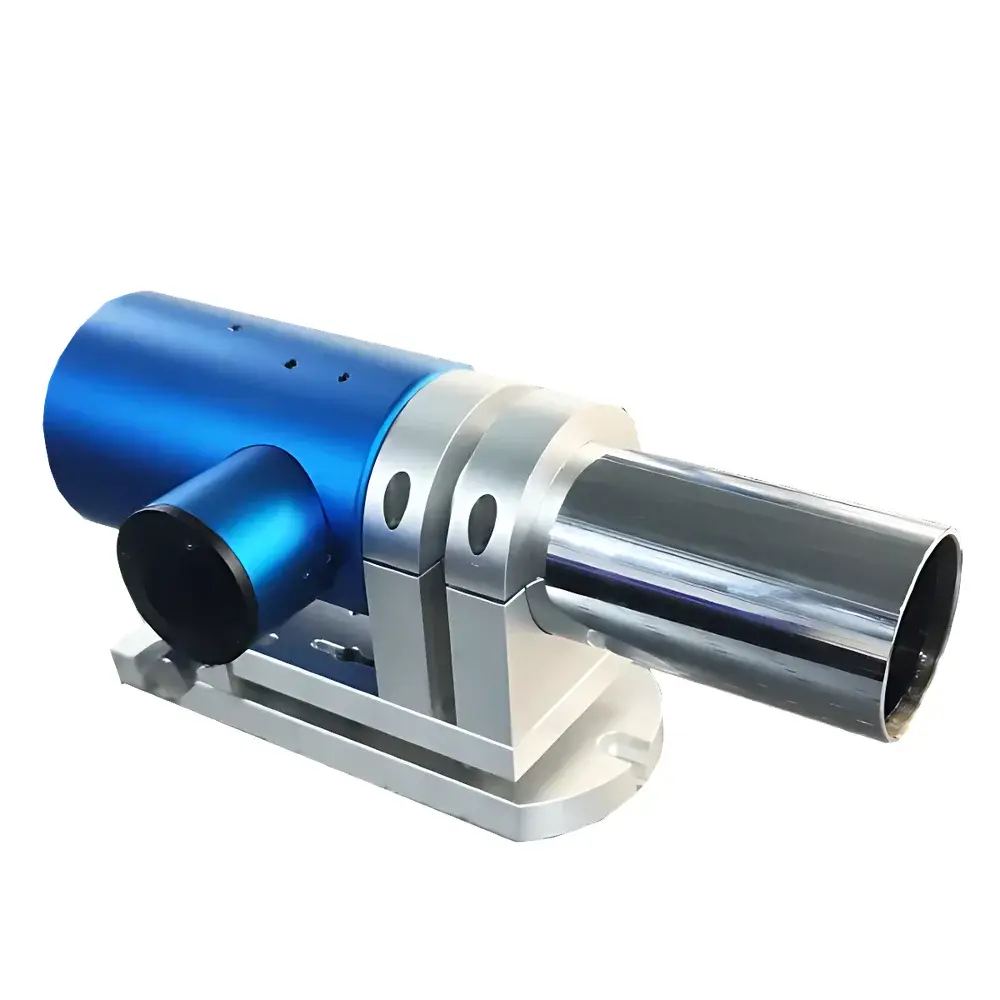
YANRUN MC030-YRMBT2000 Dual-Axis Photoelectric Autocollimator
| Brand | YANRUN |
|---|---|
| Origin | Shanghai, China |
| Manufacturer Type | Manufacturer |
| Model | MC030-YRMBT2000 |
| Focal Length | 200 mm |
| Aperture | 48 mm |
| Light Source | High-Stability Semiconductor LED |
| Detector | High-Resolution Photodiode Array |
| Angular Resolution | Adjustable to 1″ / 0.1″ / 0.01″ (arc sec) |
| Field of View (X/Y) | 8000″ × 6000″ (arc sec) |
| Accuracy (Center) | ±0.5″ (0–±100″), ±1″ (0–±1000″) |
| Measurement Bandwidth | ≤30 Hz |
| Dimensions | 296 × 115 × 125 mm |
| Weight | 4.0 kg |
| Interface | USB 2.0/3.0 |
| OS Requirement | Windows 7 or later (64-bit), Intel Core i3-4th Gen or higher, ≥2.3 GHz |
Overview
The YANRUN MC030-YRMBT2000 Dual-Axis Photoelectric Autocollimator is an advanced optomechanical metrology instrument engineered for high-precision angular measurement in industrial metrology, precision assembly, and calibration laboratories. It operates on the fundamental principle of optical autocollimation: a collimated beam—generated by projecting a reticle located at the focal plane of a 200 mm focal length objective lens—is reflected off a flat mirror surface and re-imaged onto a high-resolution photodiode array positioned at the same focal plane. When the mirror rotates by an angle α, the returned image shifts by ΔS = 4f·α (in linear displacement), enabling sub-arcsecond angular quantification via calibrated pixel mapping. Unlike traditional visual autocollimators requiring subjective eyepiece alignment, the MC030-YRMBT2000 replaces the ocular system with a digital imaging sensor and real-time centroid calculation algorithms—eliminating parallax, observer fatigue, and human aiming error. Its dual-axis architecture simultaneously captures X- and Y-direction angular deviations within a full field of view of 8000″ × 6000″, making it suitable for comprehensive geometric error mapping of machine tool axes, rotary stages, and optical mounts.
Key Features
- Dual-axis synchronous measurement with independent X/Y angular readouts, enabling vectorial tilt analysis without mechanical reorientation.
- Real-time electronic eyepiece display showing live centroid-tracked crosshair image, updated at up to 30 Hz for dynamic alignment monitoring.
- Adjustable angular resolution down to 0.01 arc seconds—configurable via software for trade-offs between speed and precision.
- Integrated long-life semiconductor LED illumination (rated >20,000 hours), thermally stabilized to minimize drift during extended thermal equilibrium periods.
- Compact monolithic housing (296 × 115 × 125 mm, 4.0 kg) with rigid aluminum alloy construction, optimized for portability without compromising mechanical stability.
- USB 2.0/3.0 interface ensures plug-and-play compatibility with standard industrial PCs; no external power supply required beyond USB bus power.
- Multi-language GUI supporting English, Chinese, Russian, and Korean—designed for global deployment in multinational manufacturing and R&D environments.
- Modular software architecture allows seamless integration of optional analysis modules for straightness, flatness, perpendicularity, and parallelism evaluation per ISO 230-1, ISO 10360, and ASME B89.3.7 standards.
Sample Compatibility & Compliance
The MC030-YRMBT2000 is compatible with standard optical flats (e.g., Grade 0 or better per ISO 10110-7), kinematic mirror mounts, and retroreflector-equipped targets used in CNC machine tool calibration. Its measurement traceability aligns with national metrological standards through factory calibration against NIST-traceable angle artifacts. The system supports GLP-compliant operation when used with audit-trail-enabled software configurations—recording operator ID, timestamp, environmental conditions (ambient temperature/humidity logged externally), and raw image metadata. While not FDA 21 CFR Part 11 certified out-of-the-box, the software framework permits validation documentation packages for regulated environments (e.g., aerospace MRO, medical device manufacturing) upon request. All electrical components comply with CE marking requirements (EMC Directive 2014/30/EU and Low Voltage Directive 2014/35/EU).
Software & Data Management
The bundled YANRUN AutoAlign Pro software runs natively on Windows 7+ (64-bit) platforms meeting minimum specifications: Intel Core i3-4th generation or newer, ≥2.3 GHz CPU, 4 GB RAM, and DirectX 11-compatible GPU. It provides real-time centroid tracking, automatic curve fitting (e.g., polynomial, spline), deviation reporting against nominal geometry, and statistical process control (SPC) charting. Raw sensor frames and processed results are stored in HDF5 format for interoperability with MATLAB, Python (NumPy/H5Py), and LabVIEW. Export options include ISO-standard-compliant Excel reports (XLSX), CSV for spreadsheet analysis, and PDF measurement certificates with embedded digital signatures. Optional modules enable GD&T evaluation per ASME Y14.5–2018 and automated report generation aligned with internal quality management systems (QMS), including CAPA linkage for nonconformance tracking.
Applications
- Precision alignment of multi-axis machine tools—including linear axis squareness verification and spindle tilt characterization per ISO 230-1 Annex C.
- Calibration of air-bearing rotary tables and goniometers used in semiconductor lithography equipment.
- Optical component mounting and collimation in laser cavity assembly, interferometer setup, and telescope alignment.
- Geometric error mapping of granite surface plates and reference flats under ISO 10360-2 compliance testing.
- Dynamic angular stability assessment of vibration-isolated optical benches and inertial navigation platform test rigs.
- Education and research in undergraduate and graduate optics laboratories—demonstrating wavefront sensing principles, beam steering sensitivity, and closed-loop feedback control fundamentals.
FAQ
What is the recommended warm-up time before high-accuracy measurements?
For measurements targeting ≤0.1″ repeatability, a minimum 15-minute power-on stabilization period is required. For metrological calibration-grade use (e.g., ISO 10360 verification), the instrument must be thermally equilibrated in a controlled environment (±0.5°C) for ≥24 hours prior to measurement.
Does the system support remote operation over Ethernet or TCP/IP?
Standard configuration uses USB only; however, OEM-level firmware and SDK support Ethernet-based command-and-control integration upon custom agreement.
Can the MC030-YRMBT2000 measure angular motion over extended durations (e.g., 8+ hours)?
Yes—provided ambient temperature remains stable within ±1°C and the LED source is operated at nominal current (not maximum brightness). Long-term drift is typically <0.3″/hour after thermal stabilization.
Is third-party software integration possible?
Yes—the instrument exposes a documented ASCII command protocol over USB CDC ACM, enabling integration with National Instruments TestStand, Keysight VEE, or custom Python/C# applications via serial emulation.
Are calibration certificates provided with each unit?
Each shipped unit includes a factory calibration certificate referencing traceable angle standards, valid for 12 months. Accredited ISO/IEC 17025 calibration services are available as an add-on option.





