
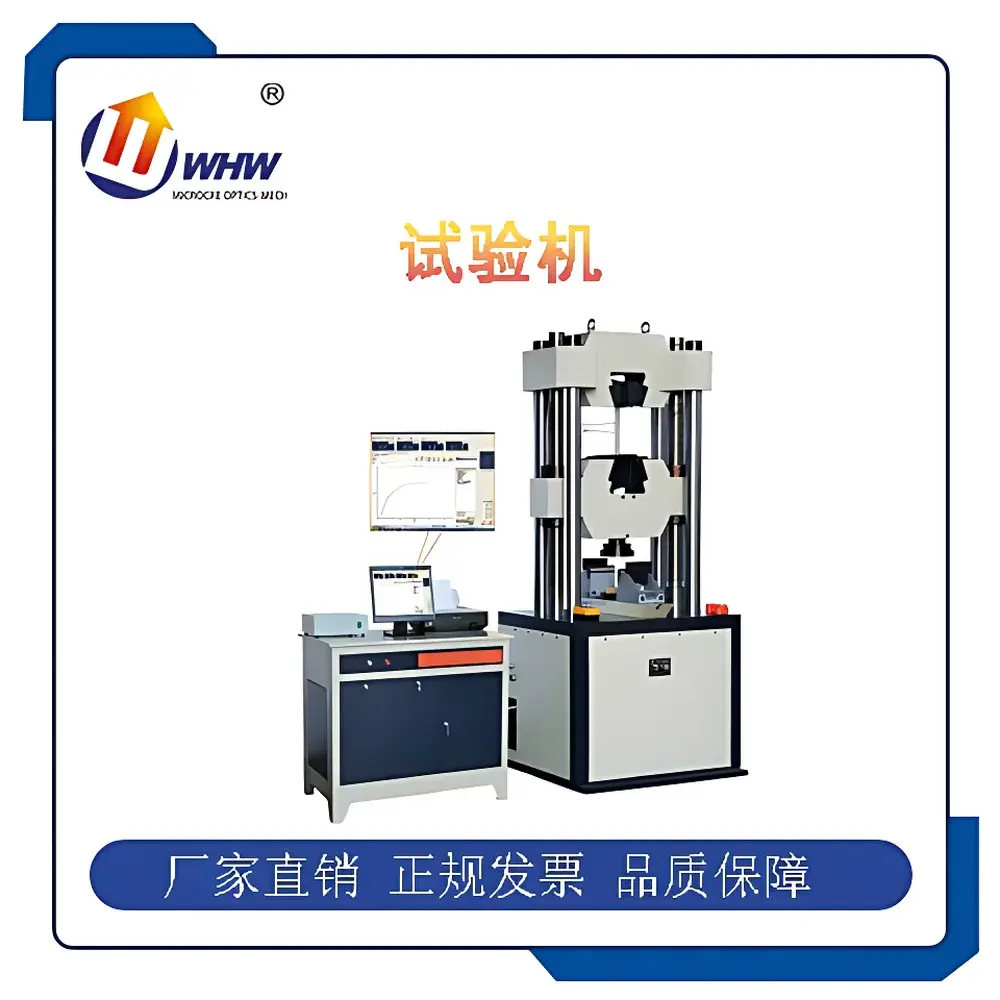
YANRUN MC009-WAW-600G Microcomputer-Controlled Electro-Hydraulic Servo Universal Testing Machine
| Brand | YANRUN |
|---|---|
| Origin | Shanghai, China |
| Manufacturer Type | Manufacturer |
| Model | MC009-WAW-600G |
| Load Range | 12–600 kN |
| Load Accuracy | ±1% or ±0.5% |
| Test Force Resolution | 0.002 kN |
| Displacement Resolution | 0.01 mm |
| Deformation Measurement Accuracy | 0.005 mm |
| Control Modes | Constant Force / Constant Displacement / Constant Strain (0.4–100% FS) |
| Clamping Method | Integrated Hydraulic Grips |
| Max Piston Speed | 50 mm/min |
| Tensile Space | 850 mm |
| Compression Space | 750 mm |
| Piston Stroke | 250 mm |
| Round Specimen Grip Range | Φ13–Φ40 mm |
| Flat Specimen Grip Thickness | 0–30 mm |
| Bending Span | 450 mm |
| Bending Roller Diameter | Φ30 mm |
| Max Bending Deflection | 150 mm |
| Host Dimensions (W×D×H) | 1250 × 780 × 2650 mm |
| Oil Source Dimensions | 1150 × 700 × 950 mm |
| Weight | 3050 kg |
Overview
The YANRUN MC009-WAW-600G is a microcomputer-controlled electro-hydraulic servo universal testing machine engineered for high-fidelity mechanical property characterization of metallic and non-metallic materials under tension, compression, bending, and shear loading conditions. It operates on the principle of closed-loop hydraulic actuation, where a servo-controlled proportional valve regulates high-pressure oil flow into a bottom-mounted cylinder, enabling precise force and displacement control across the full load range (12–600 kN). The system employs a dual-closed-loop architecture—simultaneously regulating test force via load cell feedback and crosshead position via encoder-based displacement measurement—ensuring geometric alignment between loading axis and specimen axis. This design minimizes parasitic bending moments and guarantees repeatability in accordance with ISO 7500-1:2018 (Class 0.5 or Class 1 verification) and ASTM E4-23 (Standard Practices for Force Verification of Testing Machines). Its lower-cylinder configuration provides enhanced structural rigidity and long-term stability, while the worm-gear-driven adjustable test space decouples positioning mechanics from load transmission—reducing maintenance frequency and extending service life.
Key Features
- Bottom-mounted hydraulic cylinder with precision gap-seal piston technology for minimal internal leakage and consistent pressure response
- Integrated hydraulic wedge-type grips with automatic clamping pressure modulation, supporting round specimens (Φ13–Φ40 mm) and flat specimens (up to 30 mm thick)
- Four-channel closed-loop control system managing test force, specimen deformation (via extensometer interface), crosshead displacement, and test progression in real time
- High-resolution data acquisition: 1/500,000 full-scale resolution, no range switching required across the entire 12–600 kN operating span
- Dual-stage protection logic: hardware-based over-travel limit switches and software-enforced overload cutoff (triggered at >103% of set maximum load)
- Modular oil source unit featuring high-efficiency motor-pump assembly, pressure-compensated servo valve, differential pressure filtration, and temperature-stabilized reservoir
- Configurable host color scheme and ergonomic console layout compliant with ISO 13857 safety clearance requirements
Sample Compatibility & Compliance
The MC009-WAW-600G accommodates standardized test specimens per ISO 6892-1 (tensile), ISO 15630-1 (reinforcing steel), ASTM A370, ASTM C39 (concrete compression), and EN 10002-1. Its 850 mm tensile height and 750 mm compression gap support both short gauge-length coupons and full-scale structural components. Bending fixtures conform to ISO 7438 and ASTM E290 specifications, with interchangeable rollers (Φ30 mm diameter, 140 mm width) and adjustable support spans up to 450 mm. All control algorithms and calibration routines comply with GLP documentation standards; audit trails, electronic signatures, and user-access-level management are available through optional FDA 21 CFR Part 11-compliant software modules. System verification follows ISO 7500-1 procedures, with as-delivered accuracy certified to ±0.5% of reading (Class 0.5) or ±1.0% (Class 1), traceable to NIM (National Institute of Metrology, China) reference standards.
Software & Data Management
The embedded Windows-based control platform supports multi-language UI (English, German, French, Spanish), real-time curve overlay (force–displacement, stress–strain, load–time), and automated report generation in PDF/XLS formats. Raw data is stored in binary .tdm format (compatible with ASAM MCD-2MC standard) with timestamped metadata including operator ID, environmental conditions (optional sensor input), calibration history, and instrument configuration snapshot. Export functions include CSV, MATLAB .mat, and universal HDF5. For enterprise integration, OPC UA server capability enables seamless connection to LIMS (e.g., LabVantage, Thermo Fisher SampleManager) and MES platforms. Firmware updates are delivered via secure HTTPS with SHA-256 signature validation; all parameter changes are logged with immutable timestamps and user attribution.
Applications
- Mechanical validation of structural steels, aluminum alloys, titanium grades, and composite laminates per aerospace (AMS, NADCAP) and nuclear (ASME BPVC Section III) codes
- Quality assurance of welded joints, castings, and forged components in heavy machinery and energy infrastructure sectors
- R&D of advanced high-strength steels (AHSS), shape-memory alloys, and additively manufactured parts requiring high-fidelity cyclic loading protocols
- Concrete and mortar compressive strength testing in civil engineering laboratories accredited to ISO/IEC 17025
- Educational use in university materials science programs for hands-on instruction in fracture mechanics, plasticity theory, and constitutive modeling
- Third-party certification testing for CE marking (EN 10002 series) and CCC (China Compulsory Certification) compliance
FAQ
What international standards does the WAW-600G meet for force measurement accuracy?
It complies with ISO 7500-1:2018 Class 0.5 (±0.5% of reading) or Class 1 (±1.0%), verified using traceable deadweight standards and documented in factory calibration certificates.
Can the system perform strain-controlled fatigue testing?
Yes—when equipped with an extensometer interface module and optional high-frequency servo valve, it supports displacement- and strain-controlled cyclic tests per ASTM E606 and ISO 1099.
Is remote diagnostics and firmware update supported?
Yes—via encrypted TLS-enabled web interface; diagnostic logs, sensor health status, and hydraulic pressure profiles are accessible remotely with role-based authentication.
What is the maximum recommended ambient temperature for continuous operation?
40 °C, with relative humidity ≤80% non-condensing; optional oil-cooling package extends operational envelope to 45 °C.
Does the controller support custom test sequences with conditional branching?
Yes—the scripting engine accepts Python-based test definitions with IF/ELSE logic, loop structures, and external trigger inputs (TTL, 24 VDC).



