
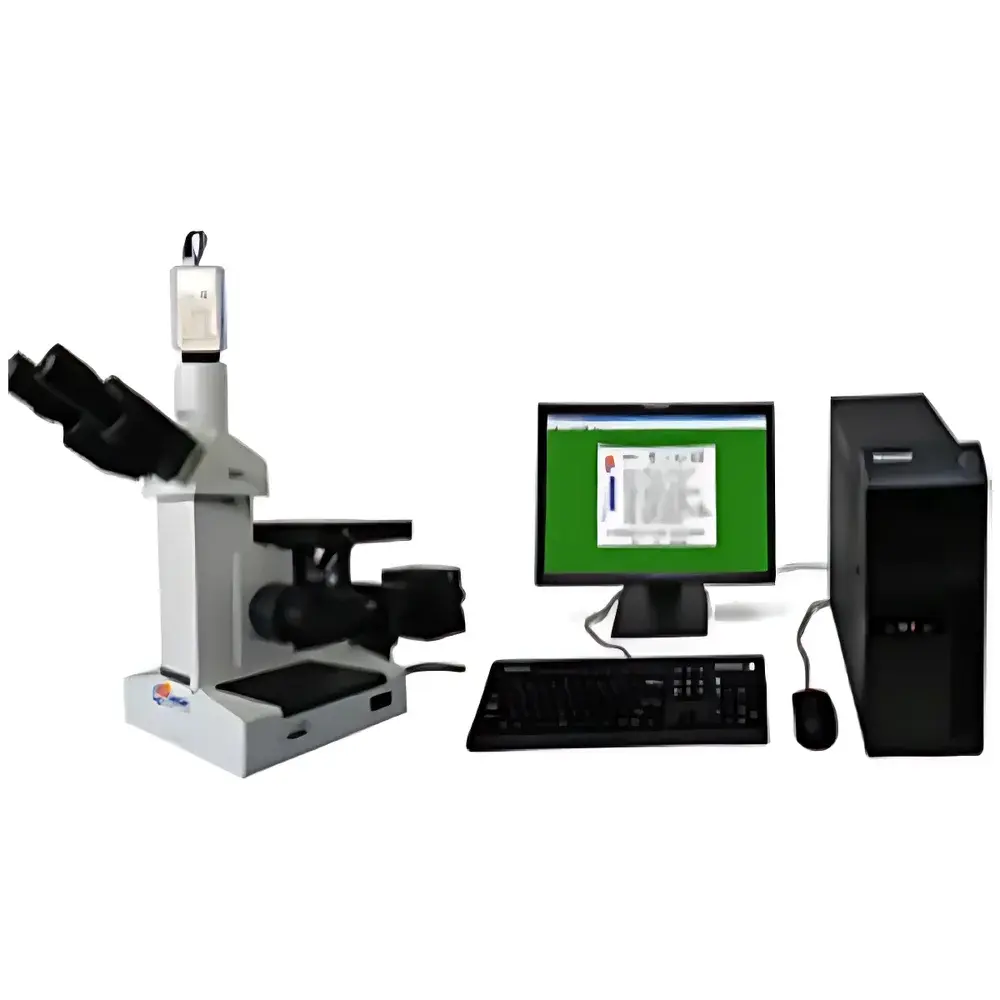
YANRUN 4XC-P Inverted Metallurgical Microscope with Video Imaging Capability
| Brand | YANRUN |
|---|---|
| Origin | Shanghai, China |
| Manufacturer Type | Direct Manufacturer |
| Product Type | Inverted |
| Optical Total Magnification | 100×–1000× (Optional Extended to 1600×) |
| Eyepieces | 10× wide-field (18 mm field number) |
| Objectives | 10×/0.25, 20×/0.40, 40×/0.60, 100×/1.25 (oil immersion) |
| Working Distances | 8.8 mm, 8.6 mm, 3.7 mm, 0.44 mm |
| Focusing | Coaxial coarse/fine adjustment |
| Fine focus graduation | 2 µm |
| Stage | Dual-layer mechanical stage (180 × 150 mm), travel range 15 × 15 mm |
| Illumination | Köhler illumination with 6 V / 20 W halogen lamp, intensity adjustable |
| Power Supply | 220 V / 50 Hz (optional 110 V / 60 Hz) |
| Tube | Inverted trinocular head, 30° inclination, interpupillary adjustment 53–75 mm, diopter compensation |
Overview
The YANRUN 4XC-P is a precision-engineered inverted metallurgical microscope designed for routine and advanced metallographic analysis in quality control laboratories, foundry environments, and materials research facilities. Its inverted optical configuration positions the objectives beneath the specimen stage—enabling stable observation of large, heavy, or irregularly shaped metallic samples (e.g., castings, weldments, heat-treated components) without requiring sample sectioning or mounting in vertical orientation. The system operates on conventional brightfield illumination with Köhler optical alignment, ensuring uniform illumination and optimal resolution across the entire field of view. Equipped with parfocal, parcentric plan achromatic objectives (10×, 20×, 40×, 100× oil), the microscope delivers high-contrast, low-aberration imaging essential for grain boundary delineation, phase identification, inclusion analysis, and microstructural defect assessment per ASTM E3, ISO 643, and EN 10365 standards.
Key Features
- Inverted trinocular head with 30° inclined eyepiece tubes, interpupillary distance adjustment (53–75 mm), and individual diopter compensation for ergonomic long-duration use.
- Plan achromatic objective set with standardized numerical apertures (NA = 0.25, 0.40, 0.60, 1.25) and calibrated working distances (8.8 mm to 0.44 mm), optimized for both dry and oil-immersion observation.
- Coaxial coarse and fine focusing mechanism with 30 mm vertical travel and 2 µm fine-focus graduation—enabling precise Z-axis positioning required for depth-of-field evaluation and serial sectioning workflows.
- Dual-layer mechanical stage (180 × 150 mm footprint) with 15 × 15 mm translation range, integrated centerable aperture inserts (φ10 mm and φ20 mm), and lockable position retention for repeatable sample repositioning.
- Stable Köhler illumination system featuring a 6 V / 20 W halogen lamp with continuous brightness control, heat-absorbing filter, and field/condenser diaphragms for contrast optimization and glare reduction.
- Standard 160 mm mechanical tube length compliant with DIN/ISO 10933 specifications—ensuring compatibility with third-party accessories including polarization kits, DIC sliders, and certified calibration standards.
Sample Compatibility & Compliance
The 4XC-P accommodates specimens up to 30 mm in height and 150 mm in diameter, making it suitable for as-polished, etched, or coated metallographic mounts—including bulk forgings, turbine blades, rail steel coupons, and additive-manufactured alloy builds. Its rigid base and vibration-damped column minimize thermal drift and mechanical instability during extended imaging sessions. The instrument meets fundamental requirements for GLP-compliant documentation when paired with validated image capture hardware (e.g., USB 3.0 CMOS cameras meeting ISO 13660 linearity thresholds). While not inherently FDA 21 CFR Part 11–compliant, its modular architecture supports integration with audit-trail-enabled software platforms used in regulated manufacturing environments (e.g., aerospace component certification per AS9100 Rev D).
Software & Data Management
The 4XC-P is supplied in multiple configurations: base microscope only, or bundled with optional digital imaging subsystems—including dedicated video capture modules (composite or HDMI output), USB-based CMOS sensors (1.3 MP to 5 MP), and entry-level image analysis suites supporting measurement annotation, grain size estimation (ASTM E112), and report generation in PDF/XLS formats. All digital variants retain full manual optical control—preserving traceability for method validation. Raw image data is stored in lossless TIFF or BMP format to maintain pixel fidelity for archival review and inter-laboratory comparison. Firmware updates and driver packages are distributed via secure manufacturer portal, with version history logs maintained for internal QA records.
Applications
- Microstructural characterization of ferrous and non-ferrous alloys (e.g., austenitic stainless steels, aluminum 6061-T6, titanium Ti-6Al-4V) per ASTM E3 and ISO 643.
- Heat treatment verification—including case depth measurement, martensite quantification, and carbide network analysis in tool steels.
- Weld inspection—evaluation of fusion zone morphology, HAZ microcracking, and intermetallic phase formation in dissimilar metal joints.
- Failure analysis—identification of fatigue striations, cleavage facets, and corrosion-induced pitting in service-exposed components.
- Quality assurance in automotive casting production—porosity mapping, dendrite arm spacing measurement, and secondary phase distribution profiling.
FAQ
Is the 4XC-P compatible with polarized light or differential interference contrast (DIC) observation?
Yes—the trinocular port and standardized DIN-mount objectives support aftermarket polarizer analyzers and Nomarski prism sets; however, these accessories must be sourced separately and aligned per manufacturer alignment protocols.
What is the maximum specimen weight the stage can support without compromising focus stability?
The reinforced stage assembly maintains positional integrity under loads up to 5 kg; for specimens exceeding this mass, optional counterbalanced stage adapters are available upon request.
Can the 100× oil-immersion objective be used with non-oil media such as water or glycerol?
No—this objective is specifically corrected for immersion oil (n = 1.518); using alternative media will induce spherical aberration and significantly degrade resolution and contrast.
Does the microscope include calibration certification for metrological traceability?
A factory-issued dimensional calibration certificate (covering stage micrometer verification and objective magnification accuracy per ISO 10933 Annex B) is provided with each unit; NIST-traceable recalibration services are available through authorized regional partners.
Is firmware or software update capability built into the video imaging variant?
Yes—USB-connected imaging modules feature field-upgradable firmware via Windows/macOS utilities; update logs are timestamped and exportable for internal audit compliance.




