
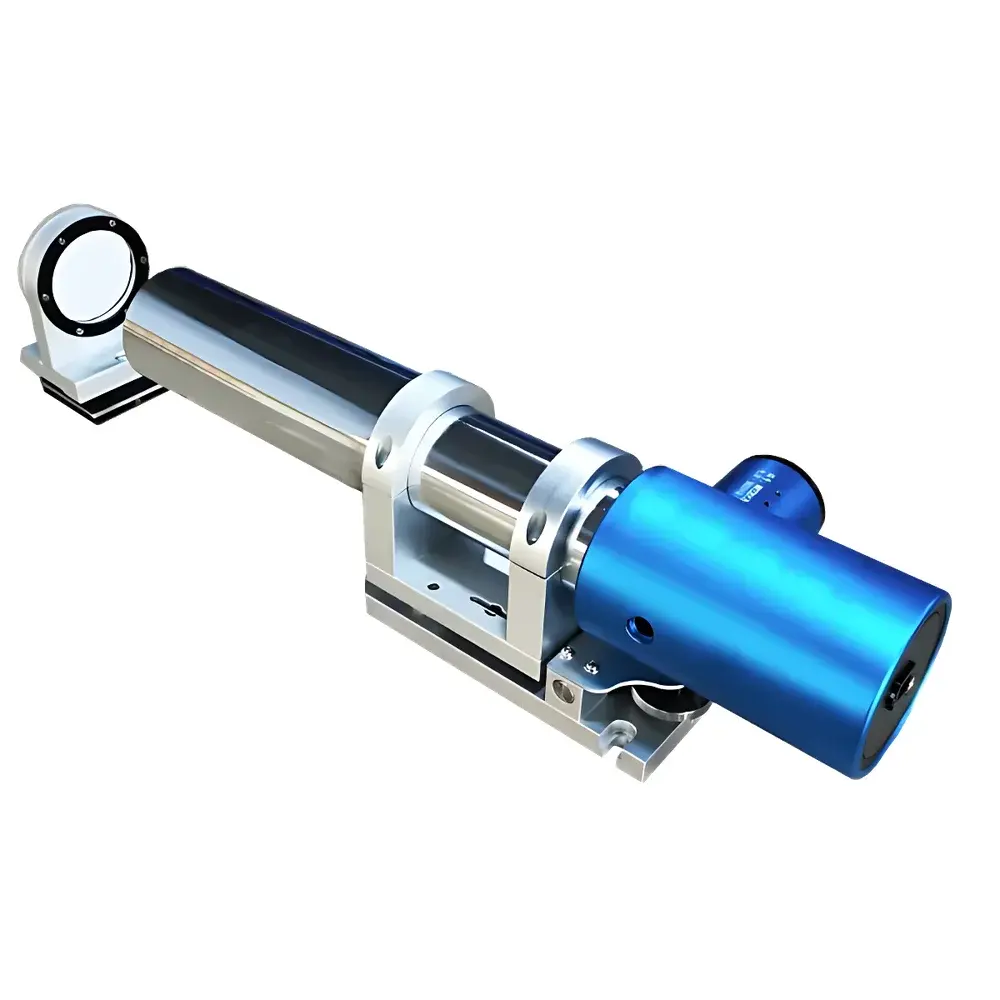
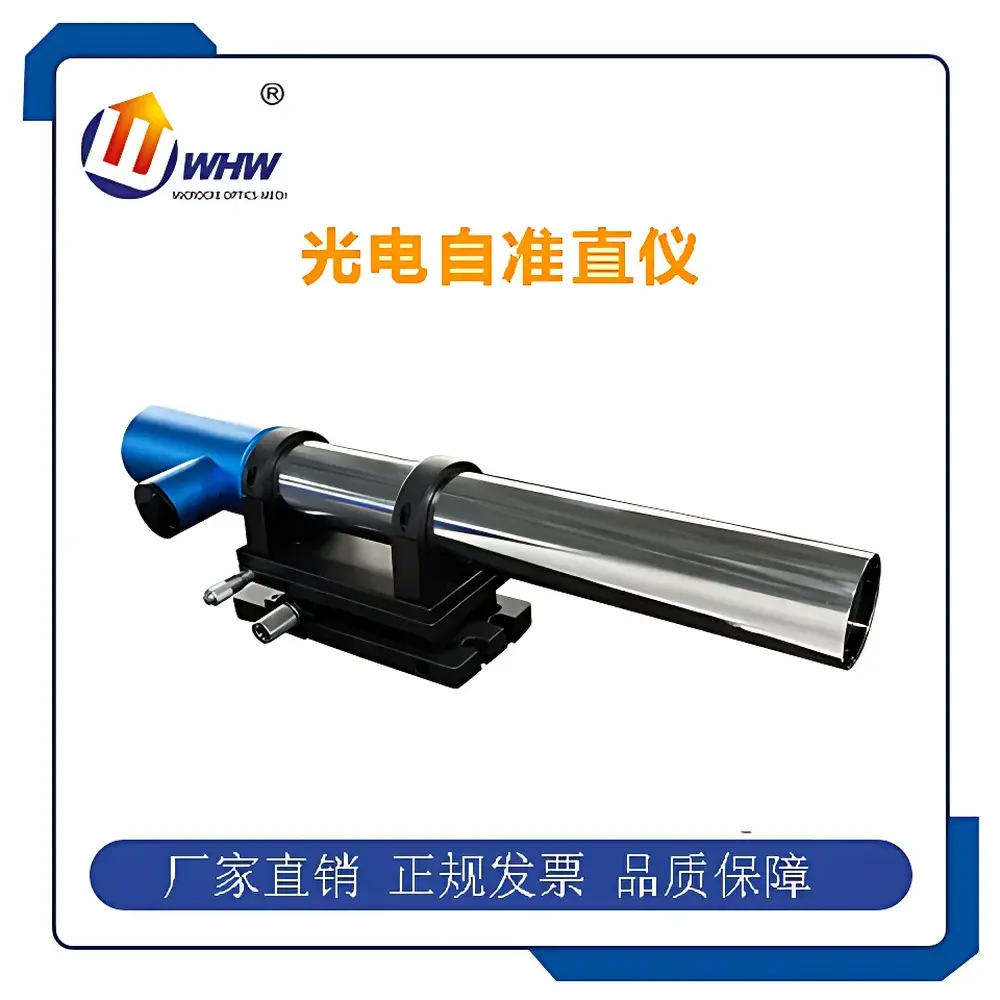
YANRUN MC030-YRMBT400/68/0.5 Dual-Axis Photoelectric Autocollimator
| Focal Length | 400 mm |
|---|---|
| Aperture | 68 mm |
| Angular Resolution | Adjustable down to 0.0001″ (arc sec) |
| Field of View | 1700″ × 1350″ (X/Y) |
| Accuracy (Center Range ±600″) | ±0.5″ |
| Measurement Distance | 0–50 m |
| Detector | High-Precision Photodetector Array |
| Light Source | Long-Life Imported Semiconductor LED |
| Interface | USB 2.0 |
| Operating System | Windows 7 or later (64-bit) |
| Dimensions | 490 × 135 × 125 mm |
| Weight | 7.2 kg |
| Frequency Response | ≤30 Hz |
Overview
The YANRUN MC030-YRMBT400/68/0.5 Dual-Axis Photoelectric Autocollimator is an advanced angular metrology instrument engineered for high-precision, non-contact measurement of small angular deviations in two orthogonal axes (X and Y). It operates on the fundamental principle of optical autocollimation: a collimated beam—generated by projecting a reticle located at the focal plane of a high-aperture objective lens—is reflected back from a planar mirror surface and reimaged onto a calibrated photodetector array positioned at the same focal plane. When the mirror rotates by an angle α, the returned image shifts by ΔS ≈ 2f·α (where f = 400 mm), enabling sub-arcsecond angular quantification through precise centroid detection. This system replaces traditional visual autocollimators by eliminating observer-dependent parallax and mechanical micrometer errors, delivering traceable, repeatable angular data under ambient laboratory or industrial shop-floor conditions.
Key Features
- Dual-axis simultaneous measurement capability with independent X/Y readouts, enabling real-time evaluation of tilt, roll, and misalignment without reorientation.
- High-resolution CMOS-based photodetector array optimized for centroid stability and low noise, supporting selectable angular resolution from 1″ down to 0.0001″ (arc sec).
- Integrated long-life semiconductor LED illumination system (rated >20,000 hours), providing stable, flicker-free, temperature-insensitive collimated light output.
- Compact, rigid aluminum alloy housing (490 × 135 × 125 mm; 7.2 kg) with vibration-damped base mount, suitable for portable deployment and integration into coordinate measuring setups.
- Real-time electronic eyepiece display showing live retroreflected crosshair image, dynamic offset vectors, and statistical trend overlays during acquisition.
- USB 2.0 interface compatible with standard industrial PCs (Intel Core i3-4th gen or higher, 64-bit Windows 7+), ensuring deterministic latency and plug-and-play configuration.
- Modular software architecture supporting optional analysis modules for straightness, flatness, perpendicularity, parallelism, and rotational axis error mapping per ISO 230-1 and ISO 10360 standards.
Sample Compatibility & Compliance
This autocollimator is designed for use with polished planar mirrors (minimum reflectivity ≥95% at 635 nm), including fused silica, BK7, and coated metallic substrates. It supports measurements across distances up to 50 meters, accommodating large-scale machine tool calibration (e.g., CNC gantries, hydrostatic guideways) as well as micro-optical alignment tasks. The instrument complies with general requirements for optical angular measurement equipment defined in ISO 10110-1 (optical component tolerancing) and aligns with metrological practices referenced in ISO/IEC 17025:2017 for accredited calibration laboratories. While not inherently FDA 21 CFR Part 11 compliant, audit-ready data logs—including timestamped raw pixel coordinates, environmental metadata (ambient temperature, humidity if externally logged), and operator ID—can be exported in CSV or Excel format to support GLP/GMP documentation workflows.
Software & Data Management
The included Windows-based control and analysis software provides full instrument control, real-time visualization, and post-processing functionality. It features built-in curve fitting (polynomial, spline, least-squares), deviation mapping, and tolerance banding against user-defined limits. All measurement sessions are automatically archived with embedded metadata (system time, firmware version, detector gain settings, exposure duration). Export options include standardized Excel reports (ASTM E29-compliant rounding), PNG/SVG vector graphics, and ASCII-delimited files for import into MATLAB, Python (NumPy/Pandas), or enterprise MES/QMS platforms. Multi-language UI support includes English, Chinese, Russian, and Korean—enabling seamless operation in multinational R&D and manufacturing environments.
Applications
- Precision alignment of optical benches, interferometer components, and laser cavity optics.
- Dynamic angular monitoring of rotary stages and air-bearing spindles in semiconductor lithography tools.
- Geometric error mapping of linear and rotary axes in multi-axis CNC machines per ISO 230-2 and VDI/VDE 2617.
- Verification of flatness and straightness in granite surface plates and precision ground rails using reversal techniques.
- Calibration of inclinometers, gyroscopes, and MEMS-based attitude sensors in aerospace test facilities.
- Telescope collimation and adaptive optics wavefront sensor alignment in astronomical instrumentation labs.
- Educational demonstration of optical lever principles, Fourier optics, and closed-loop feedback control systems.
FAQ
What is the recommended warm-up time before high-accuracy measurements?
For measurements requiring ≤±0.5″ repeatability, power-on stabilization for ≥15 minutes is required. For metrological verification or calibration against national standards, thermal equilibration in a temperature-controlled environment (±0.5°C) for ≥24 hours is advised.
Can this autocollimator measure angular motion dynamically?
Yes—the system supports continuous acquisition at up to 30 Hz, making it suitable for characterizing low-frequency angular vibrations, servo response, and thermal drift in precision positioning systems.
Is external referencing or periodic recalibration necessary?
The instrument maintains intrinsic linearity over its ±600″ central range without drift under stable thermal conditions. However, annual verification using NIST-traceable angle artifacts or a calibrated rotary table is recommended for ISO/IEC 17025 compliance.
Does the software support automated pass/fail reporting per GD&T specifications?
Yes—tolerance zones can be defined per ASME Y14.5 or ISO 1101, and the software generates annotated deviation maps with color-coded conformance indicators and summary statistics.
Are custom optical interfaces or extended-range accessories available?
YANRUN offers optional telecentric relay lenses, motorized mirror mounts, vacuum-compatible versions, and API-compatible SDKs for OEM integration into automated inspection cells.





