
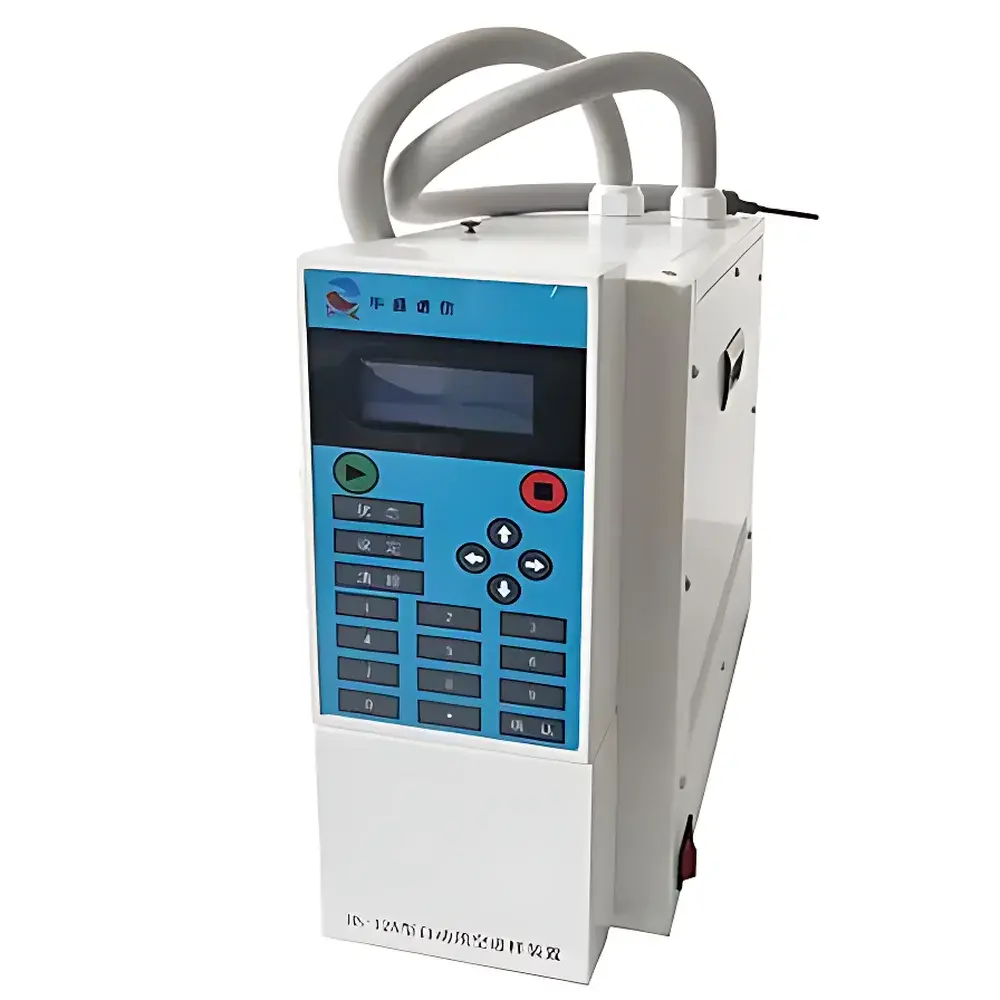
HuaShengPuXin HS-12A Static Headspace Sampler
| Brand | HuaShengPuXin (HSPX) |
|---|---|
| Origin | Beijing, China |
| Manufacturer Type | Direct Manufacturer |
| Instrument Type | Static Headspace Sampler |
| Automation Level | Semi-Automatic |
| Sample Vial Capacity | 12 positions |
| Vial Sizes Supported | 10 mL and 20 mL |
| Oven Temperature Range | Ambient to 220 °C |
| Valve & Loop Temperature Range | Ambient to 180 °C |
| Sample Transfer Line Temperature Range | Ambient to 200 °C |
| Quantitative Loop Volume | 1–2 mL (adjustable) |
| Temperature Control Accuracy | < ±0.5 °C |
| Temperature Uniformity (Gradient) | < ±0.5 °C |
| Dimensions (W×D×H) | 400 × 200 × 380 mm |
| Weight | 15.5 kg |
Overview
The HuaShengPuXin HS-12A Static Headspace Sampler is an engineered solution for automated, pressure-balanced headspace analysis in conjunction with gas chromatography (GC) systems. Designed around the fundamental principle of static headspace equilibrium—where volatile analytes partition between a liquid/solid sample matrix and its overlying vapor phase—the HS-12A enables reproducible extraction of volatile organic compounds (VOCs), residual solvents, flavor compounds, and environmental contaminants without direct liquid injection. Its semi-automatic architecture balances operational flexibility with analytical robustness, making it suitable for QC laboratories, pharmaceutical stability studies, food safety testing, and forensic toxicology workflows where method validation, trace-level detection, and thermal stability are critical.
Key Features
- 12-position heated sample carousel: Precisely accommodates standard 10 mL and 20 mL crimp-top or screw-cap headspace vials; each position features independent thermal coupling to ensure uniform equilibration across all samples.
- Triple-zone independent temperature control: Separate PID-regulated ovens manage the sample vial oven (ambient to 220 °C), valve/loop assembly (ambient to 180 °C), and transfer line (ambient to 200 °C), minimizing condensation and carryover while preserving analyte integrity.
- Pressure-balanced sampling mechanism: Uses precise pneumatic actuation to equalize vial headspace pressure with GC carrier gas before loop filling—eliminating vacuum-induced fractionation and ensuring stoichiometric transfer of the vapor-phase composition.
- Adjustable quantitative loop: Integrated 1–2 mL stainless steel loop allows method-specific volume selection; loop volume is fixed per run but configurable between analyses to optimize sensitivity and dynamic range.
- High-stability thermal performance: Achieves < ±0.5 °C temperature accuracy and uniformity across all zones—critical for compliance with ASTM D7217, ISO 11843, and USP <467> residual solvent methodologies.
- Compact benchtop footprint: Measures only 400 × 200 × 380 mm and weighs 15.5 kg—designed for integration into space-constrained GC labs without sacrificing thermal mass or mechanical rigidity.
Sample Compatibility & Compliance
The HS-12A supports a broad range of solid, liquid, and semi-solid matrices—including aqueous solutions, polymers, pharmaceutical tablets, soil slurries, beverages, and packaged foods—provided they remain thermally stable within the defined heating range. It is compatible with all major GC and GC-MS platforms via standard 1/16″ stainless steel transfer tubing and universal pneumatic interfaces (e.g., Agilent, Thermo Fisher, Shimadzu, PerkinElmer). The instrument’s thermal control architecture and pressure-balanced sampling design align with regulatory expectations for validated methods under GLP and GMP environments. While the HS-12A itself does not embed audit trail or electronic signature capabilities, its repeatable thermal profiles and deterministic sampling sequence support full traceability when paired with compliant GC data systems operating under FDA 21 CFR Part 11 requirements.
Software & Data Management
The HS-12A operates via front-panel keypad and LCD interface, supporting manual method entry and real-time status monitoring (temperature, valve position, cycle progress). It outputs TTL-level trigger signals synchronized with GC start commands and accepts external start pulses from the chromatograph—enabling seamless integration into existing laboratory workflows without proprietary software dependencies. Method parameters (equilibration time, oven/valve temperatures, pressurization duration, loop fill time) are stored in non-volatile memory and recalled per vial position. For laboratories requiring enhanced documentation, optional RS-232 or USB-to-serial adapters enable basic command-line control and event logging via third-party acquisition software—supporting raw data archiving and post-run review consistent with ISO/IEC 17025 documentation practices.
Applications
- Residual solvent analysis in APIs and excipients per ICH Q3C and USP <467>
- Volatile impurity profiling in polymer packaging materials (e.g., ethylene oxide, chloromethane)
- Alcohol and fermentation byproduct quantification in beverages and biofuels
- Environmental VOC screening in water and soil extracts (EPA Method 502.2, 624)
- Flavor and fragrance compound release kinetics in food and cosmetic formulations
- Stability-indicating assays for accelerated degradation studies (ICH Q1A)
FAQ
Is the HS-12A compatible with my existing GC system?
Yes—the HS-12A uses industry-standard pneumatic and electrical interfaces and connects via 1/16″ stainless steel transfer line. Configuration details for specific GC models (e.g., Agilent 7890/8890, Thermo ISQ, Shimadzu GC-2030) are provided in the installation manual.
What maintenance is required for long-term reliability?
Routine maintenance includes periodic cleaning of the sample needle and valve seat, verification of septum integrity on vials, and annual calibration of temperature sensors using NIST-traceable probes. No consumables beyond vial septa and crimp caps are required.
Can the HS-12A perform dynamic headspace or purge-and-trap sampling?
No—it is designed exclusively for static headspace analysis. Dynamic modes require dedicated purge-and-trap concentrators with cryofocusing capability.
Does the instrument support method sequencing across multiple vials with different parameters?
Each run executes a single user-defined method; however, up to 12 discrete methods can be preloaded and assigned manually to individual vial positions prior to batch initiation.
Is remote operation or network connectivity supported?
The base model does not include Ethernet or Wi-Fi. Remote control is achievable via RS-232/USB serial interface using custom scripts or third-party lab automation frameworks (e.g., LabVIEW, Python pySerial), subject to local IT policy and firewall configuration.



