
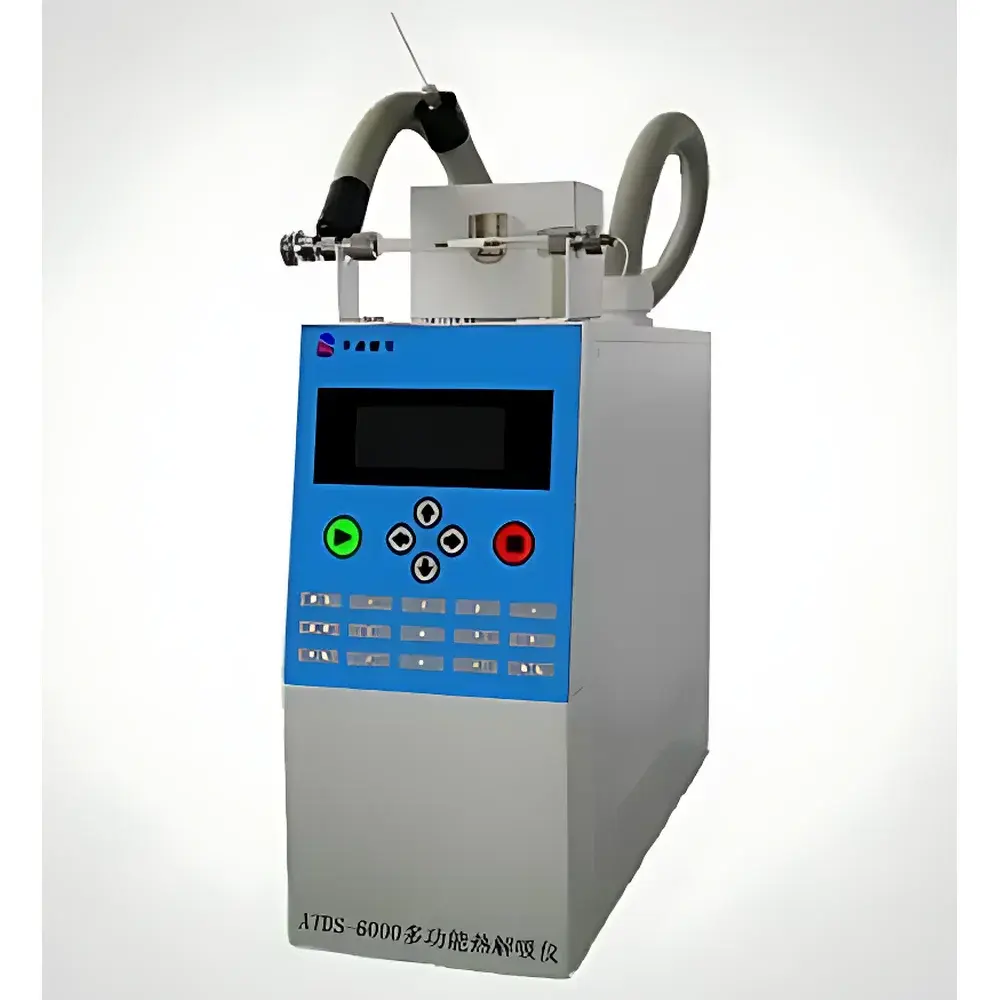
HuaShengPuXin ATDS-6000D Semi-Automatic Thermal Desorber
| Brand | HuaShengPuXin (HSPX) |
|---|---|
| Origin | Beijing, China |
| Manufacturer Type | Direct Manufacturer |
| Instrument Type | Single-Stage Thermal Desorber |
| Automation Level | Semi-Automatic |
| Sample Zone Temperature Range | Ambient to 400 °C |
| Valve Injection System Temperature Range | Ambient to 180 °C |
| Transfer Line Temperature Range | Ambient to 200 °C |
| Temperature Control Accuracy | ±0.1 °C |
| Desorption Recovery Rate | ≥95% |
| Sample Position Capacity | 1 |
| Dimensions | 170 × 390 × 400 mm |
| Weight | ~10 kg |
Overview
The HuaShengPuXin ATDS-6000D Semi-Automatic Thermal Desorber is a precision sample introduction system engineered for quantitative analysis of volatile and semi-volatile organic compounds (VOCs and SVOCs) in solid, liquid, or air-captured matrices. It operates on the principle of controlled thermal desorption—where analytes pre-concentrated on sorbent tubes are thermally released in a narrow, reproducible band and transferred directly into the injection port of a gas chromatograph (GC). Unlike cryogenic cold-trap systems, the ATDS-6000D employs a single-stage desorption architecture optimized for routine compliance testing and targeted forensic or occupational hygiene applications. Its design prioritizes thermal stability, minimal carryover, and compatibility with both domestic and international GC platforms—including Agilent, Thermo Fisher, Shimadzu, and PerkinElmer systems—without requiring hardware modification or proprietary interface modules.
Key Features
- Triple-zone independent temperature control: Sample bed (ambient–400 °C), valve manifold (ambient–180 °C), and transfer line (ambient–200 °C), each adjustable in 1 °C increments for method optimization.
- High-fidelity thermal regulation: Achieves ±0.1 °C accuracy and <±0.1 °C gradient uniformity across all heated zones—critical for preserving analyte integrity and ensuring retention time reproducibility.
- Low-voltage heating for transfer line: Operates at safe extra-low voltage (ELV) to meet IEC 61000-4-5 surge immunity requirements and reduce risk of electrical arcing in inert carrier gas environments.
- Robust stainless-steel fluidic path: Minimizes adsorption losses and prevents catalytic degradation of sensitive compounds such as aldehydes, terpenes, and halogenated VOCs.
- Single-tube configuration with manual tube loading: Designed for laboratories performing standardized, high-priority analyses where throughput is secondary to method traceability and operator control.
- Compact benchtop footprint (170 × 390 × 400 mm) and lightweight construction (~10 kg): Enables flexible integration into regulated QC labs, mobile monitoring units, or field-deployable analytical setups.
Sample Compatibility & Compliance
The ATDS-6000D supports standard 6 mm OD × 89 mm length stainless-steel or quartz sorbent tubes packed with common media including Tenax TA, Carbopack B/C, Carboxen 1000, and mixed-bed configurations. It meets essential performance criteria outlined in ISO 16017-1:2000 (Indoor, ambient and workplace air — Sampling and analysis of volatile organic compounds), ASTM D6196-22 (Standard Practice for Selecting Air Monitoring Methods for Formaldehyde and Other Volatile Organic Compounds), and GB 50325–2020 (Code for Indoor Environmental Pollution Control of Civil Building Engineering). While not fully automated, its semi-automatic operation allows full documentation of desorption parameters—temperature ramps, hold times, flow rates—supporting GLP-compliant audit trails when paired with LIMS-integrated GC data systems.
Software & Data Management
The ATDS-6000D operates via front-panel keypad navigation with real-time LED display of setpoints and actual temperatures. No embedded software or PC dependency is required; however, all thermal profiles are manually loggable for SOP adherence. When integrated with GC systems featuring vendor-native acquisition software (e.g., OpenLab CDS, Chromeleon, GCMSsolution), method parameters—including desorption start time, trap bake-out duration, and splitless transfer timing—can be synchronized via TTL trigger signals. The unit complies with basic electronic record requirements under FDA 21 CFR Part 11 when used in conjunction with validated chromatography data systems that enforce user authentication, electronic signatures, and audit trail generation.
Applications
- Indoor air quality assessment per GB 50325–2020: Quantification of benzene, toluene, ethylbenzene, xylenes (BTEX), and total volatile organic compounds (TVOC).
- Occupational exposure monitoring: Analysis of workplace air samples for OSHA- or NIOSH-listed VOCs (e.g., methylene chloride, styrene, acetone).
- Forensic toxicology: Detection of volatile drug metabolites (e.g., ethanol, chloroform, isopropanol) in breath or headspace extracts.
- Pharmaceutical residual solvent testing: Compliant with ICH Q3C guidelines for Class 2 and 3 solvents in active pharmaceutical ingredients (APIs).
- Packaging migration studies: Evaluation of VOC leachables from polymer films, adhesives, and laminates under simulated storage conditions.
- Chemical threat screening: Rapid identification of organophosphorus agents, sulfur mustard markers, or nitroaromatic explosives precursors in perimeter air sampling.
FAQ
Is the ATDS-6000D compatible with split/splitless GC injectors?
Yes—it delivers a narrow, focused analyte band suitable for both splitless and pulsed splitless injection modes. Optimal transfer is achieved using helium or nitrogen at 30–60 mL/min carrier gas flow.
Does it support cold trapping or focusing?
No—the ATDS-6000D is a single-stage thermal desorber without cryogenic cooling capability. For applications requiring enhanced sensitivity below 10 pg or multi-analyte resolution, a two-stage desorber with cryofocusing is recommended.
Can it be used with thermal desorption tubes from other manufacturers?
Yes—provided tubes conform to standard dimensions (6 mm OD × 89 mm) and use chemically inert frits and packing materials compatible with 400 °C maximum temperature.
What maintenance is required for long-term reliability?
Routine inspection of O-rings in the valve manifold, periodic cleaning of the transfer line with methanol or acetone, and annual verification of temperature calibration using NIST-traceable thermocouple standards.
Is method validation support available?
HuaShengPuXin provides application notes aligned with GB 50325–2020 and ASTM D6196, including recovery studies, LOD/LOQ determination protocols, and carryover assessment procedures. Full IQ/OQ documentation packages are available upon request for regulated environments.






