
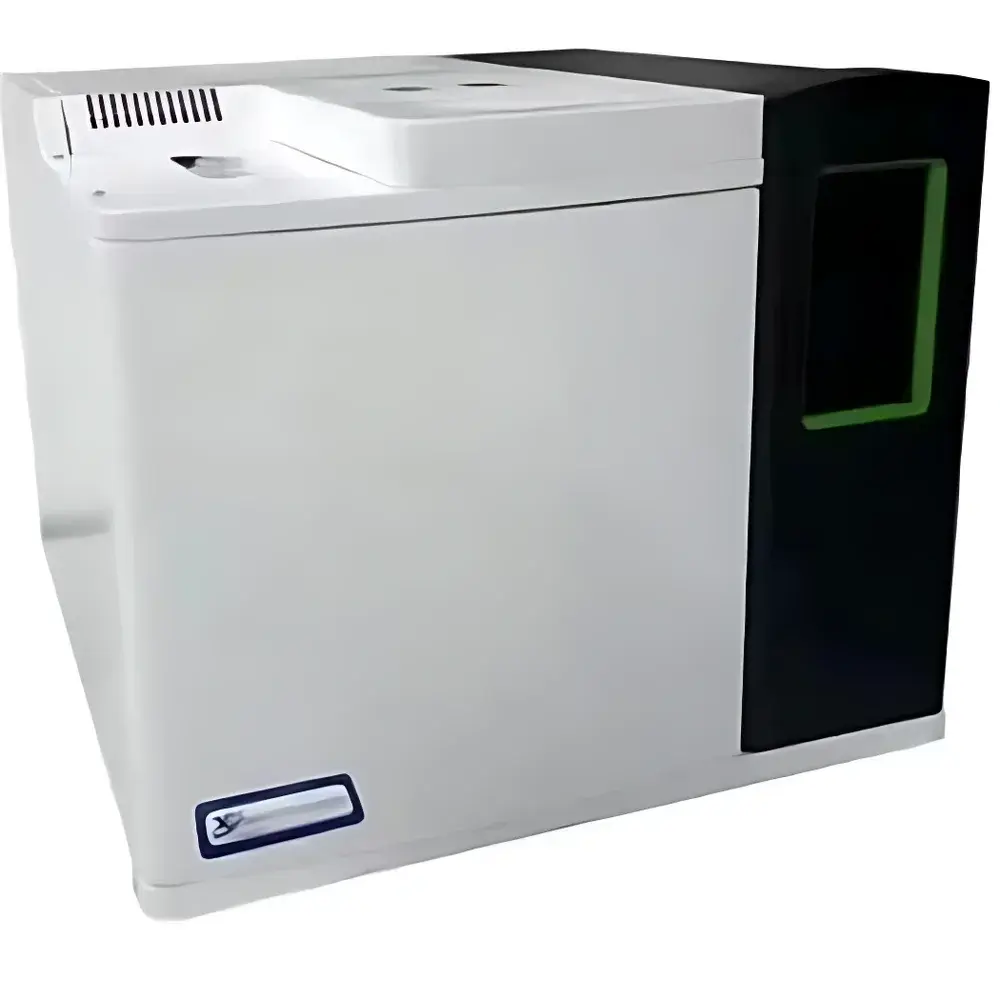
HSPX Solvent Residue Analysis Dedicated Gas Chromatograph (Model HSPX-GC-6S)
| Brand | HSPX |
|---|---|
| Origin | Beijing, China |
| Manufacturer Type | Direct Manufacturer |
| Instrument Type | Laboratory Gas Chromatograph |
| Application Scope | Solvent Residue Analysis in Edible Oils, Food Additives, and Pesticide Residues |
| Oven Temperature Range | Ambient to 400 °C |
| Oven Ramp Rate | 0.1–40 °C/min |
| Oven Cool-down Time | ~6 min (400 °C → 50 °C) |
| Carrier Gas Flow Control Range | 0–1200 mL/min |
| Carrier Gas Pressure Control Range | 0–0.6 MPa |
| Injector Maximum Operating Temperature | 400 °C |
| Injector Pressure Setting Range | 0–0.6 MPa |
| Injector Total Flow Setting Range | 0–1200 mL/min |
| Detector | Flame Ionization Detector (FID) |
| Column Compatibility | Capillary columns for volatile organic solvent separation (e.g., DB-VRX, HP-PONA, or equivalent polar/non-polar GC columns) |
| Data System | Integrated GC workstation with peak integration, calibration curve generation, and audit-trail-capable reporting |
Overview
The HSPX Solvent Residue Analysis Dedicated Gas Chromatograph (Model HSPX-GC-6S) is a purpose-engineered laboratory gas chromatograph designed specifically for the quantitative determination of residual hydrocarbon solvents—particularly No. 6 solvent oil (hexane/heptane-based extraction solvent)—in edible oils, food matrices, and agricultural products. It operates on the principle of capillary gas chromatography coupled with flame ionization detection (GC-FID), enabling high-resolution separation and sensitive quantification of volatile aliphatic and aromatic compounds—including n-hexane, n-heptane, benzene, toluene, and other low-boiling hydrocarbons—at trace levels (ppm to sub-ppm). The instrument complies with key national and industry standards governing solvent residue limits in food-grade oils, including GB 16629–2026 (formerly GB/T 5009.37), which specifies maximum allowable residues of hexane and related solvents in solvent-extracted vegetable oils. Its thermal architecture supports rapid, reproducible temperature programming essential for resolving complex solvent mixtures with narrow boiling point distributions.
Key Features
- Programmable oven with precise temperature control from ambient to 400 °C and ramp rates adjustable between 0.1 and 40 °C/min—optimized for sharp elution of C5–C10 hydrocarbons.
- Rapid cool-down capability (400 °C to 50 °C in approximately 6 minutes), minimizing cycle time between consecutive analyses without compromising column integrity.
- Dual independent pressure and flow control for carrier gas (N₂, H₂, or He), supporting both constant-pressure and constant-flow modes across a wide operational range (0–0.6 MPa; 0–1200 mL/min).
- High-temperature split/splitless injector (up to 400 °C), compatible with liquid and headspace sampling configurations for direct injection or automated thermal desorption of oil extracts.
- Optimized FID detector with linear dynamic range exceeding 10⁷, low noise (<0.5 pA), and stable baseline performance—critical for accurate integration of low-abundance solvent peaks amid high-fat matrix interferences.
- Robust mechanical design with vibration-dampened optical path and sealed detector chamber, ensuring long-term signal stability under routine QC laboratory conditions.
Sample Compatibility & Compliance
The HSPX-GC-6S is validated for analysis of solvent residues in refined soybean oil, rapeseed oil, peanut oil, and other lipid-rich foodstuffs following standardized extraction protocols (e.g., GB 5009.262–2016 for residual solvents in foods). It supports sample introduction via manual syringe injection, autosampler integration (optional), or headspace vial analysis—enabling method flexibility across regulatory testing labs, quality control departments in edible oil refineries, and third-party food safety laboratories. The system meets fundamental requirements of ISO/IEC 17025:2017 for analytical competence and supports compliance with Chinese national standards GB 16629–2026 and GB 5009.262–2016. When configured with secure user authentication, electronic signatures, and audit trail-enabled software, it satisfies documentation requirements aligned with GLP principles and FDA 21 CFR Part 11 for regulated environments.
Software & Data Management
The integrated chromatography data system provides full method development, sequence control, real-time monitoring, and post-run processing capabilities. It supports multi-point external standard calibration, internal standard correction (e.g., using cyclohexane or dichloromethane as surrogate), and automatic calculation of solvent residue concentrations based on peak area ratios. All raw data files are stored in vendor-neutral formats (e.g., .cdf or .axd), and metadata—including instrument parameters, operator ID, date/time stamps, and version-controlled method files—is embedded and retained for traceability. Audit trail functionality logs all critical events (method edits, result overrides, report exports) with immutable timestamps and user attribution—facilitating internal audits and regulatory inspections.
Applications
- Quantitative determination of residual No. 6 solvent (n-hexane, n-heptane, benzene, toluene) in solvent-extracted edible oils per GB 16629–2026.
- Residual solvent profiling in food additives, flavorings, and nutraceutical extracts where hydrocarbon-based extraction is employed.
- Verification of cleaning validation in pharmaceutical manufacturing equipment after use of volatile organic solvents.
- Environmental monitoring of hydrocarbon contamination in soil and water samples using EPA Method 8015M-compliant workflows.
- Quality assurance testing in edible oil refineries, national food inspection agencies, and accredited food safety laboratories.
FAQ
What types of solvents can this instrument quantify?
It is optimized for aliphatic hydrocarbons (C5–C10), including n-hexane, n-heptane, and methylcyclohexane, as well as aromatic impurities such as benzene and toluene—common contaminants in No. 6 solvent oil.
Is the system compliant with Chinese national food safety standards?
Yes—the method configuration and performance specifications align with GB 16629–2026 and GB 5009.262–2016 for solvent residue testing in edible oils and food products.
Can the instrument be upgraded for headspace analysis?
Yes—compatible with standard headspace autosamplers (e.g., Agilent 7697A or equivalent) for automated, matrix-free vapor-phase injection of oil samples.
What detector options are available beyond FID?
While FID is standard for hydrocarbon detection, optional TCD or PID configurations may be implemented for specific applications requiring universal or selective response profiles.
Does the software support 21 CFR Part 11 compliance?
When deployed with role-based access control, electronic signature modules, and enabled audit trail logging, the workstation meets core technical requirements for Part 11 compliance in regulated laboratories.
Related Products





