
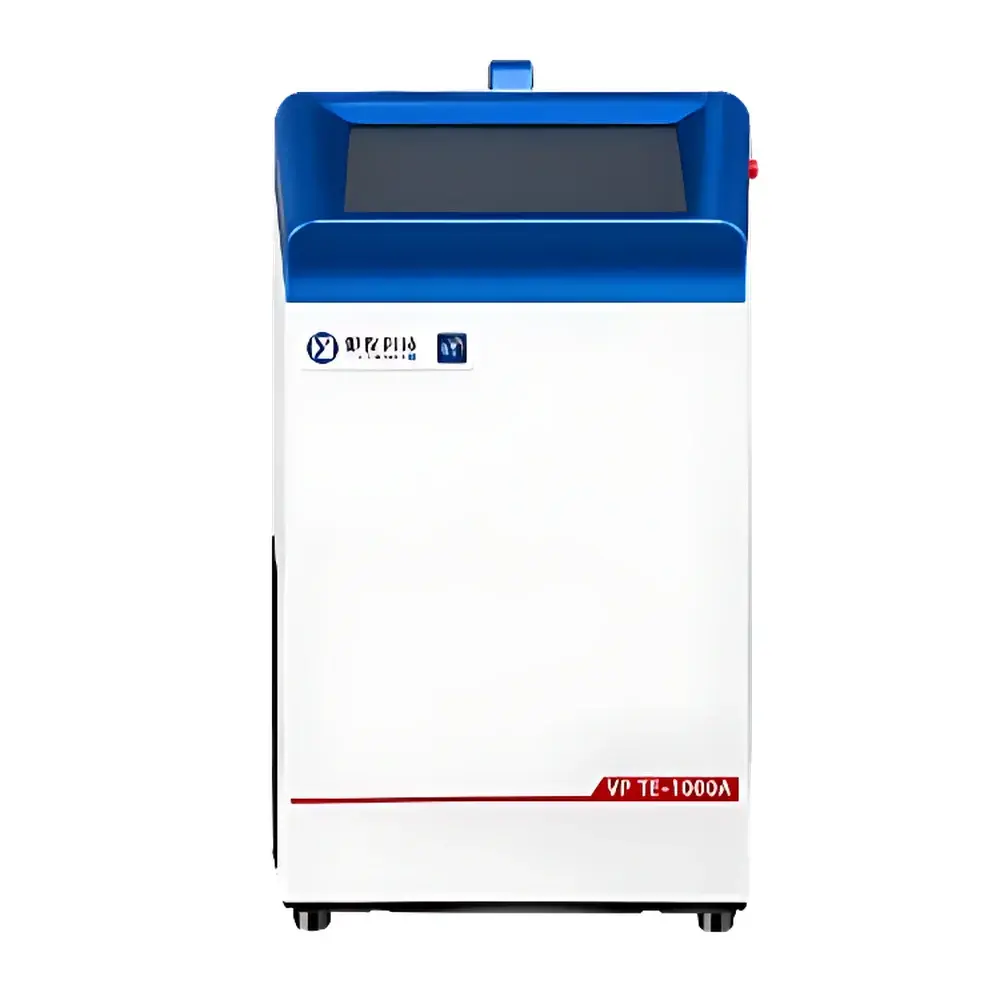
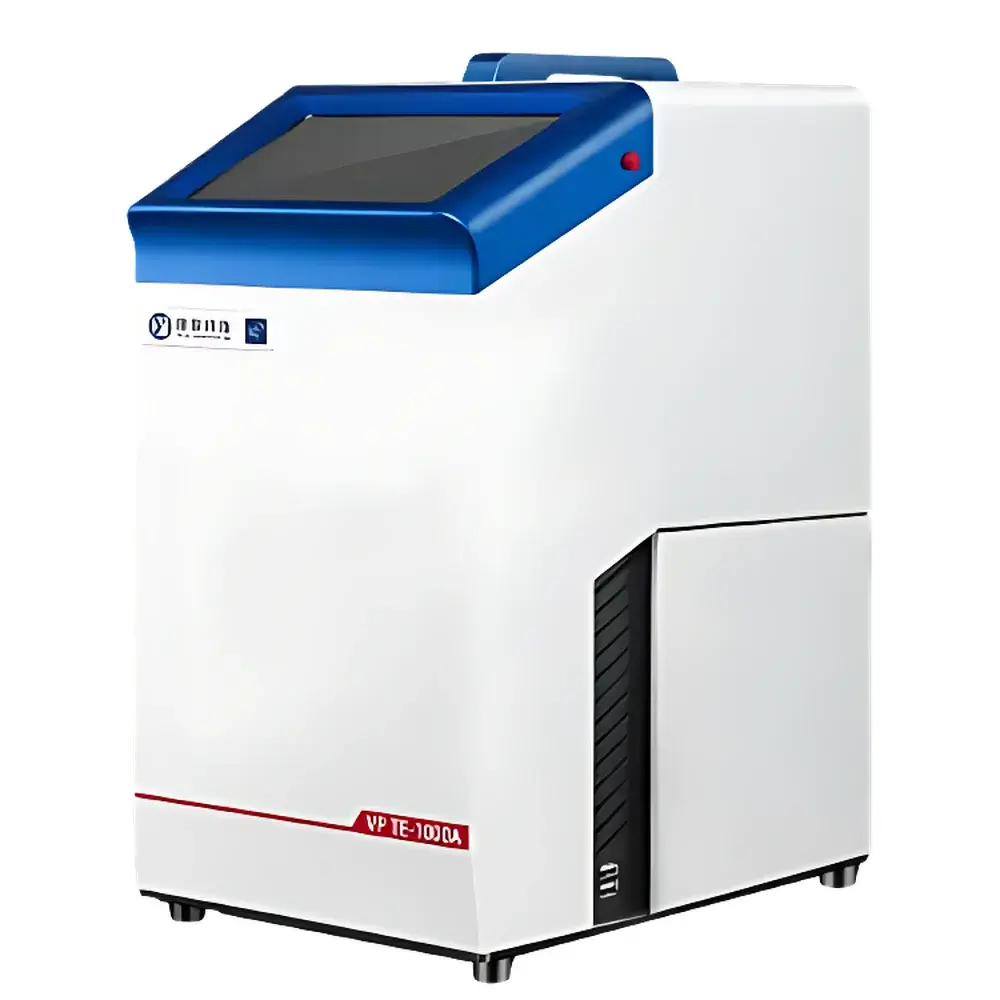
Young Instruments VP TE-1000A Automated Micro Vapor Pressure Analyzer
| Brand | Young Instruments |
|---|---|
| Origin | Zhejiang, China |
| Manufacturer Type | Direct Manufacturer |
| Country of Origin | China |
| Model | VP TE-1000A |
| Pricing | Upon Request |
| Analytical Method | Three-Stage Expansion Method |
| Pressure Range | 0–1000 kPa |
| Temperature Range | 0–120 °C |
| Temperature Stability | ±0.1 °C |
| Pressure Resolution | 0.01 kPa |
| Repeatability | ≤0.3 kPa (@37.8 °C, 70 kPa) |
| Reproducibility | ≤0.7 kPa (@37.8 °C, 70 kPa) |
| Sample Volume | 1 mL (10 mL including wash cycle) |
| Vapor–Liquid Ratio | 0.02:1 to 4:1 |
| Dimensions | 225 × 290 × 390 mm |
| Weight | 12 kg |
| Power Supply | AC 220 V / 50 Hz |
| Power Consumption | 150 W |
| Environmental Operating Conditions | 5–40 °C, <85% RH |
Overview
The Young Instruments VP TE-1000A is an automated micro vapor pressure analyzer engineered for precise, rapid, and operator-independent determination of Reid Vapor Pressure (RVP) and True Vapor Pressure (TVP) of volatile petroleum liquids—including gasoline, reformulated fuels, naphthas, condensates, and light distillates. It operates on the internationally recognized three-stage expansion principle, in strict accordance with thermodynamic equilibrium protocols defined in ASTM D5191 (RVP by Mini-METHOD), ASTM D6377 (TVP at 37.8 °C), and ASTM D6378 (TVP over extended temperature ranges). Unlike traditional piston-type or static methods, the VP TE-1000A implements controlled, sequential expansion of a fixed-volume sample into calibrated expansion chambers—enabling accurate vapor-phase pressure equilibration without phase separation artifacts or manual venting. Its compact benchtop architecture integrates Peltier-based thermal control, high-stability pressure transduction, and sealed gas-handling pathways to ensure metrological integrity across the full 0–1000 kPa pressure range and 0–120 °C temperature span.
Key Features
- Three-stage expansion methodology compliant with ASTM D5191, D6377, D6378, EN 13016-1 & -2, IP 394/409/481, SN/T 2932, and Chinese standards SH/T 0769–2005 and SH/T 0794–2007
- Minimal sample requirement: only 1 mL of test liquid per analysis; total fluid consumption including automated cleaning is ≤10 mL
- Full automation from loading to reporting—no manual valving, venting, or timing interventions required
- Integrated thermal regulation with ±0.1 °C stability across the 0–120 °C operating range, enabling multi-point TVP profiling
- High-resolution pressure sensing (0.01 kPa resolution) and verified repeatability (≤0.3 kPa at 37.8 °C / 70 kPa) and reproducibility (≤0.7 kPa under same conditions)
- Dedicated solvent-assisted cleaning protocol between runs to eliminate carryover and cross-contamination
- Maintenance-free measurement chamber designed for >10,000 consecutive cycles under routine QC laboratory conditions
- 7-inch color TFT capacitive touchscreen with real-time graphical display of pressure transient curves, temperature ramp status, and system diagnostics
- User-level access control supporting administrator, operator, and viewer roles with password authentication and audit-trail logging
- Dual USB ports (for flash storage and peripheral connectivity), RS-232 serial interface, and Ethernet (RJ45) for LIMS integration and remote monitoring
Sample Compatibility & Compliance
The VP TE-1000A accommodates a broad spectrum of low-viscosity, volatile hydrocarbon mixtures—ranging from ethanol-blended motor fuels and aviation turbine fuels to crude assay fractions and liquefied petroleum gas (LPG) condensates. Its adjustable vapor–liquid ratio (0.02:1 to 4:1) allows method optimization for both highly volatile (e.g., butane-rich streams) and moderately volatile (e.g., diesel-range cuts) samples. All operational sequences are traceable to ISO/IEC 17025:2017 requirements for testing laboratories, and data integrity conforms to FDA 21 CFR Part 11 principles when paired with validated software configurations. The instrument supports GLP-compliant workflows through electronic signature support, time-stamped event logs, and immutable result archiving.
Software & Data Management
Built-in firmware provides embedded method storage, customizable test templates, and automatic generation of ASTM-aligned reports—including RVP, TVP, vapor–liquid ratio, and temperature-corrected pressure values. Raw pressure vs. time datasets are exportable in CSV format via USB or network transfer. Optional PC-based software enables advanced curve fitting, statistical process control (SPC) charting, calibration certificate management, and batch report compilation. Audit trails record all user actions, parameter modifications, and calibration events with tamper-proof timestamps—fully supporting regulatory inspections under EPA, API, and CNPC quality assurance frameworks.
Applications
- Quality control of gasoline blending components and finished fuels in refinery laboratories
- Regulatory compliance testing for EPA Tier 3, EU Fuel Quality Directive (FQD), and China VI fuel specifications
- R&D studies on volatility impact of oxygenates (MTBE, ethanol), bio-components, and synthetic hydrocarbons
- Field-deployable verification of vapor pressure during custody transfer and terminal operations
- Teaching and method validation in university petroleum engineering and analytical chemistry programs
FAQ
What vapor pressure standards does the VP TE-1000A support?
It fully implements ASTM D5191 (Mini-RVP), D6377 (TVP at 37.8 °C), and D6378 (broad-temperature TVP), along with EN 13016-1/-2, IP 394/409/481, and SH/T 0769–2005.
Can the instrument perform multi-temperature TVP measurements automatically?
Yes—users can define up to 12 temperature setpoints within 0–120 °C; the system executes sequential equilibration and records corresponding vapor pressures without manual intervention.
Is external calibration required for pressure or temperature sensors?
The unit ships with NIST-traceable factory calibration certificates; field recalibration is optional and supported via built-in adjustment routines using certified reference standards.
How is sample carryover prevented between analyses?
An integrated purge-and-rinse sequence uses inert carrier gas and programmable solvent flushes, validated to reduce residual contamination to <0.05% v/v across consecutive high-volatility samples.
Does the VP TE-1000A meet cybersecurity requirements for network-connected lab instruments?
Yes—it supports TLS 1.2 encrypted communication, role-based firewall rules, and configurable session timeouts in line with IEC 62443-3-3 guidelines for industrial control systems.




