
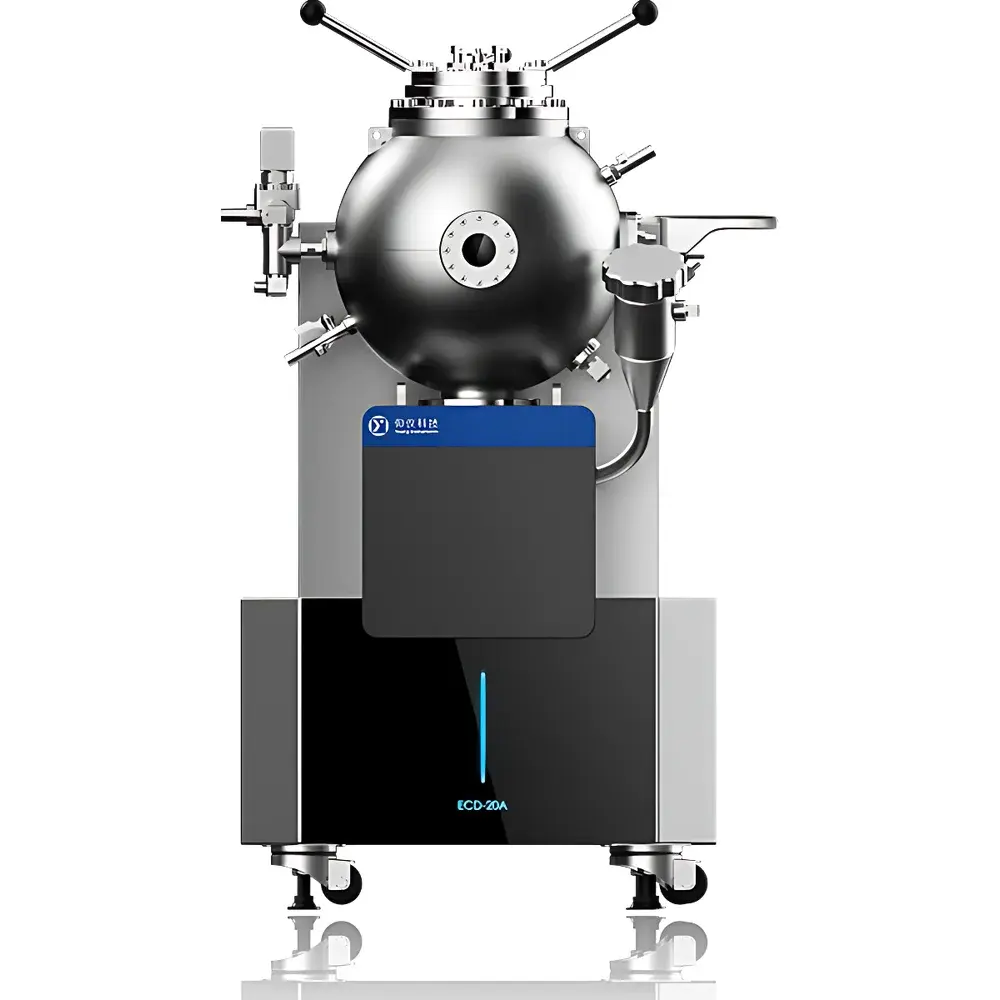
Young Instruments ECD-20A 20-Liter Spherical Dust Explosion Test Apparatus
| Brand | Young Instruments |
|---|---|
| Origin | Zhejiang, China |
| Manufacturer Type | Direct Manufacturer |
| Country of Origin | China |
| Model | ECD-20A |
| Operating Principle | Pneumatic Dust Dispersion + Controlled Ignition (Chemical or Electrostatic) |
| Explosion Protection Rating | Ex d IIB T4 Gb |
| Relative Uncertainty | ±8.8% (per ISO/IEC 17025-compliant validation protocol) |
Overview
The Young Instruments ECD-20A is a fully integrated 20-liter spherical dust explosion test apparatus engineered for precise determination of fundamental explosion parameters under standardized and customized test conditions. It operates on the principle of controlled pneumatic dispersion followed by reproducible ignition—either via calibrated chemical igniters (2 kJ or 10 kJ energy output) or electrostatic spark ignition (10 J)—within a certified pressure-rated spherical vessel. The system captures high-fidelity time–pressure transients during deflagration using piezoresistive pressure transducers sampling at ≥100 kHz, enabling accurate derivation of key safety-critical metrics: maximum explosion pressure (Pmax), maximum rate of pressure rise ((dp/dt)max), and the derived Kst value (bar·m/s). These parameters are essential inputs for quantitative explosion risk assessment, vent sizing calculations per NFPA 68 and EN 14491, suppression system design per NFPA 69, and process hazard analysis (PHA) in accordance with OSHA 1910.119 and ATEX Directive 2014/34/EU.
Key Features
- Multi-phase compatibility: Validated for testing combustible dusts, flammable gases, and hybrid mixtures (solid–gas suspensions) within a single platform
- Standards-compliant operation: Preloaded test protocols aligned with ASTM E1226, ISO/IEC 61241-2-1, EN 14034-1 to -4, and VDI 2263 Part 1
- Dual ignition modalities: Selectable chemical ignition (adjustable energy levels) or electrostatic spark ignition with programmable timing synchronization
- Automated mechanical handling: Motorized lid actuation system eliminates manual lifting; interlocked safety circuit prevents operation when lid is not fully sealed
- Thermostatically controlled vessel: Integrated water-jacketed sphere (1.5 L jacket volume) enables active temperature regulation from 20 °C to 60 °C ±0.5 °C
- Intelligent gas management: Vacuum evacuation and inert/oxidant gas blending performed automatically; target dust concentration calculated and achieved via mass-based dispersion control
- High-efficiency dispersion: Patented nozzle geometry and timed pulse delivery ensure uniform cloud formation with <0.5% residual mass in the powder reservoir
- Real-time visualization: On-screen synchronized display of pressure–time curve, ambient temperature/humidity, and ignition event markers
- Remote operation capability: Full functional control via Ethernet-connected PC interface; all hazardous phases executed without operator presence in test zone
- Comprehensive data export: Raw pressure/time files (CSV), annotated curves (PNG/SVG), and summary reports compliant with GLP documentation requirements
Sample Compatibility & Compliance
The ECD-20A accommodates a broad spectrum of organic and inorganic particulates—including metal powders (Al, Zn), polymer granules, pharmaceutical intermediates, food-grade starches (wheat flour, sugar), biomass derivatives (wood dust, tea leaf fines), and coal-derived particulates—provided particle size distribution falls within the D90 ≤ 75 µm range recommended by ISO/IEC 80079-20-2. All structural components meet ASME BPVC Section VIII Div. 1 requirements for pressure containment up to 3.0 MPa. The apparatus carries CE marking under the ATEX and PED directives and conforms to IEC 60079-0 and IEC 60079-1 for flameproof enclosure integrity. Electrical interfaces comply with IEC 61000-4 immunity standards. Calibration traceability follows ISO/IEC 17025 through accredited third-party laboratories.
Software & Data Management
Control and analysis are managed via Young Instruments’ proprietary EXPLOSION LAB v4.2 software suite, running on Windows 10/11 (64-bit). The application supports role-based user access, full audit trail logging (per FDA 21 CFR Part 11 requirements), and automated report generation in PDF/A-1b format. Pressure signal processing includes digital filtering (Butterworth low-pass), baseline correction, and derivative computation with configurable smoothing windows. Curve interpretation algorithms apply ISO/IEC 61241-2-1 Annex B criteria for (dp/dt)max identification and uncertainty propagation per GUM (JCGM 100:2008). Export formats include ASCII, MATLAB .mat, and direct integration with LabArchives ELN.
Applications
- Hazard classification of raw materials and intermediates in chemical, pharmaceutical, and food manufacturing
- Design verification of explosion relief panels, rupture discs, and flameless venting systems
- Validation of inerting strategies (N2, CO2, argon) and determination of Limiting Oxygen Concentration (LOC)
- Supporting Process Safety Information (PSI) packages for PHA, HAZOP, and LOPA studies
- Research into dust cloud ignition sensitivity, particle morphology effects, and moisture influence on explosibility
- Regulatory submission documentation for REACH, CLP, and OSHA Process Safety Management compliance
FAQ
What standards does the ECD-20A support out-of-the-box?
ASTM E1226, ISO/IEC 61241-2-1, EN 14034-1 to -4, VDI 2263 Part 1, and GB/T 16425–16432 (Chinese national standards). Custom protocol scripting is available upon request.
Is the system suitable for testing nano-sized powders?
Yes—provided agglomeration is minimized during dispersion and the test chamber is purged with inert gas prior to each run to prevent premature oxidation or static discharge artifacts.
How is measurement uncertainty quantified?
Relative uncertainty of ±8.8% is validated per ISO/IEC 17025 for Pmax and (dp/dt)max under reference conditions (20 °C, 50% RH, 1 kg/m³ cornstarch); full uncertainty budget documentation is supplied with each instrument.
Can the apparatus be integrated into an existing laboratory automation network?
Yes—RS232 and Ethernet interfaces support Modbus TCP and OPC UA protocols for bidirectional communication with SCADA and MES platforms.
What maintenance intervals are recommended?
Pressure transducer recalibration annually; ignition system verification before each test series; full preventive maintenance (seal inspection, vacuum pump oil change, water jacket descaling) every 6 months or 200 tests—whichever occurs first.







