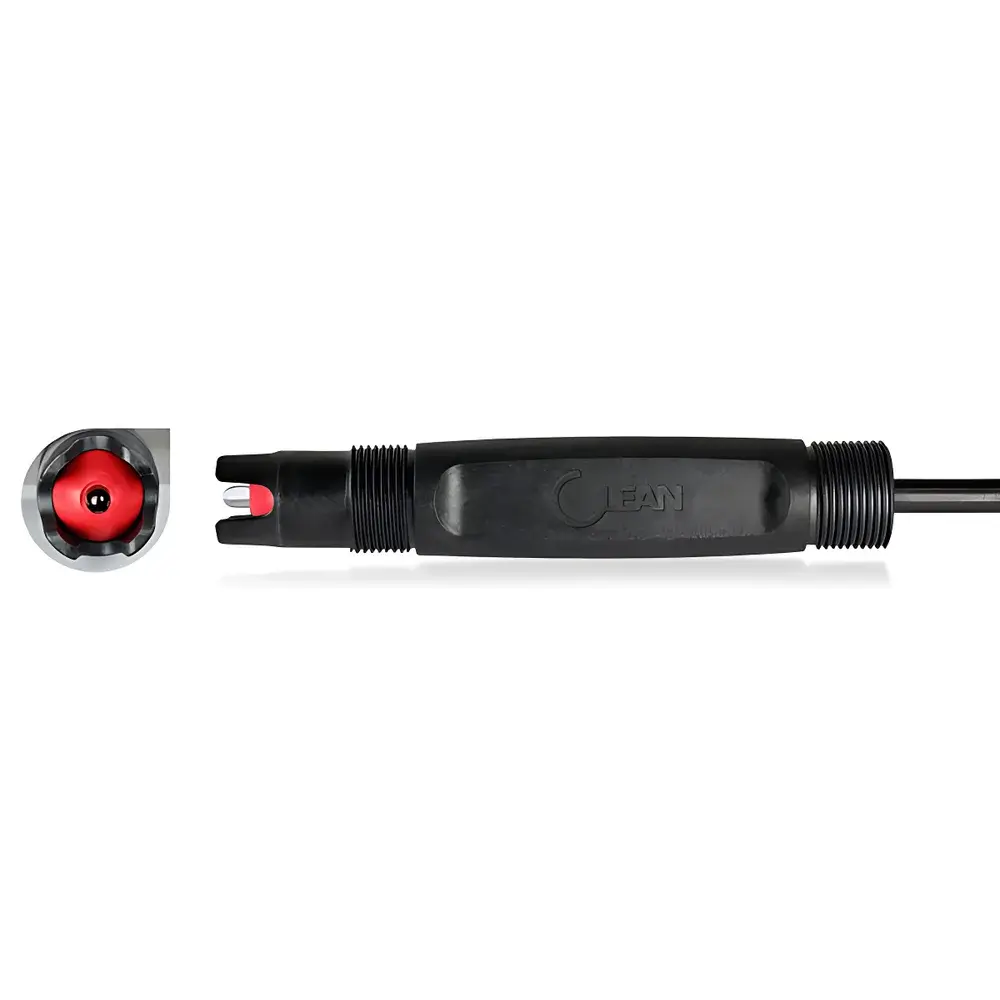
CLEAN CS1768 SNEX Solid-Junction Heavy-Duty Online pH Electrode for High-Fouling, Viscous, and Particulate-Laden Industrial Processes
| Brand | CLEAN |
|---|---|
| Origin | Taiwan |
| Model | CS1768 |
| pH Range | 0–14 |
| Temp. Range | 0–90 °C |
| Max. Pressure | 20 bar (@50 °C) |
| Junction Type | SNEX Solid-State Ag/AgCl/KCl |
| Housing Material | PPS or PA+GF |
| Temperature Sensor | Pt1000 (standard), Pt100 / NTC10K (optional) |
| Thread | NPT 3/4" or PG13.5 |
| Cable | 5 m coaxial with BNC connector |
| Sensitive Bulb Type | B11 |
| Output Compatibility | Designed for CLEAN PH3000 transmitter |
Overview
The CLEAN CS1768 is an industrial-grade, solid-junction composite pH electrode engineered specifically for continuous online measurement in extreme process environments where conventional gel- or ceramic-junction electrodes fail. It operates on the potentiometric principle, measuring the hydrogen ion activity across a pH-sensitive glass membrane relative to a stable, low-resistance reference system. Unlike traditional liquid-junction electrodes—whose porous frits or sleeve junctions rapidly clog in slurries, viscous emulsions, or high-solids streams—the CS1768 integrates the patented U.S.-developed SNEX solid-state junction. This junction eliminates electrolyte leakage while enabling consistent, high-rate electrolyte diffusion through a micro-porous polymer matrix saturated with KCl and Ag/AgCl. The result is sustained electrochemical stability, minimal junction potential drift, and reliable signal integrity—even under dynamic pressure (up to 20 bar at 50 °C), aggressive chemical exposure (e.g., concentrated NaOH/KOH, cyanide, chromates, sulfides), or mechanical abrasion from suspended solids.
Key Features
- SNEX solid-state reference junction: Non-clogging, maintenance-free architecture delivering stable liquid junction potential and eliminating salt bridge blockage in pulp, paint, sugar, dairy, and petrochemical applications.
- Dual-material housing options: Chemically inert polyphenylsulfone (PPS) for broad solvent resistance, or glass-filled polyamide (PA+GF) for enhanced mechanical robustness in high-vibration or thermal-cycling installations.
- B11 high-durability pH-sensitive glass bulb: Optimized for rapid response and long-term stability in alkaline, silicate-rich, or protein-laden matrices—resisting sodium error and surface fouling.
- Integrated Pt1000 temperature sensor (IEC 60751 Class A): Enables precise, real-time automatic temperature compensation (ATC) without external probes; optional Pt100 or NTC10K configurations available for legacy system compatibility.
- Standardized mechanical interface: NPT 3/4″ female thread (PPS version) or PG13.5 (PA+GF version) ensures secure, leak-tight mounting in pressurized pipelines or reactor vessels.
- 5-meter shielded coaxial cable with BNC termination: Provides noise-immune signal transmission to CLEAN PH3000 or other compatible 2-wire/4–20 mA transmitters meeting IEC 61326-1 EMC requirements.
Sample Compatibility & Compliance
The CS1768 demonstrates proven performance across chemically heterogeneous and physically demanding media—including paper pulp suspensions, sugar beet juice, latex emulsions, cosmetic creams, drilling muds, seawater, brines, LNG condensates, and caustic scrubber solutions. Its SNEX junction resists poisoning by sulfides, proteins, heavy metals, and colloidal silica—common failure modes in wastewater treatment, biorefineries, and pharmaceutical manufacturing. The electrode meets IP68 submersion rating when installed with appropriate gland fittings and complies with CE marking directives (2014/30/EU EMC, 2014/35/EU LVD). When paired with CLEAN PH3000 transmitters configured for audit-trail logging and user-access control, the system supports alignment with FDA 21 CFR Part 11 (electronic records/signatures) and GLP/GMP data integrity expectations.
Software & Data Management
While the CS1768 itself is an analog sensing element, its integration into CLEAN’s PH3000 transmitter platform enables comprehensive digital functionality: dual-point pH calibration with configurable buffer sets (US, EU, CN, JP standards), ORP offset correction, configurable 4–20 mA output scaling (pH, mV, or temperature), relay-based cleaning cycle triggers, and diagnostic alerts for high impedance, open circuit, or temperature sensor fault. Transmitter firmware supports Modbus RTU over RS-485 for SCADA integration and stores ≥1000 timestamped calibration and measurement events with full traceability—meeting ISO/IEC 17025 documentation requirements for accredited laboratories.
Applications
- Pulp & paper: Continuous pH monitoring in brownstock washers, bleach plant stages, and effluent streams containing lignin and fiber debris.
- Food & beverage: In-line acidity control during syrup concentration, dairy fermentation, and sauce homogenization where viscosity and particulates challenge conventional electrodes.
- Chemical processing: Caustic soda (NaOH) and potassium hydroxide (KOH) concentration control; cyanide destruction in metallurgical leach circuits.
- Oil & gas: Downstream desalting unit monitoring, produced water pH stabilization, and LNG dehydration system feedback control.
- Pharmaceutical & biotech: Cell culture broth pH tracking in stirred-tank reactors exposed to protein fouling and sterilization cycles.
FAQ
What makes the SNEX junction resistant to clogging?
The SNEX junction uses a rigid, microporous polymer matrix impregnated with solid-phase KCl and Ag/AgCl—eliminating free electrolyte flow paths that trap particles. Diffusion occurs via controlled ion exchange, not bulk fluid movement.
Can the CS1768 be used in high-temperature sterilization cycles?
It is rated for continuous operation up to 90 °C; intermittent exposure to 121 °C saturated steam is permissible for ≤30 minutes—but repeated autoclaving may accelerate glass membrane aging.
Is calibration required more frequently than with standard electrodes?
No—due to stable junction potential and reduced drift, typical recalibration intervals extend to 7–14 days in stable processes, versus 1–3 days for conventional electrodes in comparable conditions.
Does it support two-point calibration with non-standard buffers?
Yes—the CLEAN PH3000 transmitter supports CU.CAL mode, allowing user-defined calibration points using any two certified buffer solutions within the 0–14 pH range.
How is electrode health monitored during operation?
The PH3000 continuously calculates and logs asymmetry potential and slope deviation; values exceeding ±30 mV asymmetry or <85% theoretical slope trigger maintenance alerts via relay or HMI interface.
Related Products