
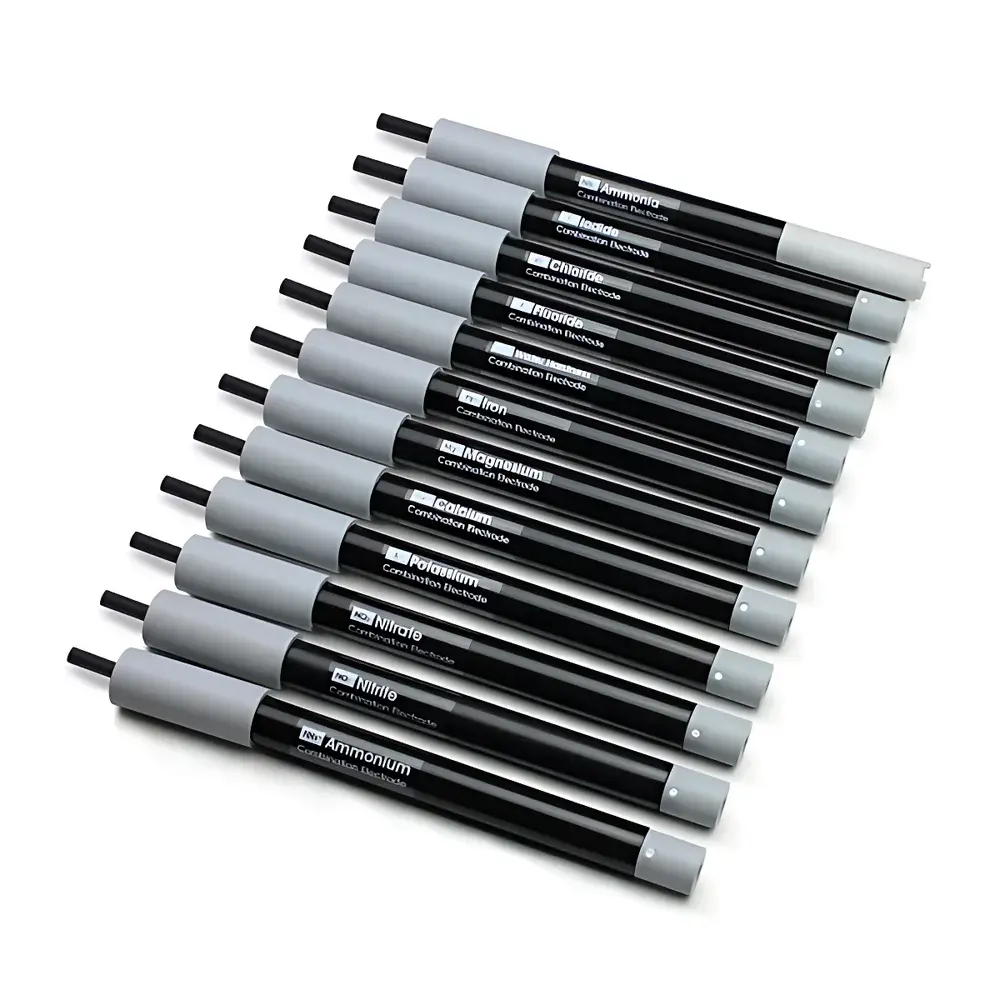
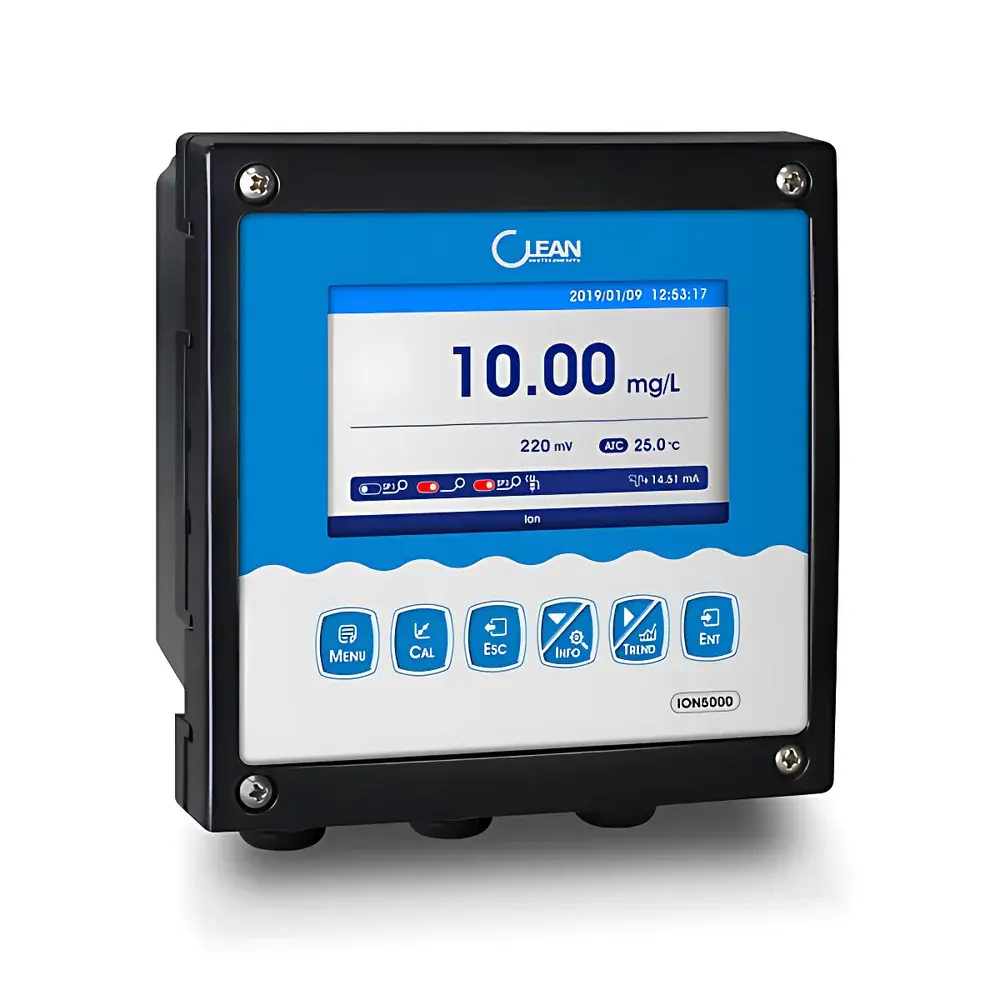
CLEAN CS6510F Fluoride Ion-Selective Electrode (ISE)
| Brand | CLEAN |
|---|---|
| Origin | Shanghai, China |
| Model | CS6510F |
| Instrument Type | Online ISE Probe |
| Measurement Range | 0–99,999 mg/L (ppm) F⁻ |
| Detection Limits | 0.01 / 0.1 / 1 mg/L (ppm) |
| Response Time | 30 s (to 95% signal stability) |
| Accuracy | ±2.5% of reading |
| Operating Temperature | 0–50 °C |
| pH Range | 5–8 |
| Temperature Compensation | Integrated |
| Reference Electrode | Double-junction, annular ceramic junction |
| Body Material | Glass |
| Dimensions | Ø12 × 110 mm |
| Connector | BNC |
| Pressure Rating | 0–70 psi |
| Interface Compatibility | Compatible with pH meters, ion meters, and online ion analyzers (e.g., ION5000 series) |
| Interferences | Al³⁺, Fe³⁺ (requires masking agents or pH control) |
| Storage | Long-term—dry |
| Electrode Slope | 57 ± 2 mV/decade at 25 °C |
| Input Impedance | 100–200 kΩ |
| Equivalence Point | 20 ppm F⁻ (for potentiometric titration support) |
Overview
The CLEAN CS6510F Fluoride Ion-Selective Electrode is a robust, glass-bodied potentiometric sensor engineered for reliable quantification of free fluoride ions (F⁻) in aqueous matrices. Based on the principle of selective membrane potential generation—where a lanthanum fluoride (LaF₃) single-crystal membrane develops a Nernstian response to F⁻ activity—the electrode delivers stable, reproducible measurements across environmental, industrial, and clinical sample types. Unlike colorimetric or spectrophotometric methods, this ISE operates without reagents or optical components, enabling continuous online deployment in water treatment plants, effluent monitoring stations, and process control loops. Its design conforms to fundamental electrochemical measurement standards under ISO 10523 (water quality — determination of pH) and supports compliance with method-specific regulatory frameworks including ASTM D4327 (ion chromatography) and EPA Method 300.1 (anions by ion-selective electrodes), when used within validated system configurations.
Key Features
- Glass-body construction with LaF₃ crystalline membrane ensures long-term mechanical stability and chemical resistance in aggressive media (e.g., low-pH wastewater, seawater, acid leachates)
- Integrated temperature compensation circuitry enables automatic correction over 0–50 °C, minimizing thermal drift during unattended operation
- Double-junction reference system with annular ceramic junction reduces clogging risk and extends service life in turbid or particulate-laden samples
- BNC output interface ensures compatibility with benchtop ion meters (e.g., Thermo Orion, Metrohm 940), pH/ISE controllers, and the CLEAN ION5000 online analyzer platform
- Optimized slope performance (57 ± 2 mV/decade at 25 °C) meets IUPAC-recommended Nernstian behavior for trace-level fluoride detection
- Designed for both laboratory batch analysis and permanent online installation—supports PG13.5 and 3/4″ NPT mounting options
Sample Compatibility & Compliance
The CS6510F demonstrates validated performance across diverse matrices: drinking water, surface water, industrial wastewater, flue gas scrubber liquors, dental product extracts (per GB 8372–2001), solid waste leachates (per GB/T 15555.11–1995), and biological fluids (serum, urine, saliva). Accurate measurement requires pH stabilization between 5.0 and 8.0—typically achieved using TISAB II (Total Ionic Strength Adjustment Buffer) for complex samples containing Al³⁺ or Fe³⁺, which otherwise form non-dissociated complexes and suppress free F⁻ activity. The electrode complies with GLP data integrity expectations when paired with instruments supporting audit-trail logging (e.g., CLEAN ION5000 with 21 CFR Part 11–compliant firmware). It is not intended for direct use in hydrofluoric acid (HF) solutions or strongly alkaline media (>pH 10), where membrane dissolution or hydroxide interference occurs.
Software & Data Management
When integrated with the CLEAN ION5000 online ion monitor, the CS6510F leverages embedded Modbus RTU (RS485) communication for real-time telemetry to SCADA or LIMS platforms. The host instrument provides multi-point calibration routines (2–5 point), automatic drift compensation algorithms, and time-stamped data logging with trend curve visualization. All measurement events—including calibration timestamps, electrode impedance diagnostics, and temperature-compensated mV readings—are stored with configurable retention periods (up to 30 days onboard). Optional cloud upload via Ethernet gateway supports remote validation and regulatory reporting. Raw mV output remains accessible for third-party software integration (e.g., LabVIEW, MATLAB) using standard ISE voltage-to-concentration conversion protocols.
Applications
- Continuous monitoring of fluoride in municipal drinking water distribution systems (WHO guideline: ≤1.5 mg/L)
- Compliance tracking for industrial discharge permits (e.g., aluminum smelting, phosphate fertilizer production)
- Leachate analysis from landfill containment cells per EPA SW-846 Method 9213
- Quality control of fluoridated toothpaste and mouthwash formulations
- Speciation studies of soluble vs. bound fluoride in soil and sediment pore water
- Indirect determination of aluminum and silica via fluoride complexation titrations
- Process endpoint detection in fluoride removal units (e.g., activated alumina, bone char filtration)
FAQ
What is the recommended storage method for long-term electrode preservation?
Store dry in its original protective cap at room temperature. Avoid prolonged exposure to air moisture or high-humidity environments.
Can the CS6510F be used in seawater or high-salinity brines?
Yes—its double-junction reference design minimizes liquid junction potential errors in ionic-strength-variable media. However, TISAB addition is mandatory to mask hydrolysis effects and maintain activity coefficient consistency.
Why is pH adjustment critical before fluoride measurement?
Below pH 5, HF formation reduces free F⁻ concentration; above pH 8, OH⁻ competes at the LaF₃ surface, causing positive bias. TISAB buffers at pH ~5.5 and supplies ionic strength uniformity.
How often should calibration be performed in continuous online operation?
Daily two-point calibration (e.g., 0.1 and 10 mg/L F⁻ standards) is recommended for regulatory-grade applications; weekly verification suffices for process trending where absolute accuracy is secondary to relative change detection.
Is the electrode compatible with automated cleaning systems?
No—mechanical abrasion or ultrasonic cleaning damages the LaF₃ crystal surface. Gentle rinsing with deionized water and periodic reconditioning in 10⁻⁴ M NaF solution are sufficient maintenance steps.
Related Products







