
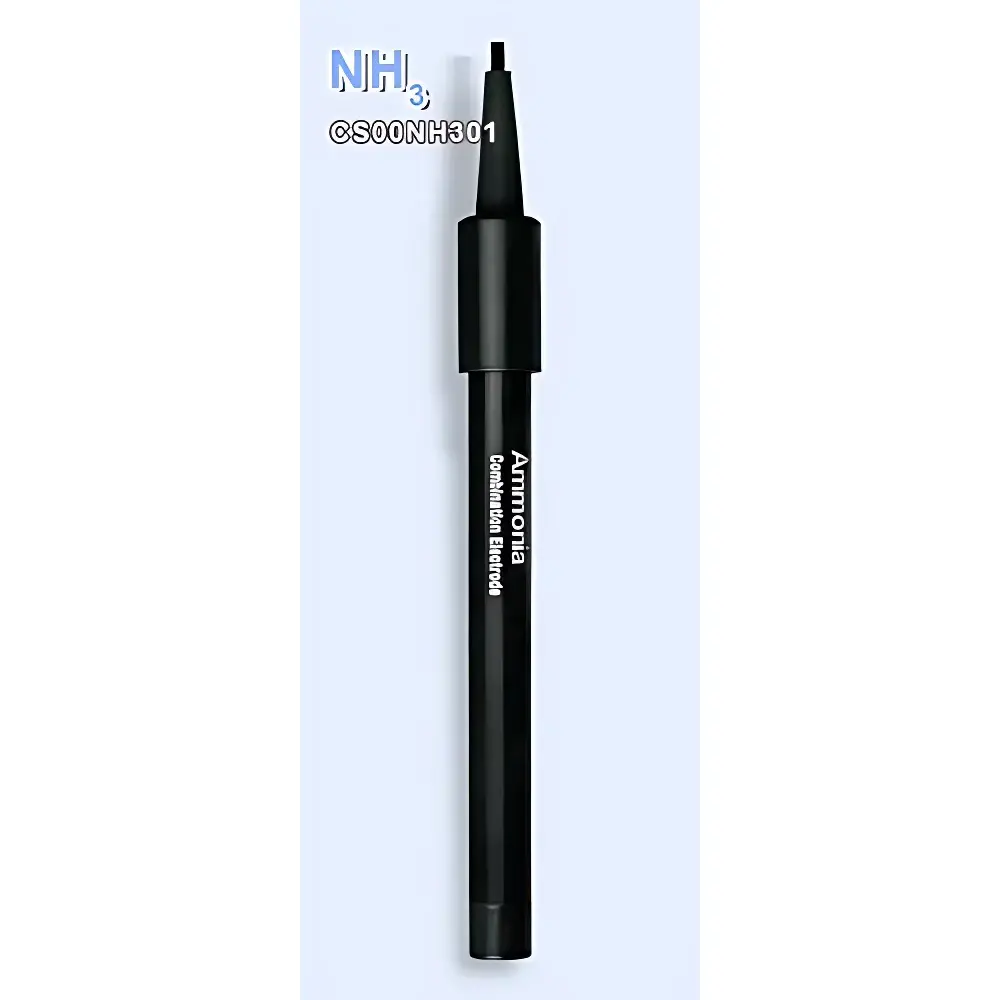
CS00NH301 Ammonia Gas-Sensing Electrode (NH₃)
| Origin | USA |
|---|---|
| Manufacturer Type | Authorized Distributor |
| Origin Category | Imported |
| Model | CS00NH301 |
| Pricing | Available Upon Request |
| Measurement Range | 0.01–17,000 ppm |
| Slope | 56 ± 3 mV/decade at 25 °C |
| Repeatability | ±2% |
| Response Time | ≤30 s to 95% of final value |
| Operating Temperature | 0–50 °C |
| Pressure Rating | 0–30 psi |
| pH Compatibility | >11 |
| Interferents | Volatile amines |
| Housing Material | Epoxy resin |
| Dimensions | 12 × 110 mm |
| Cable Length | 1 m |
| Connector | BNC |
| Membrane | Replaceable |
Overview
The CS00NH301 Ammonia Gas-Sensing Electrode is a selective potentiometric sensor engineered for direct, real-time measurement of dissolved ammonia (NH₃) in aqueous media via the gas-diffusion principle. Unlike ammonium ion (NH₄⁺) electrodes, this device employs a hydrophobic gas-permeable membrane that allows only neutral NH₃ molecules—whose concentration is governed by the solution’s pH and temperature—to diffuse into an internal electrolyte chamber. There, NH₃ equilibrates with ammonium ions, altering the pH of the internal buffer and generating a Nernstian potential shift across a pH-sensitive glass or solid-state sensing element. This architecture ensures high selectivity for free ammonia over total nitrogen species, making it indispensable for applications where speciation matters—such as high-purity water monitoring in power generation, aquaculture system management, and wastewater nitrification/denitrification process control.
Key Features
- Wide dynamic range: 0.01–17,000 ppm NH₃, enabling both trace-level detection in ultrapure boiler feedwater and high-concentration analysis in industrial effluents.
- Stable Nernstian response: 56 ± 3 mV per decade change in NH₃ activity at 25 °C, calibrated against certified standard solutions traceable to NIST.
- Rapid equilibration: Achieves ≥95% signal stability within 30 seconds under continuous flow or static immersion conditions.
- Robust epoxy housing and replaceable membrane assembly ensure long-term reliability and reduce cost of ownership through field-serviceable components.
- Optimized for alkaline environments: Functional only above pH 11, where >99% of total ammonia exists as volatile NH₃—eliminating interference from NH₄⁺ and minimizing matrix effects.
- BNC connector and 1-meter shielded cable facilitate seamless integration with standard benchtop or portable ion meters, data loggers, and SCADA-compatible analog input modules.
Sample Compatibility & Compliance
The CS00NH301 is validated for use in diverse aqueous matrices including ultra-high-purity steam condensate (≥18.2 MΩ·cm), recirculating aquaculture systems, seawater, municipal and industrial wastewater, electroplating rinse baths, and biological suspensions. Its operational pressure rating of 0–30 psi supports inline installation in low-pressure process streams. While not intrinsically safe for explosive atmospheres, it complies with IEC 61000-4 electromagnetic compatibility standards and meets material restrictions under RoHS Directive 2011/65/EU. When deployed in regulated environments—including EPA Method 350.1-compliant wastewater labs or ISO/IEC 17025-accredited testing facilities—the electrode supports GLP documentation workflows when paired with compliant data acquisition software featuring audit trails and electronic signatures (e.g., FDA 21 CFR Part 11–enabled platforms).
Software & Data Management
The electrode operates independently of proprietary firmware; however, optimal performance requires integration with ion meters or analyzers supporting adjustable slope calibration, temperature compensation (ATC), and non-linear curve fitting for extended-range measurements. Compatible software platforms—including Metrohm OMNIS, Thermo Scientific Orion Star™ Suite, and LabVIEW-based custom DAQ systems—enable automated calibration verification, drift trending, and export of time-stamped concentration logs in CSV or XML format. All raw mV outputs are retained for retrospective reprocessing using updated thermodynamic correction factors (e.g., revised pKa values for NH₄⁺/NH₃ equilibrium at elevated temperatures).
Applications
- Power plant chemistry: Continuous monitoring of NH₃ breakthrough in condensate polishing units to prevent copper alloy corrosion in turbine systems.
- Aquaculture: Real-time tracking of toxic free ammonia levels in recirculating fish tanks, enabling predictive feed adjustment and aeration control.
- Wastewater treatment: Feedback control of aerobic digesters and anammox reactors by quantifying NH₃ accumulation prior to inhibition thresholds.
- Pharmaceutical manufacturing: Verification of ammonia residuals in purified water (PW) and water-for-injection (WFI) distribution loops per USP and EP 2.2.48.
- Research laboratories: Kinetic studies of enzymatic ammonia release (e.g., urease assays) and equilibrium partitioning experiments in soil-water systems.
FAQ
How does the CS00NH301 differ from an ammonium ion-selective electrode (ISE)?
The CS00NH301 measures only the unprotonated, volatile NH₃ species via gas diffusion, whereas NH₄⁺ ISEs respond directly to the cationic form. This distinction is critical in high-pH applications where NH₃ dominates—and where ISEs suffer from severe alkaline error and potassium interference.
Can this electrode be used below pH 11?
No. Below pH 11, the fraction of NH₃ drops exponentially (e.g., ~0.1% at pH 9), rendering the signal too weak and non-Nernstian. For total ammonia analysis across broad pH ranges, coupling with a separate NH₄⁺ electrode and applying speciation calculations is recommended.
What maintenance is required to sustain accuracy?
The replaceable membrane must be changed every 3–6 months depending on sample fouling; internal electrolyte should be refreshed quarterly. Regular calibration against two-point standards (e.g., 0.1 ppm and 100 ppm NH₃) is required before each analytical batch.
Is temperature compensation mandatory?
Yes. The NH₃/NH₄⁺ equilibrium constant is highly temperature-dependent. Built-in ATC (0–50 °C) is essential for accurate conversion of measured mV to concentration.
Does the electrode require a reference electrode?
No. The CS00NH301 is a complete composite sensor with integrated Ag/AgCl reference element and internal buffer—no external half-cell is needed.







