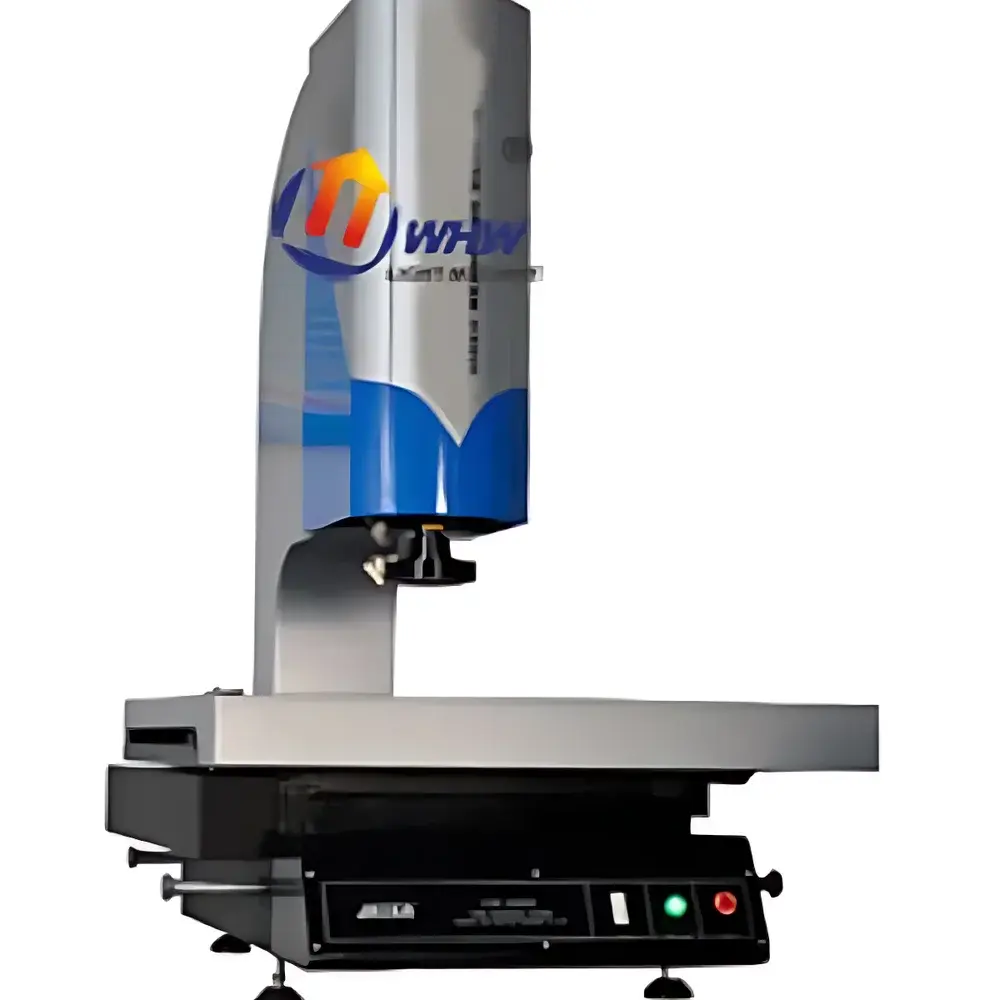
YANRUN YR-N3020 Entry-Level Automated Vision Measuring System
| Brand | YANRUN |
|---|---|
| Origin | Shanghai, China |
| Manufacturer Type | Direct Manufacturer |
| Model | YR-N3020 |
| X/Y Travel | 300 × 200 mm |
| External Dimensions (W×D×H) | 876 × 650 × 1712 mm |
| Measurement Accuracy | X/Y ≤ (3 + L/200) µm |
| Encoder Resolution | 0.5 µm |
| Camera | SONY Color CCD |
| Optical System | Fixed-magnification Zoom Lens (optional laser probe & motorized zoom lens) |
| Illumination | Programmable LED Ring Light (surface) and Profile Light with Brightness Control via Magnification |
| Software | Proprietary Automated Vision Metrology Suite |
| Power Supply | AC 220 V ±10%, 50 Hz |
| Operating Environment | 20 °C ±3 °C, 45–75% RH |
Overview
The YANRUN YR-N3020 Entry-Level Automated Vision Measuring System is a cost-optimized coordinate metrology platform engineered for high-reproducibility 2D and 3D geometric measurements of small-to-medium mechanical and electronic components. It operates on the principle of non-contact optical imaging metrology—capturing high-contrast silhouette and surface images through a fixed-magnification telecentric zoom lens, then performing sub-pixel edge detection and coordinate transformation using calibrated photogrammetric algorithms. The system integrates a precision granite base, dual-axis motorized stage (X/Y), and Z-axis manual or optional motorized focus adjustment to support repeatable positioning within its 300 mm × 200 mm measurement envelope. Designed for environments where budget constraints coexist with ISO/IEC 17025-aligned quality requirements—such as contract manufacturing labs, QC departments in Tier-2 electronics suppliers, or R&D prototyping workshops—the YR-N3020 delivers traceable dimensional verification without requiring cleanroom-grade infrastructure.
Key Features
- Stable granite base structure with vibration-damping feet, ensuring thermal and mechanical stability under standard laboratory conditions (20 °C ±3 °C).
- High-resolution SONY color CCD sensor coupled with a fixed-ratio zoom optical path, enabling consistent magnification calibration across the full field of view.
- Linear encoder feedback on X/Y axes with 0.5 µm resolution, supporting compliance with ISO 10360-2 for length measurement uncertainty estimation.
- Programmable dual-mode LED illumination system: coaxial ring light for surface feature contrast and bottom-directed profile light for edge definition—both intensity-controlled in real time based on selected magnification level.
- Modular hardware architecture permitting field upgrades: optional laser displacement sensor for non-optical height profiling; motorized zoom lens for automated magnification sequencing during multi-feature inspection routines.
- Comprehensive error compensation: software-based Abbe error correction, squareness compensation, and thermal drift modeling derived from ambient temperature input.
Sample Compatibility & Compliance
The YR-N3020 accommodates parts up to 300 mm × 200 mm footprint and typical heights under 150 mm—suitable for machined housings, PCB stencils, connector pins, injection-molded plastic gears, thin-film touch sensors, and aerospace fasteners. Its optical design supports measurement of both opaque metallic parts and semi-transparent substrates—including float glass, sapphire wafers, and polymer films—via adjustable backlight intensity and edge-threshold optimization. The system meets fundamental requirements of ISO 14253-1 (Geometrical Product Specifications) and ASTM E29 (Standard Practice for Using Significant Digits in Test Data). While not certified to full GLP/GMP audit readiness out-of-the-box, its software architecture supports user-defined calibration logs, operator ID tagging, and timestamped result export—facilitating alignment with internal QA procedures aligned with ISO 9001 Clause 7.1.5 and FDA 21 CFR Part 11 when deployed with supplementary access control and audit trail modules.
Software & Data Management
The proprietary vision metrology software provides intuitive CAD-based measurement programming, including point, line, circle, arc, slot, and custom polygon construction. All geometric tolerances—position, concentricity, parallelism, perpendicularity, and profile of a surface—are evaluated per ASME Y14.5-2018 conventions. Measurement reports are exportable in PDF, CSV, and XML formats, with embedded image thumbnails and deviation heatmaps. Raw image archives and coordinate datasets are stored in a relational SQLite database with configurable retention policies. For enterprise integration, the software exposes RESTful API endpoints for job queue submission, result retrieval, and firmware status polling—enabling linkage with MES platforms such as Siemens Opcenter or Rockwell FactoryTalk.
Applications
- Mechanical component verification: bore diameter, pitch diameter of threaded inserts, positional tolerance of dowel holes in CNC-machined fixtures.
- Electronics assembly QA: solder paste volume estimation (via grayscale thresholding), land pattern alignment on flex PCBs, coplanarity assessment of QFN leads.
- Plastic part validation: gate vestige height on molded connectors, wall thickness uniformity in medical device housings, flash width at parting lines.
- Precision instrument calibration: reference artifact verification (e.g., step gauges, pin gages), repeatability testing of micrometer anvils.
- Aerospace subcontractor audits: first-article inspection of turbine blade mounting lugs, rivet hole location and perpendicularity on aluminum airframe panels.
FAQ
Does the YR-N3020 support automatic focus tracking during multi-level Z-scans?
No—Z-axis focusing is manual by default. An optional motorized Z-stage with closed-loop stepper control and auto-focus algorithm is available as an upgrade.
Can measurement data be exported directly to SPC software such as Minitab or JMP?
Yes—CSV exports include raw coordinates, nominal values, deviations, and statistical summaries (Cp, Cpk, Pp, Ppk) calculated per subgroup, compatible with all major SPC packages.
Is the system compliant with ISO 17025 calibration requirements?
The hardware platform supports traceable calibration using NIST-traceable step gages and ball bars; however, formal ISO/IEC 17025 accreditation requires lab-specific procedural documentation, uncertainty budgeting, and third-party assessment—not provided by the manufacturer.
What is the recommended recalibration interval for routine production use?
YANRUN recommends annual verification against certified artifacts; bi-weekly system checks using a 10-mm ceramic step gauge are advised for high-volume QC environments.
Can the software run on Windows 11 with 64-bit architecture?
Yes—the current software version (v4.2.1+) is validated for Windows 10 and Windows 11 (64-bit), requiring ≥8 GB RAM and OpenGL 4.5-compatible GPU drivers.