
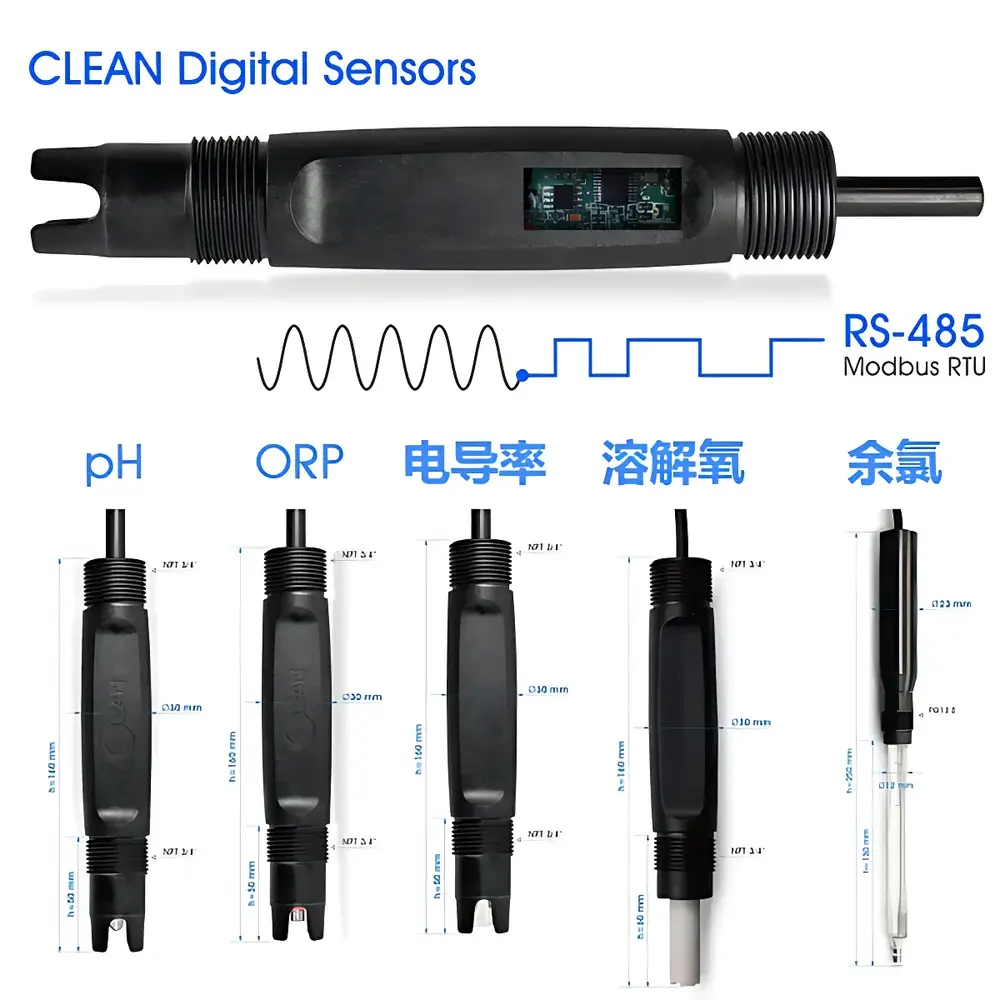
CLEAN CS4751D RS-485 Digital Dissolved Oxygen Sensor Electrode
| Brand | CLEAN |
|---|---|
| Origin | Shanghai, China |
| Manufacturer Type | Authorized Distributor |
| Country of Origin | China |
| Model | CS4751D |
| Instrument Type | Online |
| Measurement Principle | Electrochemical (Clark-type Polarographic Probe) |
| Range | 0.0–400.0% saturation, 0.00–40.00 mg/L |
| Accuracy | ±0.2% FS |
| Repeatability | 0.1% / 0.01 mg/L |
| Detection Limit | ±2 ppb (zero point) |
| Temperature Range (Operating) | 0–60 °C |
| Temperature Measurement Range | −10.0–110.0 °C |
| Temp. Resolution | 0.1 °C |
| Salinity Compensation | 0.0–50.0 ppt |
| Pressure Compensation | 600–2000 mbar |
| Response Time (t₉₅) | <60 s at 25 °C |
| Stabilization Time | 15–20 min |
| Zero Drift | <0.5% FS |
| Housing Material | PPS/PP |
| Electrode Cap Thread | NPT 3/4″ |
| Cable Length | 5 m |
| Connector | Open-terminal block |
| Communication Interface | RS-485 |
| Protocol | Modbus RTU |
| Power Supply | DC 12 V |
| Output Signals | DO concentration (mg/L and % sat), temperature |
| IP Rating | IP68 |
| Minimum Flow Rate | >0.03 m/s |
| Residual Current | <2% in air |
Overview
The CLEAN CS4751D is an industrial-grade, RS-485 digital dissolved oxygen (DO) sensor electrode engineered for continuous, high-stability online monitoring in demanding aquatic environments. Based on Clark-type polarographic electrochemistry, the sensor employs a gas-permeable membrane, cathode/anode redox pair, and optimized electrolyte formulation to generate a diffusion-limited current proportional to molecular oxygen partial pressure. Unlike optical (luminescence-based) sensors, this polarographic design offers proven long-term stability in turbid, high-fouling, or low-flow applications—common in aquaculture recirculating systems, wastewater treatment bioreactors, and industrial cooling water loops. The integrated Pt1000 temperature sensor enables real-time thermal compensation, while onboard salinity and barometric pressure correction algorithms ensure traceable accuracy across variable site conditions without external calibration hardware.
Key Features
- True digital output via RS-485 interface with native Modbus RTU protocol—eliminates analog signal degradation and supports multi-drop network configurations (up to 32 nodes on one bus)
- Onboard dual-parameter measurement: dissolved oxygen (in both mg/L and % saturation) and temperature (−10.0 to 110.0 °C), with independent resolution of 0.01 mg/L and 0.1 °C
- Configurable compensation: user-adjustable salinity (0.0–50.0 ppt), pressure (600–2000 mbar), and temperature (0.0–50.0 °C) parameters stored in non-volatile memory
- Ruggedized construction: chemically resistant PPS/PP housing and NPT 3/4″ threaded cap ensure mechanical integrity under submersion, vibration, and intermittent cleaning cycles
- IP68-rated sealing and open-terminal connector allow field-replaceable modular assembly—electrode membranes, cathodes, and electrolyte cartridges are serviceable without sensor replacement
- Low-flow tolerance: validated performance at flow velocities ≥0.03 m/s; suitable for static or low-circulation tanks when paired with optional flow cell or stirrer integration
Sample Compatibility & Compliance
The CS4751D is validated for use in freshwater, brackish water, seawater, and process effluents with total suspended solids (TSS) ≤200 mg/L and chemical oxygen demand (COD) ≤500 mg/L. It complies with ASTM D888-22 (Standard Test Methods for Dissolved Oxygen in Water) for polarographic probe methodology and supports alignment with ISO 5814:2012 (Water quality — Determination of dissolved oxygen — Electrochemical probe method). Its Modbus RTU implementation facilitates integration into SCADA, DCS, and PLC platforms compliant with IEC 61158 and IEC 61784 standards. While not certified for pharmaceutical-grade GMP environments, its stable zero-point drift (<0.5% FS) and residual current specification (<2% in air) support routine QA/QC verification per EPA Method 360.1 and USGS NWIS protocols.
Software & Data Management
The sensor operates autonomously without host software but is fully compatible with industry-standard Modbus master tools (e.g., ModScan, QModMaster, Ignition SCADA) for register mapping, polling configuration, and alarm thresholding. Key holding registers include DO concentration (32-bit IEEE-754 float), temperature (16-bit signed integer), salinity and pressure compensation flags, and diagnostic status bits (e.g., membrane dryness, cathode polarization error). All configuration changes are logged with timestamped audit trails when interfaced with systems supporting IEC 62443-3-3 or FDA 21 CFR Part 11-compliant data acquisition firmware. Firmware updates are performed via serial bootloader mode using standard UART-to-RS485 converters.
Applications
- Aquaculture process control: real-time DO feedback for aerator modulation in shrimp, salmon, and tilapia RAS (Recirculating Aquaculture Systems)
- Municipal and industrial wastewater treatment: monitoring aerobic zones in activated sludge basins, MBRs, and nitrification reactors
- Power plant cooling water management: early detection of hypoxic conditions indicative of biofilm formation or heat exchanger fouling
- Environmental monitoring stations: long-term deployment in rivers, reservoirs, and estuaries where robustness against sediment abrasion and algal biofouling is critical
- Research laboratories: benchtop validation studies requiring traceable, modbus-addressable DO inputs synchronized with pH, conductivity, and ORP sensors
FAQ
What calibration procedures does the CS4751D require?
Zero-point calibration is performed in sodium sulfite (Na₂SO₃) solution; span calibration uses air-saturated water at known temperature, salinity, and barometric pressure. Field calibration is recommended every 30–90 days depending on fouling exposure.
Can the sensor be used in high-pressure pipelines?
Yes—the housing and membrane assembly are rated for continuous operation up to +20 bar gauge pressure and transient spikes to −10 bar (vacuum), provided the NPT 3/4″ fitting is properly torqued and sealed with PTFE tape.
Is temperature compensation automatic or manual?
Fully automatic: the integrated Pt1000 sensor continuously feeds temperature data to the internal microcontroller, which applies the Winkler-derived solubility model (APHA Standard Methods 4500-O G) in real time.
How is membrane replacement performed?
The electrode cap unscrews to expose the membrane sleeve and cathode assembly; replacement kits include pre-filled electrolyte gel, O-rings, and calibrated membranes—no potentiostat adjustment is needed post-installation.
Does the sensor support Modbus ASCII or only RTU?
RS-485 communication is Modbus RTU only; ASCII mode is not implemented due to timing constraints inherent in low-power embedded architecture.







