
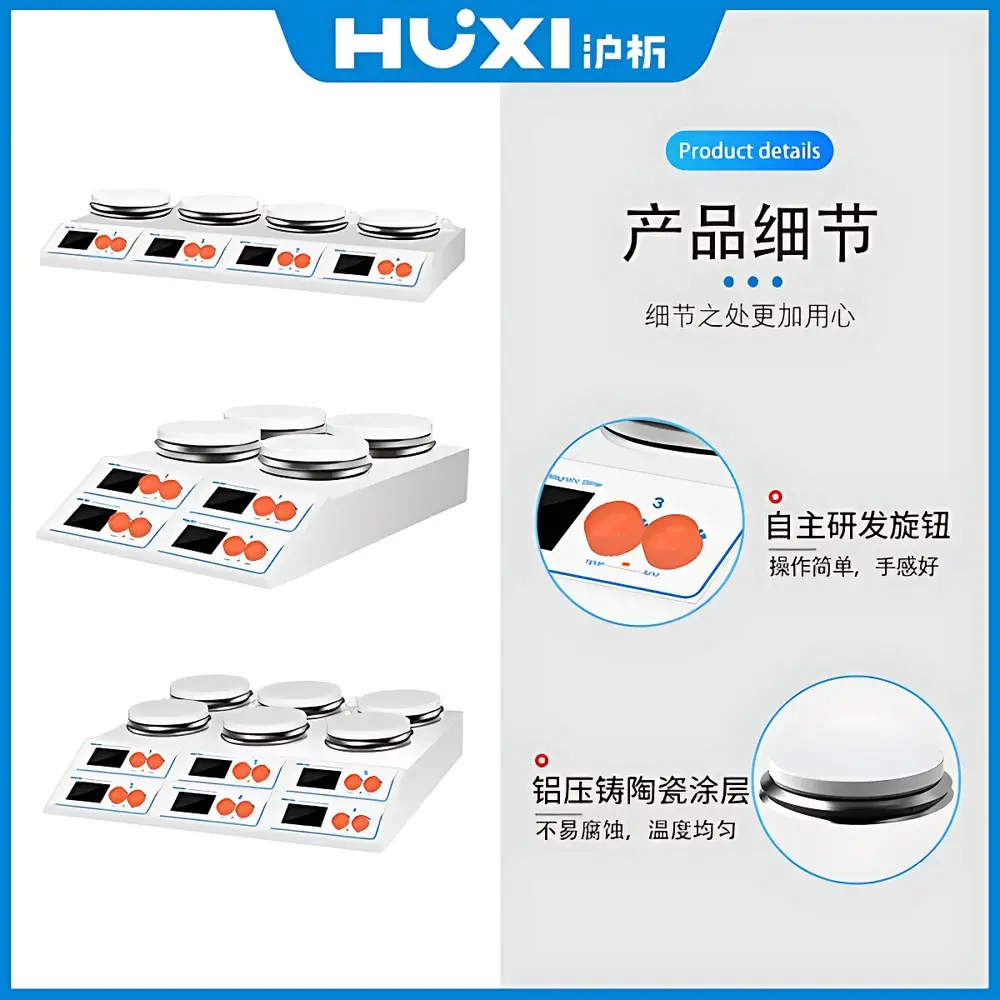
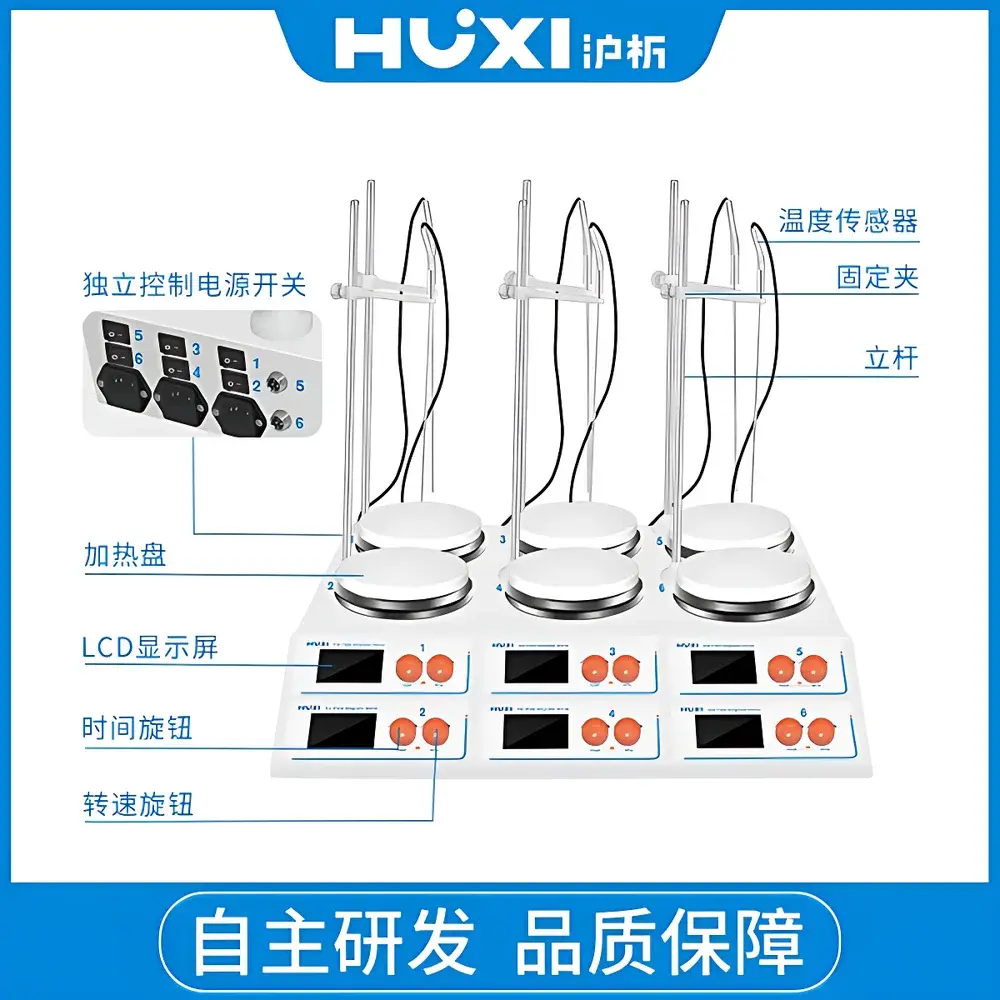
HUXI HMS-4G Four-Position Magnetic Stirrer with Independent Heating and Stirring Control
| Brand | HUXI |
|---|---|
| Origin | Shanghai, China |
| Manufacturer Type | Direct Manufacturer |
| Instrument Type | Magnetic Stirrer |
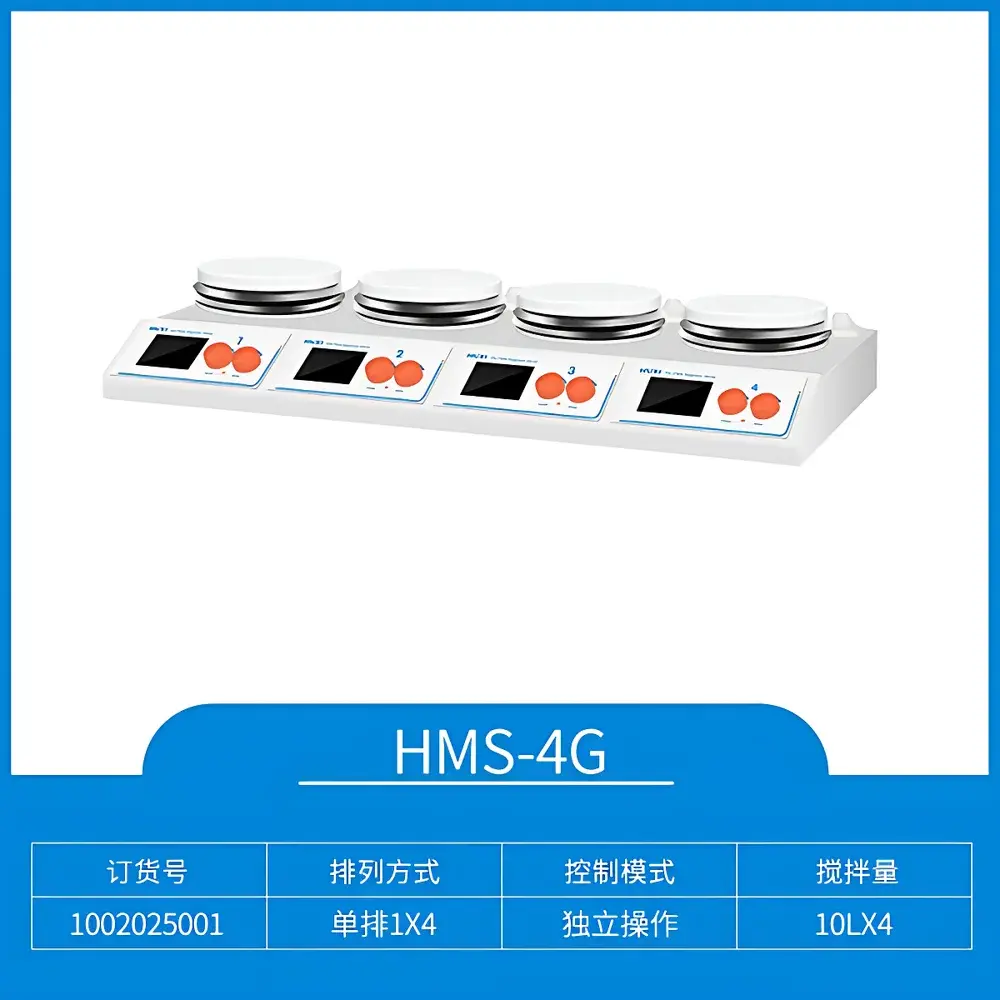
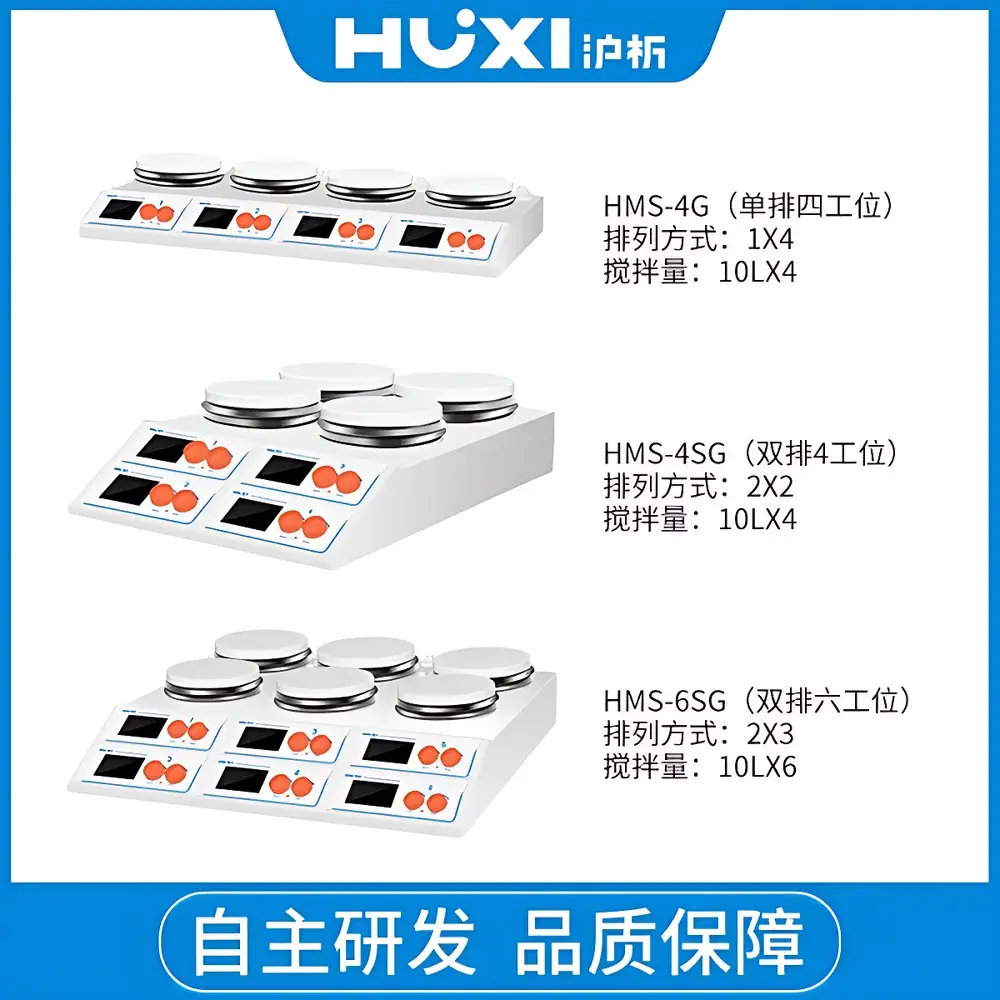
| Max Stirring Volume | 10 L × 4 positions |
| Speed Range | 50–2000 rpm |
| Temperature Control Range | RT+5°C to 160°C |
| Temperature Accuracy | ±1°C |
| Heating Plate Surface Temp | ≤320°C |
| Power Supply | AC 220 V, 50/60 Hz |
| Noise Level | ≤27 dB(A) |
| Dimensions (W×D×H) | 713 × 290 × 110 mm |
| Net Weight | 10 kg |
Overview
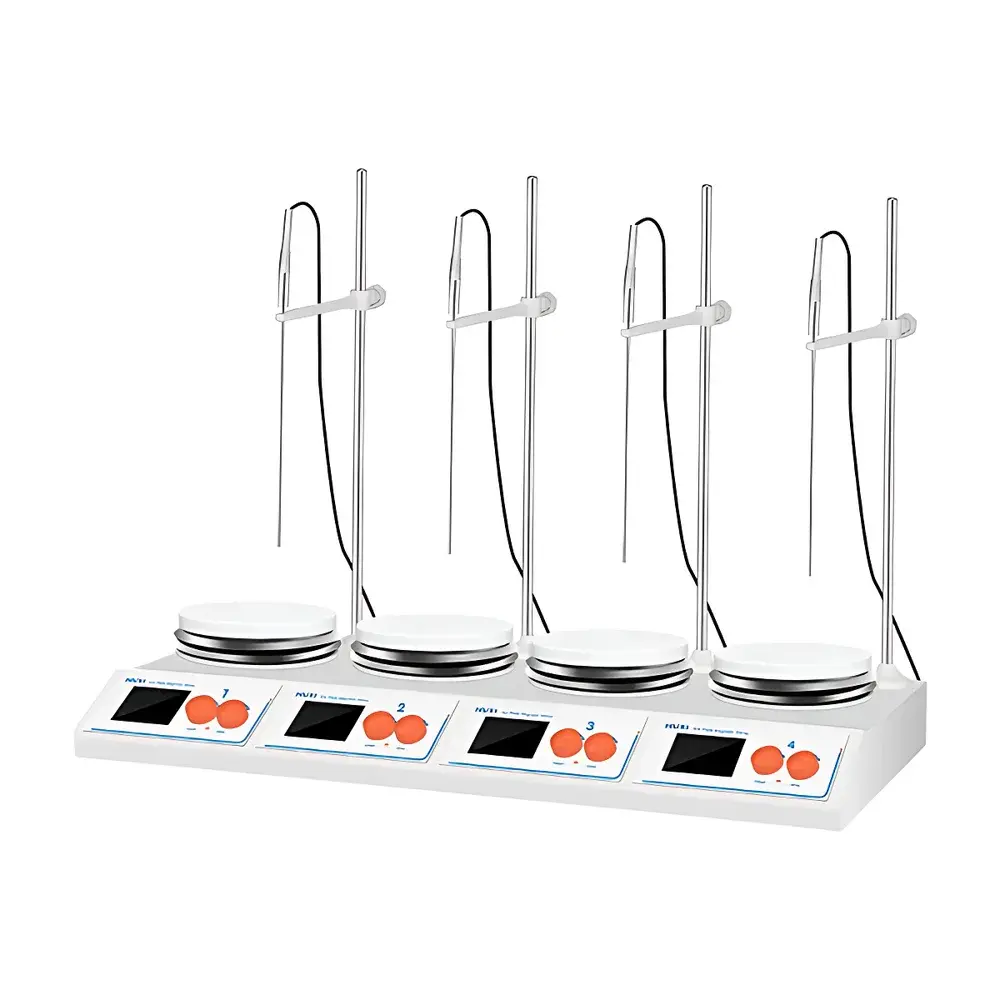
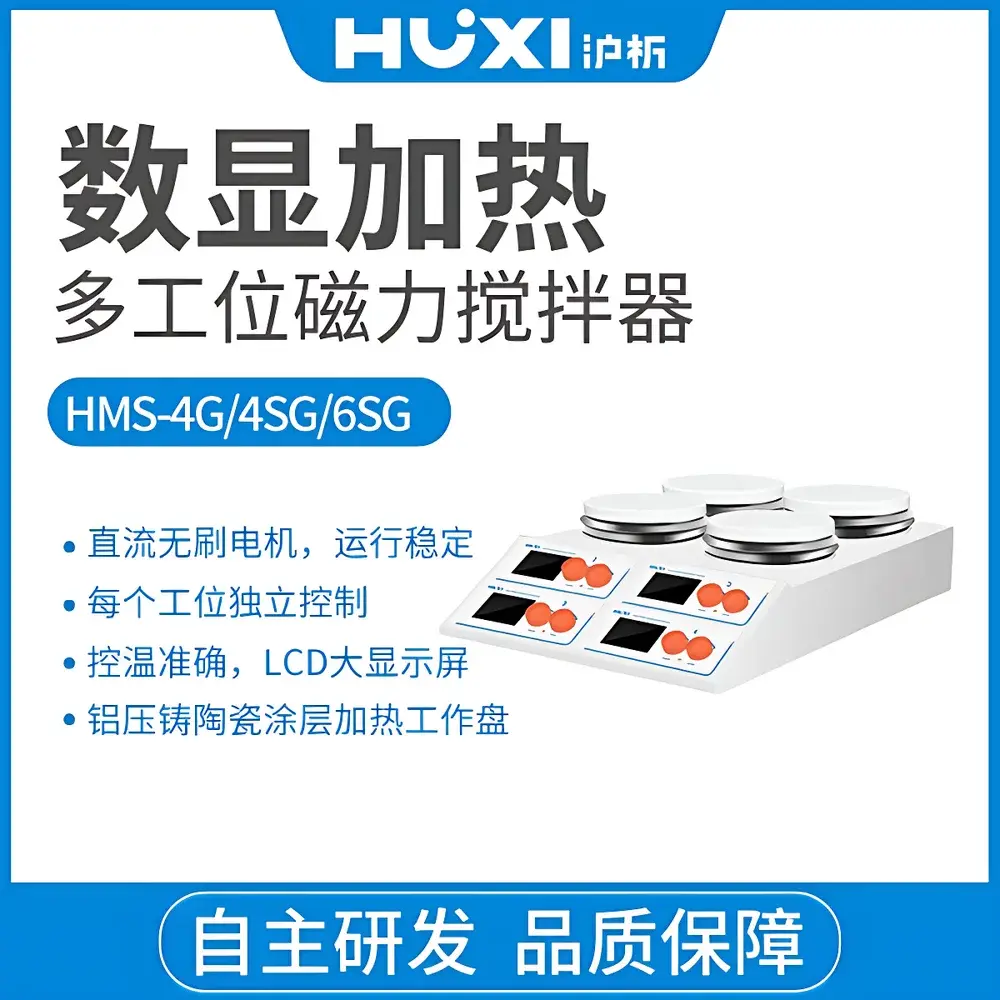
The HUXI HMS-4G is a four-position magnetic stirrer engineered for precision, reproducibility, and operational flexibility in modern laboratory environments. Unlike conventional single-station units, the HMS-4G integrates independent heating and stirring control across four parallel workstations—enabling simultaneous, non-interfering processing of up to four distinct samples under individually optimized thermal and mechanical conditions. Its operation relies on permanent magnet coupling between the internal rotating magnets beneath each ceramic-coated aluminum heating plate and standard PTFE- or glass-coated magnetic stir bars. Temperature regulation employs a PT100 resistance temperature detector (RTD) feedback loop combined with digital PID control—including auto-tuning capability—to minimize overshoot and ensure stable thermal setpoints within ±1°C accuracy across the full range of RT+5°C to 160°C. The unit’s low-noise (<27 dB[A]) brushless DC motor drive delivers consistent torque from low-speed viscous mixing (50 rpm) to high-shear dispersion (2000 rpm), making it suitable for applications requiring both gentle homogenization and vigorous agitation.
Key Features
- Four independent workstations with fully decoupled speed and temperature controls—no cross-talk between channels
- Brushless DC motors per station: maintenance-free, extended service life (>20,000 hr MTBF), and stable output across full speed range
- Ceramic-coated aluminum heating plates (Ø135 mm, max surface temp ≤320°C) offering rapid thermal response, uniform heat distribution, and corrosion resistance
- PID temperature controller with self-tuning function; real-time LCD display showing both setpoint and actual values for speed (rpm) and temperature (°C)
- Ergonomic 30° inclined front panel designed for optimal visibility during seated or standing operation
- IPX4-rated rotary control knobs with sealed construction for enhanced safety and longevity in humid or splash-prone lab settings
- Robust housing formed from high-temp-resistant metal-reinforced thermoplastic—mechanically rigid, electrically insulating, and chemically inert
- Programmable timer (0–9999 min) per station for unattended operation under defined thermal-mechanical protocols
Sample Compatibility & Compliance
The HMS-4G accommodates standard laboratory glassware including beakers (up to 10 L capacity per station), Erlenmeyer flasks, and reaction vessels compatible with magnetic stirring. Its design supports routine use with aqueous, organic, and mildly aggressive chemical systems—leveraging PTFE-encapsulated stir bars and inert ceramic-coated surfaces. While not certified for hazardous area use (e.g., ATEX or IECEx), the instrument complies with general-purpose electrical safety standards applicable to Class I, Division 2 laboratory equipment per IEC 61010-1:2010. It meets EMC requirements per IEC 61326-1 for laboratory measurement and control equipment. Though not inherently GLP/GMP-compliant out-of-the-box, its digital logging capability (via optional RS232/USB interface) supports integration into validated workflows requiring audit trails per FDA 21 CFR Part 11 when paired with compliant data acquisition software.
Software & Data Management
The HMS-4G operates as a standalone instrument with embedded firmware controlling all thermal and rotational parameters. Optional communication modules (RS232 or USB-to-serial adapter) enable remote parameter setting, real-time data streaming (temperature, rpm), and time-stamped event logging via third-party SCADA or LIMS platforms. No proprietary software is required; ASCII-based command protocols allow seamless integration with Python-, LabVIEW-, or MATLAB-driven automation sequences. For regulated environments, users may configure external validation packages to record operator ID, method version, calibration timestamps, and deviation alerts—supporting traceability requirements aligned with ISO/IEC 17025 and ASTM E2500 guidelines.
Applications
- Multi-batch synthesis optimization in pharmaceutical R&D—simultaneous screening of catalysts, solvents, or stoichiometric ratios under controlled thermal profiles
- Environmental sample preparation: digestion of wastewater sludge or soil extracts across replicate vessels at identical or gradient conditions
- Materials science: polymer dissolution kinetics, nanoparticle dispersion stability testing, and colloidal suspension aging studies
- Quality control labs: parallel titration support, buffer equilibration, and standard solution homogenization prior to HPLC or ICP-MS analysis
- Academic teaching labs: comparative experiments on viscosity-temperature dependence, reaction rate laws, or heat transfer coefficients
FAQ
Can the HMS-4G operate without heating while maintaining independent stirring control?
Yes—each station allows deactivation of heating while retaining full speed adjustment and timing functionality.
What stir bar sizes are recommended for optimal performance at maximum load (10 L)?
A-type (9×25×4 mm), C-type (7×25×4 mm), and extended C-type (8×45×4 mm) stir bars are supplied; for 10 L volumes, the 8×45×4 mm variant is advised to ensure vortex formation and bottom-layer mixing.
Is the unit compatible with external temperature probes for vessel-content monitoring?
The HMS-4G uses integrated PT100 sensors for plate temperature only; however, optional external probe inputs can be added via OEM firmware customization upon request.
Does the device support continuous operation beyond 24 hours?
Yes—the 0–9999 minute timer accommodates multi-day runs; thermal cut-off protection activates if ambient temperature exceeds 40°C or relative humidity exceeds 80% RH.
How is calibration verified for temperature and speed accuracy?
Factory calibration is performed using NIST-traceable reference standards; users may perform field verification using calibrated digital thermometers and optical tachometers—procedures documented in the included ISO/IEC 17025-aligned calibration guide.



