
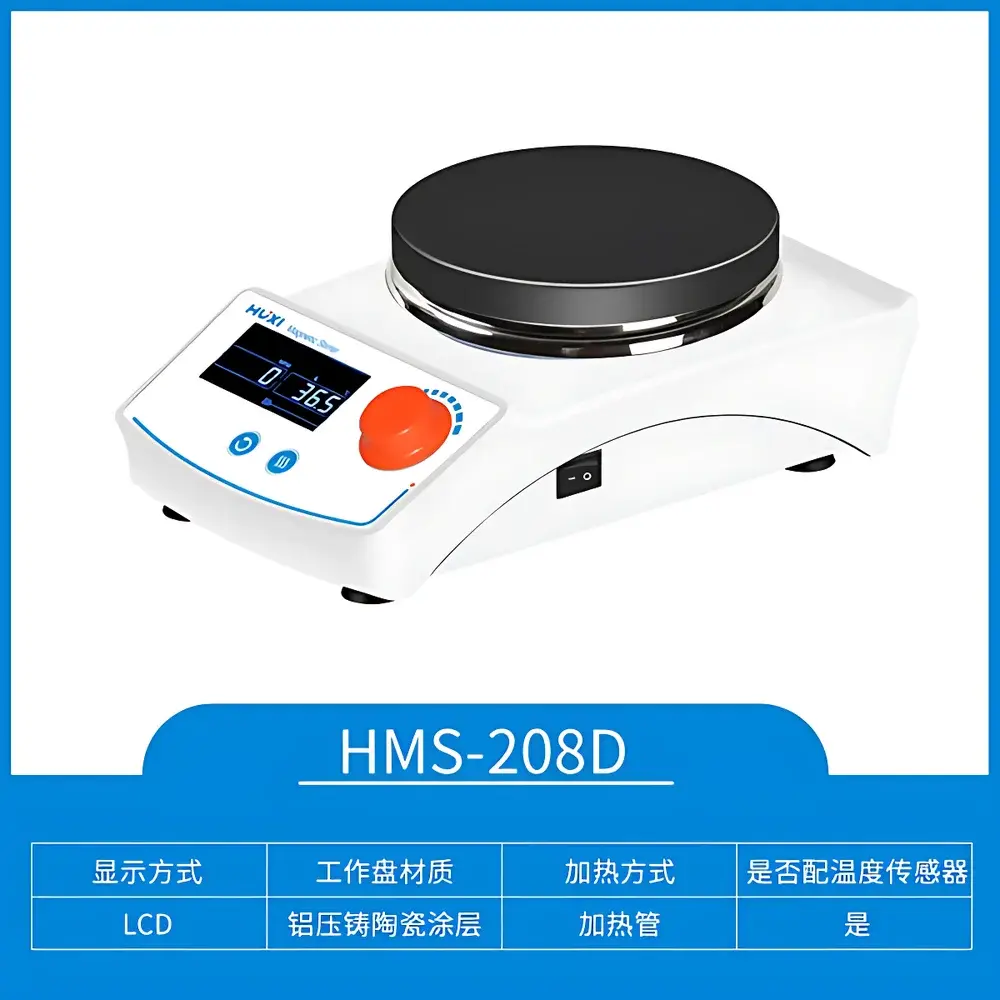
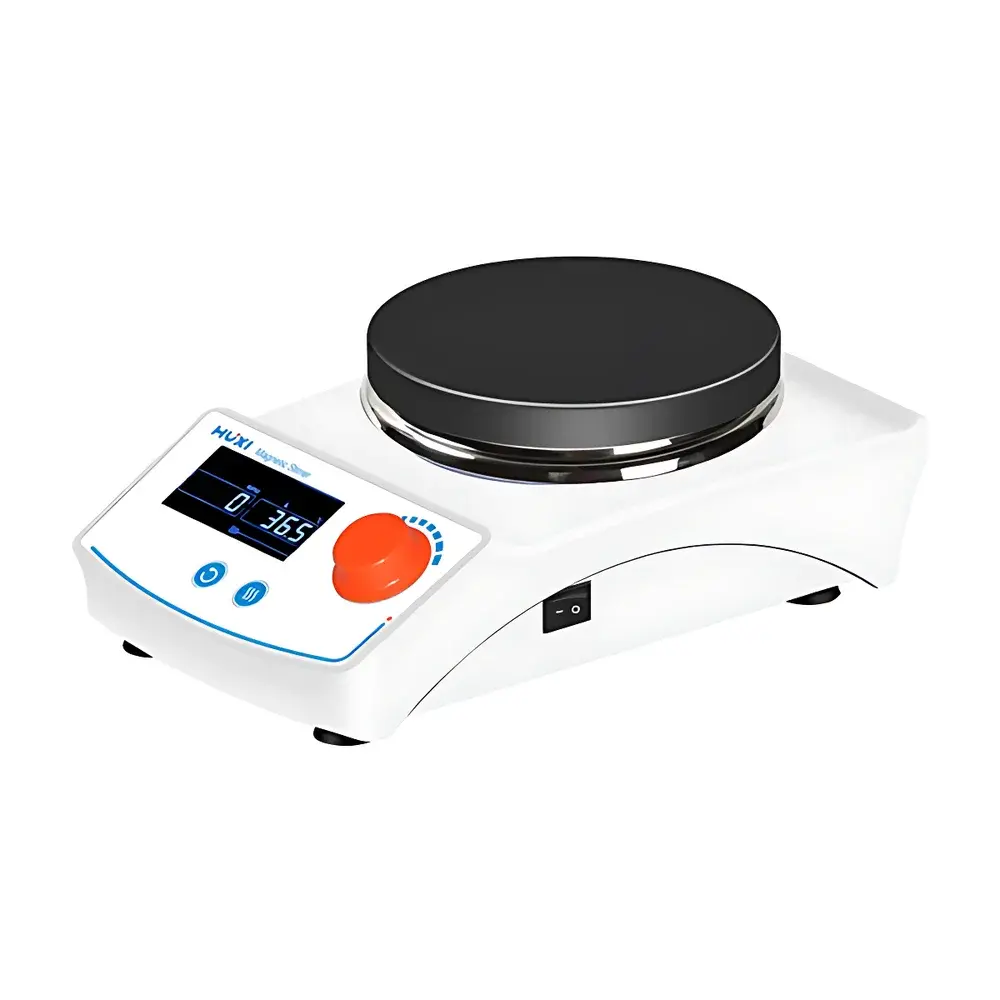
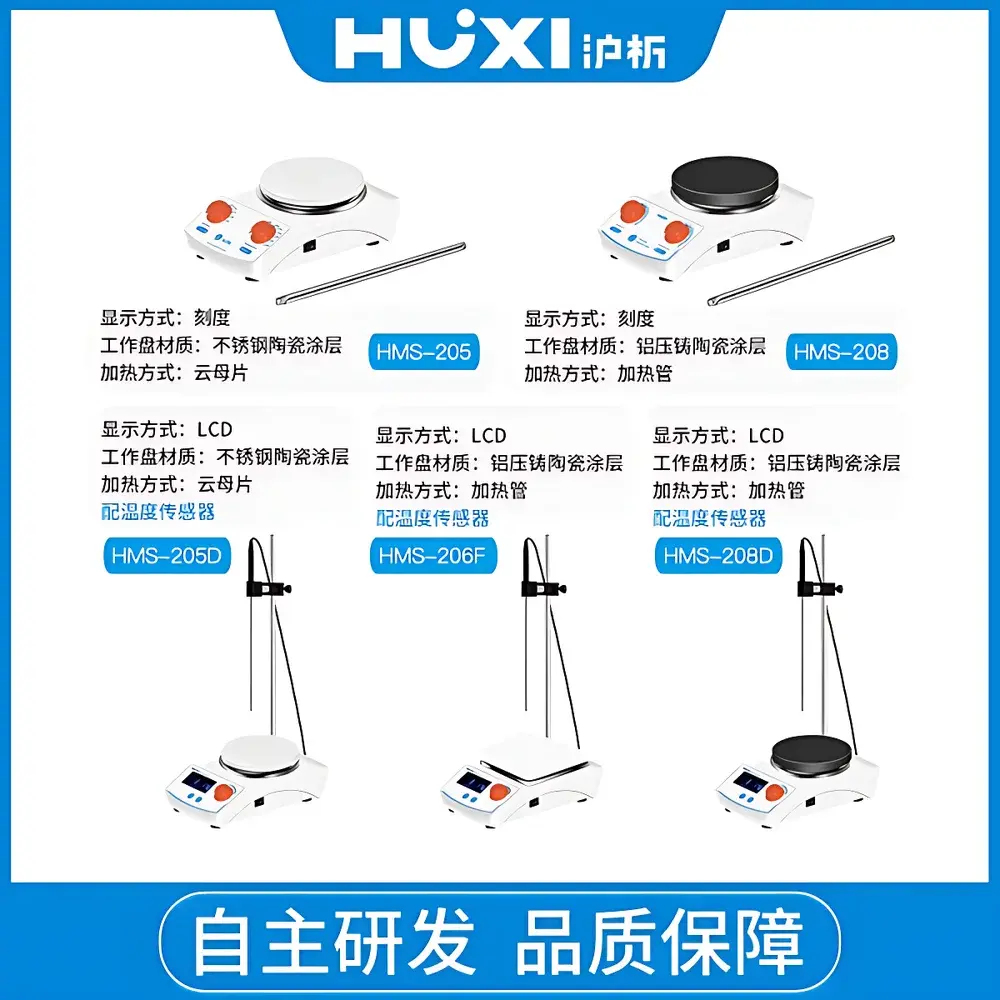
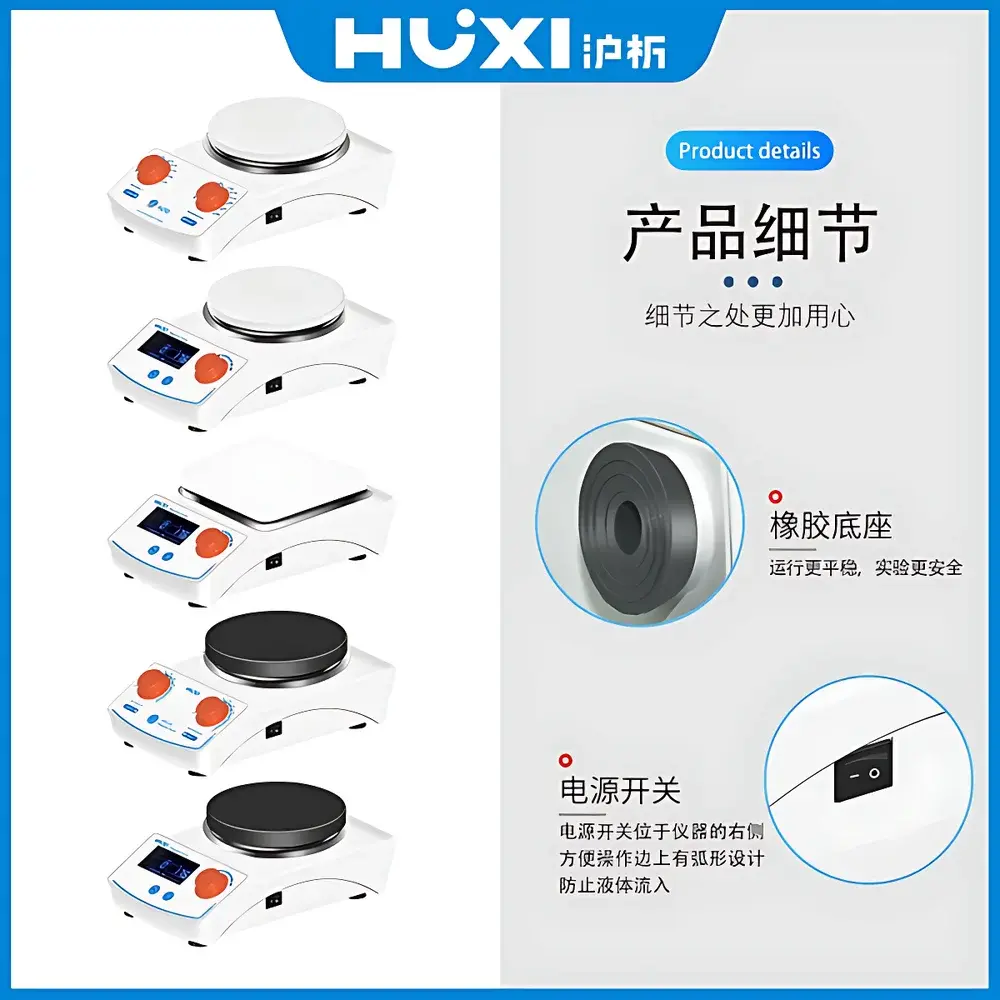
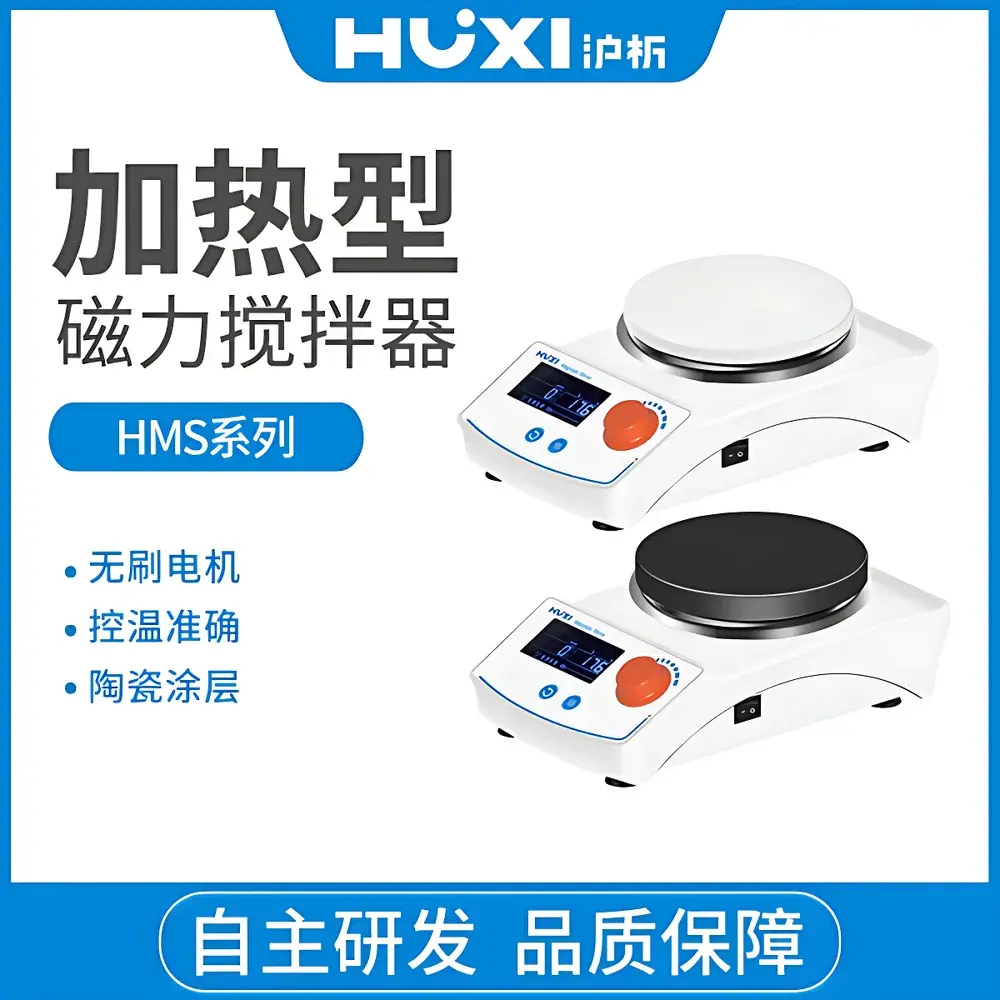
HUXI HMS-208D Heated Magnetic Stirrer
| Brand | HUXI |
|---|---|
| Origin | Shanghai, China |
| Manufacturer Type | Direct Manufacturer |
| Product Category | Domestic (China-made) |
| Model | HMS-208D |
| Instrument Type | Heated Magnetic Stirrer |
| Max. Stirring Volume | 20 L |
| Speed Range | 100–2000 rpm |
| Temperature Control Range | RT+5°C to 400°C |
| Heating Power | 850 W |
| Motor Output Power | 15 W |
| Total Power | 900 W |
| Plate Dimensions | Ø145 mm |
| Plate Material | Aluminum Die-Cast with Ceramic Coating |
| Heating Method | Embedded Heating Element with Mica Insulation |
| External Temperature Sensor | PT1000 |
| Temp. Resolution | 0.1°C |
| Temp. Setting Accuracy | ±0.1°C |
| Temp. Control Accuracy | ±0.2°C (with external probe), ±1.0°C (without probe) |
| Over-Temperature Protection | ≤450°C |
| Timer Range | 1–99 h 59 min |
| Operating Ambient | 5–40°C, ≤80% RH |
| Net Weight | 4 kg |
| Overall Dimensions | 165 × 280 × 105 mm |
Overview
The HUXI HMS-208D Heated Magnetic Stirrer is an industrial-grade laboratory instrument engineered for precise, stable, and reproducible simultaneous heating and magnetic stirring of liquid and solid–liquid mixtures. It operates on the principle of rotating magnetic fields generated by a permanent magnet array beneath a thermally robust ceramic-coated aluminum plate, inducing rotational motion in PTFE- or glass-coated magnetic stir bars immersed in the sample vessel. Unlike basic stirrers, the HMS-208D integrates dual-loop temperature control architecture and high-fidelity external feedback via a calibrated PT1000 resistance temperature detector (RTD), enabling closed-loop thermal regulation with ±0.2°C accuracy across its full operational range (RT+5°C to 400°C). Designed for continuous-duty applications in R&D, quality control, and preparative chemistry labs, it meets fundamental engineering requirements for thermal uniformity, mechanical stability, and electrical safety under ISO/IEC 17025-aligned laboratory environments.
Key Features
- Ceramic-coated aluminum die-cast heating plate (Ø145 mm) offering exceptional resistance to chemical corrosion, thermal oxidation, and mechanical abrasion — suitable for prolonged exposure to acidic, alkaline, and organic solvents.
- Dual independent heating control circuits: redundancy ensures uninterrupted thermal stability even if one circuit fails — critical for unattended overnight reactions or GxP-compliant processes.
- Brushless DC motor delivering smooth, low-noise operation (≤45 dB(A)) with consistent torque output across the full speed range (100–2000 rpm), eliminating brush wear and reducing maintenance intervals.
- Backlit LCD display showing real-time values for setpoint and actual temperature, rotational speed, elapsed time, and timer countdown — all with 0.1°C and 1 rpm resolution.
- Programmable timer (1–99 h 59 min) with auto-shutdown function; independent toggle for heating activation, visually confirmed by illuminated LED status indicator.
- Mica-insulated embedded heating elements providing rapid thermal response and uniform heat distribution — validated by surface temperature mapping per ASTM E220.
- Integrated safety systems including over-temperature cutoff (≤450°C), IP20-rated sealed housing to prevent ingress of liquids or vapors, and rotary knob lock mechanism to prevent accidental parameter changes during operation.
Sample Compatibility & Compliance
The HMS-208D accommodates standard round-bottom flasks, beakers, and reaction vessels up to 20 L volume when used with appropriately sized stir bars (recommended length: 20–80 mm; supplied: two C-type stir bars, 7×25×1 mm and 8×25×1 mm). Its wide temperature span supports solvent reflux, catalyst activation, polymer dissolution, and pre-crystallization conditioning. The unit complies with IEC 61010-1:2010 for electrical safety in laboratory equipment and incorporates design elements aligned with GLP documentation requirements — including non-volatile parameter storage, timestamped operation logs (via optional RS232/USB interface), and traceable thermal calibration pathways using NIST-traceable PT1000 sensors.
Software & Data Management
While the HMS-208D operates as a standalone benchtop device, its RS232 communication port (optional accessory) enables integration into centralized lab data management systems. When connected to compatible PC software, users can remotely configure setpoints, log temperature and speed profiles at user-defined intervals (1–60 s), export CSV-formatted datasets for statistical process control (SPC), and generate audit-ready reports compliant with FDA 21 CFR Part 11 requirements — including electronic signatures, change history, and operator ID tagging. Firmware updates are delivered via secure USB flash drive, ensuring long-term compatibility with evolving digital lab infrastructure.
Applications
- Controlled-temperature synthesis of metal–organic frameworks (MOFs) and coordination polymers requiring extended heating/stirring cycles.
- Standardization of viscosity reference fluids per ASTM D445 and ISO 3104 protocols under thermostatically stabilized conditions.
- Preparation of homogeneous catalyst suspensions for hydrogenation or cross-coupling reactions.
- Accelerated solvent extraction (ASE) and leaching studies where thermal homogeneity directly impacts analyte recovery rates.
- Calibration of thermocouples and RTDs using traceable bath media under ISO/IEC 17025-accredited temperature validation procedures.
- QC testing of pharmaceutical excipients (e.g., methylcellulose gels) where batch-to-batch rheological consistency depends on precise thermal history control.
FAQ
What is the maximum recommended vessel size for optimal stirring efficiency?
For uniform mixing and thermal transfer, use vessels with bottom diameters ≤120 mm; larger volumes (up to 20 L) require careful selection of stir bar geometry and placement relative to the center of the heated zone.
Can the HMS-208D be used under inert atmosphere conditions?
Yes — the sealed aluminum housing and absence of internal fans permit safe operation inside gloveboxes or nitrogen-purged enclosures, provided ambient humidity remains below 80% RH.
Is PT1000 sensor calibration required before first use?
The factory-calibrated PT1000 sensor is certified to ±0.1°C accuracy at 25°C and 100°C; users should verify performance annually against a NIST-traceable reference thermometer per ISO/IEC 17025 clause 6.6.
Does the instrument support ramp-and-soak temperature programming?
No — the HMS-208D provides single-setpoint temperature control only; multi-step thermal profiles require external programmable controllers interfaced via analog output (0–10 V) or RS232.
What maintenance is recommended for long-term reliability?
Wipe the ceramic plate with ethanol after each use; inspect stir bar integrity monthly; verify heater zero-offset annually using a calibrated IR thermometer; retain firmware update records for ISO audits.



