
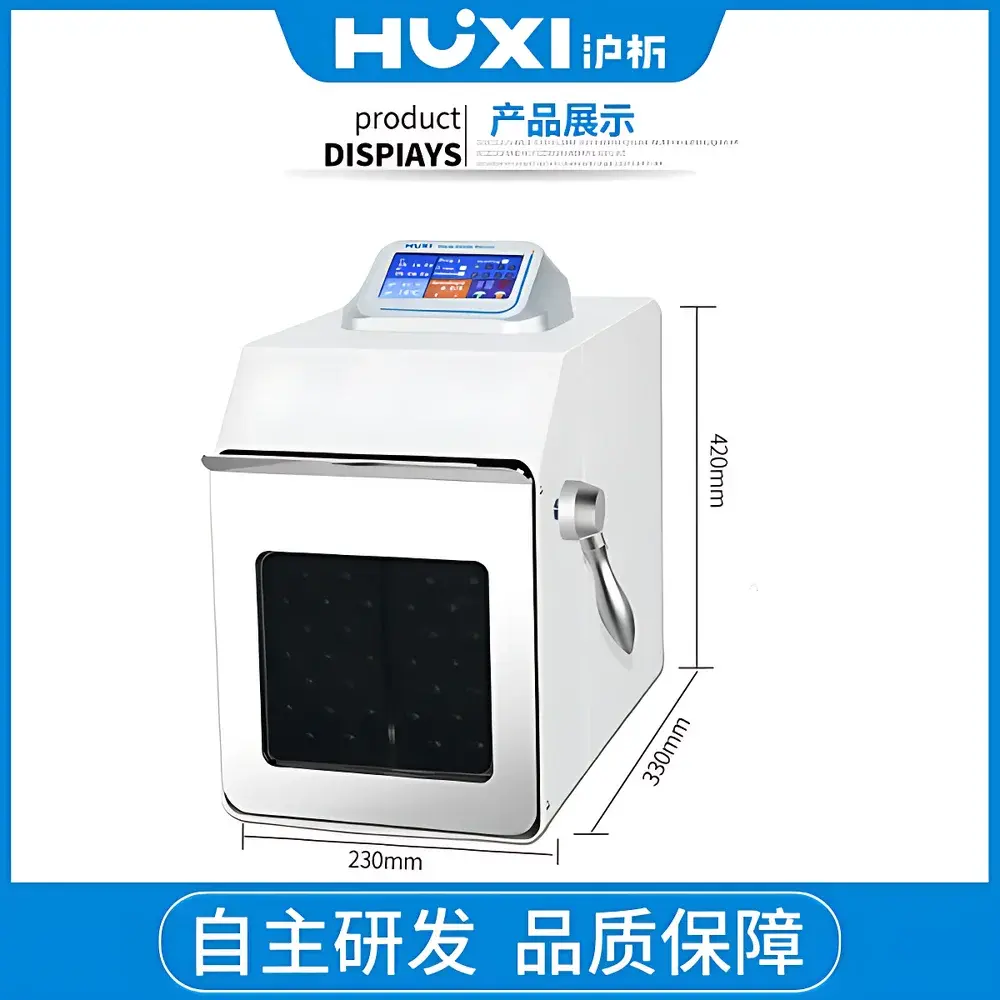
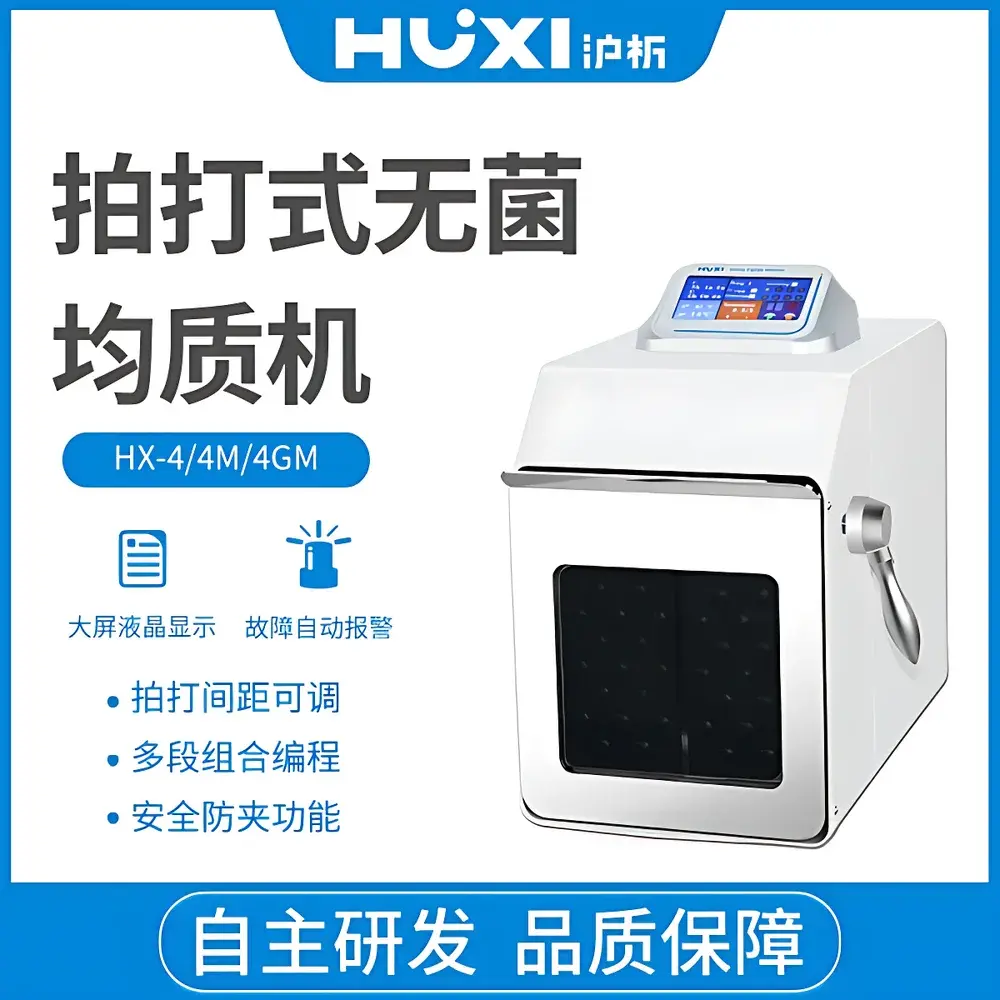
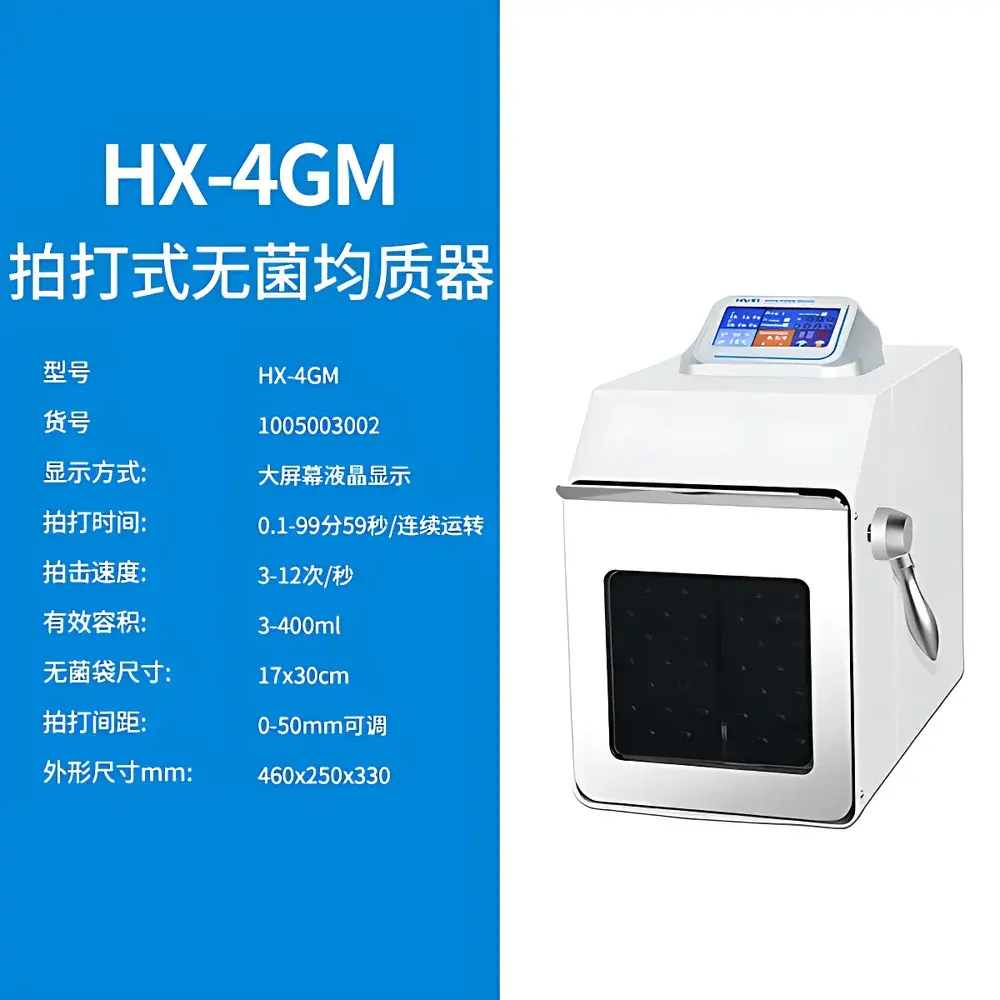
HUXI HX-4GM Stomacher-Type Aseptic Homogenizer
| Brand | HUXI |
|---|---|
| Origin | Shanghai, China |
| Manufacturer | HUXI (OEM/ODM Capable) |
| Instrument Type | Stomacher-Style (Pulsed Beating) |
| Dimensions (W×D×H) | 420 × 230 × 330 mm |
| Sample Volume Range | 3–400 mL |
| Control System | Microprocessor-Based with 8 Programmable Protocols |
| Beating Frequency | 3–12 cycles/sec |
| Beating Duration | 0.1 sec to 99 h 59 min 59 sec (or continuous mode) |
| Sterile Bag Size | 17 × 30 cm |
| Beating Chamber Material | Stainless Steel + Anti-Corrosion Coating |
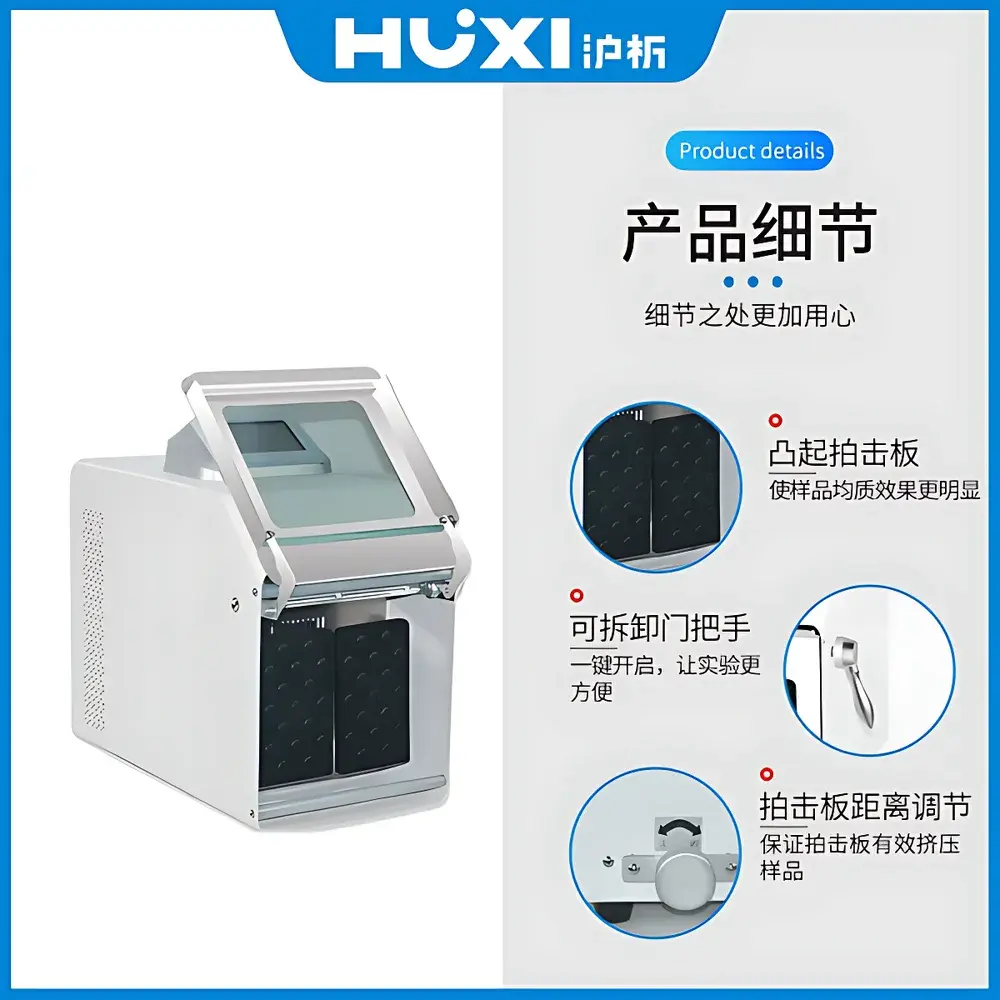
| Beating Gap Adjustment | 0–50 mm |
| Viewing Window | Removable Tempered Glass |
| Safety Features | Auto-Stop Anti-Pinch Mechanism, Soft-Start Activation, Pause Function |
| Disinfection | Built-in UV-C Lamp (253.7 nm) |
| Power Supply | 220 V AC, 500 W |
| Net Weight | 22 kg |
| Display | Large Backlit LCD |
Overview
The HUXI HX-4GM Stomacher-Type Aseptic Homogenizer is a precision-engineered laboratory instrument designed for the gentle, reproducible, and contamination-free homogenization of solid and semi-solid biological samples under aseptic conditions. Operating on the stomacher (pulsed beating) principle, it subjects sealed sterile sample bags to controlled mechanical oscillation between two parallel plates — one stationary and one reciprocating — generating consistent shear and impact forces without direct contact between the sample and instrument surfaces. This method ensures minimal thermal generation (<1 °C rise under standard protocols), no cellular lysis artifacts from excessive shear, and preservation of microbial viability and structural integrity — critical for quantitative microbiological assays, pathogen recovery, and downstream molecular analysis. The system complies with core principles outlined in ISO 6887-1:2017 (microbiological examination of food and animal feeding stuffs) and ASTM D6975-04 (standard practice for preparation of environmental samples for culturing), supporting validated workflows in regulated environments.
Key Features
- Microprocessor-controlled operation with eight user-programmable protocols, enabling precise replication of beating frequency (3–12 cycles/sec), duration (0.1 sec to 99 h 59 min 59 sec), and gap settings (0–50 mm).
- Integrated UV-C disinfection module (253.7 nm wavelength) for decontamination of the beating chamber interior between runs — reducing cross-contamination risk without chemical residues.
- Full-access tempered glass viewing window and fully opening front door facilitate rapid visual inspection, bag loading/unloading, and chamber cleaning; all internal surfaces are constructed from electropolished stainless steel with corrosion-resistant coating.
- Patented soft-start activation and auto-stop anti-pinch mechanism ensure operator safety and prevent bag rupture during initialization or misalignment.
- No sample contact with instrument components: all processing occurs inside single-use, certified sterile homogenization bags (17 × 30 cm), eliminating carryover, cross-contamination, and post-run cleaning requirements.
- Acoustically optimized enclosure achieves >35 dB(A) noise reduction, enabling integration into shared laboratory spaces without acoustic interference.
Sample Compatibility & Compliance
The HX-4GM accommodates a broad spectrum of sample matrices — including raw meat, poultry, seafood, leafy greens, dairy products, cosmetic emulsions, clinical tissue biopsies, and pharmaceutical suspensions — within its 3–400 mL working volume range. Its non-invasive, low-shear homogenization preserves microbial cell morphology and cultivability, supporting compliance with ISO/IEC 17025:2017 (general requirements for competence of testing and calibration laboratories) and facilitating adherence to FDA Bacteriological Analytical Manual (BAM) Chapter 4 (Aerobic Plate Count) and USP Microbiological Examination of Nonsterile Products. All homogenization bags are manufactured to meet EN 14682:2014 specifications for extractable substances and are supplied with individual sterility certificates (SAL 10⁻⁶). The instrument’s design supports GLP-compliant documentation when paired with external audit-trail-capable LIMS or ELN systems.
Software & Data Management
While the HX-4GM operates via an embedded microcontroller interface (no proprietary PC software required), its large backlit LCD display provides real-time parameter feedback, protocol recall history, and error logging (e.g., over-torque events, lid-open interruptions). Each protocol stores beating speed, time, and gap setting as discrete parameters — enabling traceable method execution per ISO 17025 clause 7.2.2. For laboratories requiring electronic records, the device supports manual entry into compliant data management platforms; optional RS-232 or USB-to-serial adapters (sold separately) enable automated timestamped protocol export for integration with 21 CFR Part 11–compliant systems when validated per organizational SOPs.
Applications
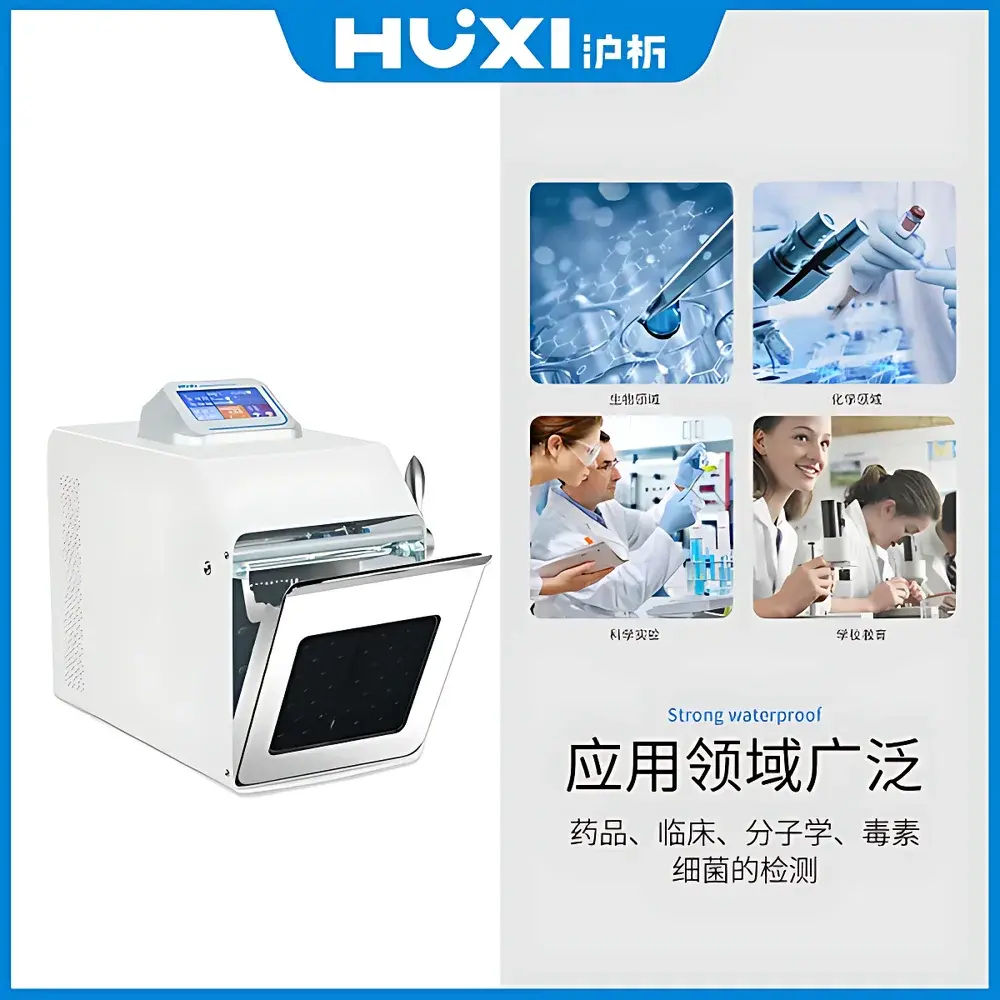
- Food safety testing: Recovery of Salmonella, Listeria monocytogenes, and E. coli O157:H7 from ground beef, ready-to-eat salads, and frozen seafood.
- Clinical microbiology: Homogenization of biopsy specimens, wound swabs, and stool samples prior to culture or PCR-based detection.
- Pharmaceutical QC: Uniform dispersion of active ingredients in topical ointments and suspension-based dosage forms for assay validation.
- Environmental monitoring: Extraction of biofilm-associated bacteria from membrane filters and water concentrates.
- Research applications: Preparation of single-cell suspensions from murine intestinal tissues and plant root nodules for flow cytometry and metagenomic sequencing library construction.
FAQ
What types of sterile bags are compatible with the HX-4GM?
The instrument is optimized for use with 17 × 30 cm polyethylene or nylon-reinforced sterile homogenization bags meeting ISO 7218:2017 Annex B specifications. Custom bag dimensions may be accommodated upon verification of mechanical fit and sealing integrity.
Does the HX-4GM require routine calibration?
No formal calibration is mandated per manufacturer specification; however, periodic verification of beating frequency accuracy (±0.2 cycles/sec) and timer deviation (±0.5 sec over 5 min) is recommended per internal quality assurance protocols.
Can the unit operate continuously for extended durations?
Yes — the continuous mode supports uninterrupted operation up to 99 hours, provided ambient temperature remains ≤30 °C and ventilation grilles remain unobstructed.
Is UV-C disinfection sufficient for biosafety level 2 (BSL-2) agents?
UV-C irradiation (253.7 nm) effectively inactivates vegetative bacteria and viruses on exposed chamber surfaces but does not penetrate organic residue or shadowed areas; therefore, it serves as a supplementary — not primary — decontamination step. Surface wipe disinfection with EPA-registered hospital-grade agents remains necessary after handling BSL-2 samples.
How is traceability maintained across multiple users?
Each protocol is assigned a numeric ID (1–8); operators must manually log protocol selection, sample ID, and run timestamp in a bound notebook or electronic system. No built-in user authentication or digital signature capability is included.



