
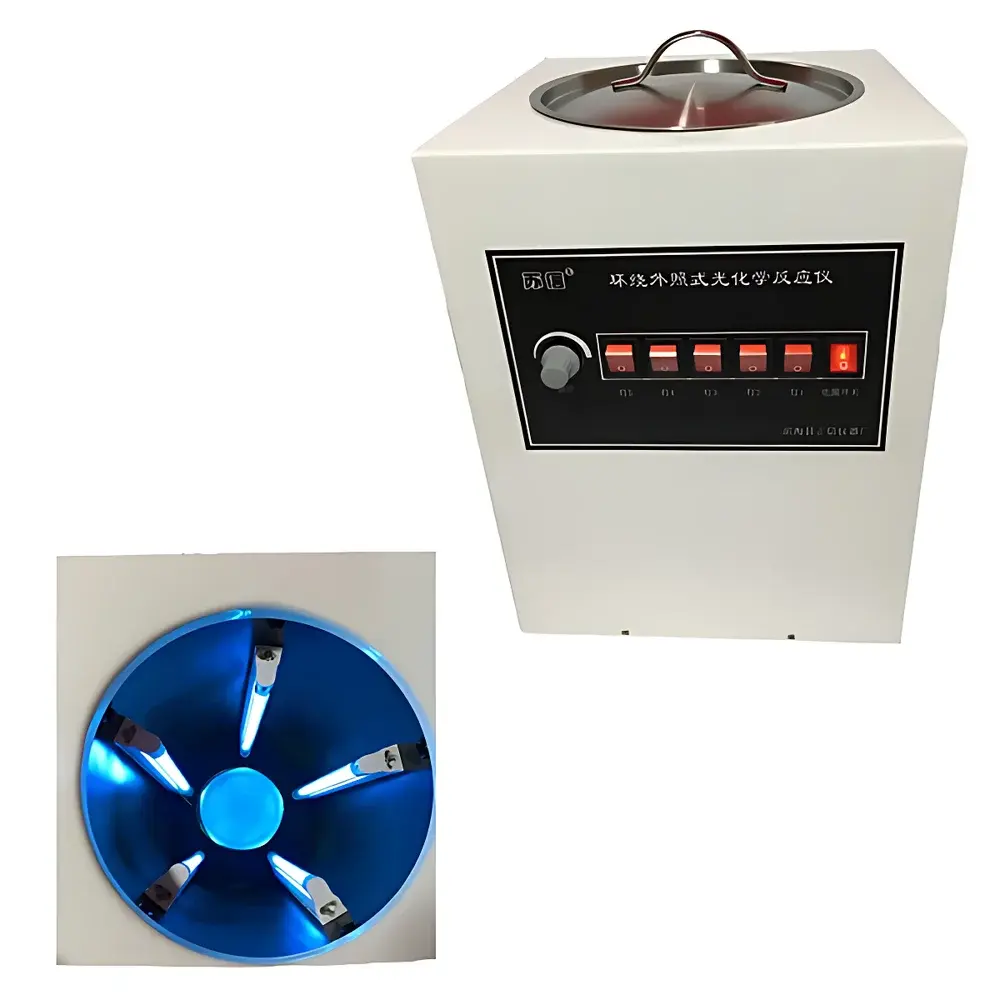
ZXF-LCA Circumferential Photochemical Reactor by Zhengxin Instrument Factory
| Brand | Zhengxin Instrument Factory |
|---|---|
| Origin | Jiangsu, China |
| Manufacturer Type | General Distributor |
| Country of Origin | China |
| Model | ZXF-LCA |
| Price | USD 1,550 (approx.) |
| Reaction Volume | Small-scale (≤50 mL) |
| Construction Material | 316 Stainless Steel |
| Operating Pressure | Low-pressure (≤0.1 MPa) |
| Vacuum Capability | Up to −0.095 MPa (absolute) |
| Light Source | Five independently controlled low-pressure Hg lamps (254 nm, 8 W each), quartz reaction vials included |
| Power Supply | 220 V AC, 50 Hz |
| Stirring | Integrated high-torque magnetic stirrer |
Overview
The ZXF-LCA Circumferential Photochemical Reactor is an engineered benchtop system designed for controlled, reproducible photochemical experimentation under ultraviolet (UV-C) irradiation. It operates on the principle of uniform circumferential photon delivery—five independently addressable low-pressure mercury vapor lamps (254 nm) surround the central reaction zone, ensuring isotropic illumination of cylindrical quartz reaction vessels. This geometry minimizes radial light intensity gradients and eliminates shadowing effects common in single-source configurations, thereby enhancing photon flux homogeneity across the entire liquid phase. The reactor supports both static and magnetically agitated reaction media, enabling rigorous kinetic studies—including quantum yield determination, time-resolved product analysis, and radical trapping experiments—under defined photonic, thermal, and mass-transfer conditions. Its low-pressure stainless-steel construction (316 SS) accommodates inert or reducing atmospheres and permits mild vacuum operation (down to −0.095 MPa absolute), facilitating solvent degassing, O2-free reactions, and volatile product capture.
Key Features
- Circumferential illumination architecture with five individually switchable 8 W, 254 nm UV-C lamps—each housed in quartz-shielded sockets for spectral stability and thermal isolation
- Integrated high-torque magnetic stirring mechanism with speed regulation (0–1,200 rpm), ensuring homogeneous mixing without introducing mechanical seals or contamination pathways
- Reaction chamber fabricated from electropolished 316 stainless steel with ISO-KF vacuum flange interface and pressure-rated sealing (max. working pressure: 0.1 MPa gauge)
- Standard quartz reaction vials (10–50 mL capacity) with conical bases and PTFE-sealed caps—compatible with TiO2 coating, photocatalyst immobilization, and gas-permeable septa
- Dedicated front-panel control: independent lamp toggles, stirrer ON/OFF and speed dial, master power switch, and status LEDs—no software dependency for basic operation
- Modular lamp compatibility: socket design accepts alternative UV (185/365 nm), visible (LED arrays), or simulated solar sources upon request—subject to optical path recalibration
Sample Compatibility & Compliance
The ZXF-LCA accommodates heterogeneous (solid catalyst + liquid/gas phase), homogeneous (dissolved photosensitizers), and biphasic systems. Quartz vials transmit >90% of 254 nm photons and resist ozone degradation during prolonged UV exposure. The reactor complies with general laboratory safety standards for Class 3B UV equipment (IEC 60825-1), requiring operator shielding (e.g., UV-blocking face shield and gloves) during lamp operation. While not certified to specific ISO or ASTM photochemical test methods out-of-the-box, its design aligns with experimental requirements outlined in ASTM D4340 (photolysis rate testing), ISO 10678 (aqueous photocatalytic oxidation), and USP for extractables assessment under UV stress. Vacuum and pressure ratings meet ASME B31.3 process piping guidelines for low-energy laboratory service.
Software & Data Management
The base configuration operates without proprietary software—lamp activation, stirring, and timing are manually controlled. For advanced workflow integration, optional RS-485 or USB-to-serial adapters enable external logging of operational states (lamp status, stir speed, elapsed time) via third-party DAQ systems (e.g., LabVIEW, Python-based PySerial). Audit trails for experimental parameters can be generated using timestamped lab notebooks or ELN platforms compliant with 21 CFR Part 11 when paired with electronic signature-capable hardware. No embedded firmware updates or cloud connectivity are provided; all calibration and maintenance records remain user-managed per GLP documentation practices.
Applications
- Quantitative evaluation of photocatalytic degradation kinetics (e.g., methylene blue, phenol, pharmaceutical residues) under standardized UV-C fluence
- Synthesis of metal–organic frameworks (MOFs) and coordination polymers via photoinduced ligand exchange or redox activation
- Photochemical C–H functionalization and [2+2] cycloadditions in flow-compatible batch mode
- Environmental simulation studies: atmospheric pollutant photolysis (NOx, VOCs), water disinfection efficacy testing, and ROS (•OH, O2•−) quantification via probe compounds
- Photobiological assays involving UV-sensitive enzymes, nucleic acid damage modeling, and photostability screening of APIs per ICH Q1B
FAQ
What is the maximum recommended operating temperature for continuous use?
The reactor is rated for ambient to 60 °C internal vessel temperature under standard lamp configuration; active cooling (e.g., circulating chiller jacket) is advised above 45 °C to preserve quartz integrity and lamp lifetime.
Can the system be used under inert gas (e.g., N2 or Ar)?
Yes—the sealed 316 SS chamber supports purging cycles and maintains atmosphere integrity at ≤0.1 MPa gauge pressure; Schlenk-line or glovebox integration is feasible via KF-16 port.
Is lamp spectral output certified and traceable to NIST standards?
Lamp spectral profiles are vendor-characterized per manufacturer datasheets; full NIST-traceable radiometric calibration requires third-party spectroradiometer validation (e.g., using a calibrated CCD-based spectrometer with cosine corrector).
Are spare quartz vials and lamp assemblies available as consumables?
Yes—standard 25 mm OD × 100 mm L quartz vials (with PTFE-lined caps) and 8 W, 254 nm low-pressure Hg lamps are stocked as replaceable components with documented lot-specific UV output decay curves.
Does the magnetic stirrer support Teflon-coated stir bars up to 40 mm length?
Yes—the stir plate delivers consistent torque up to 40 mm bar length in 50 mL vials at speeds ≥300 rpm; vortex formation is minimized via optimized impeller geometry and vessel aspect ratio.
Related Products



