
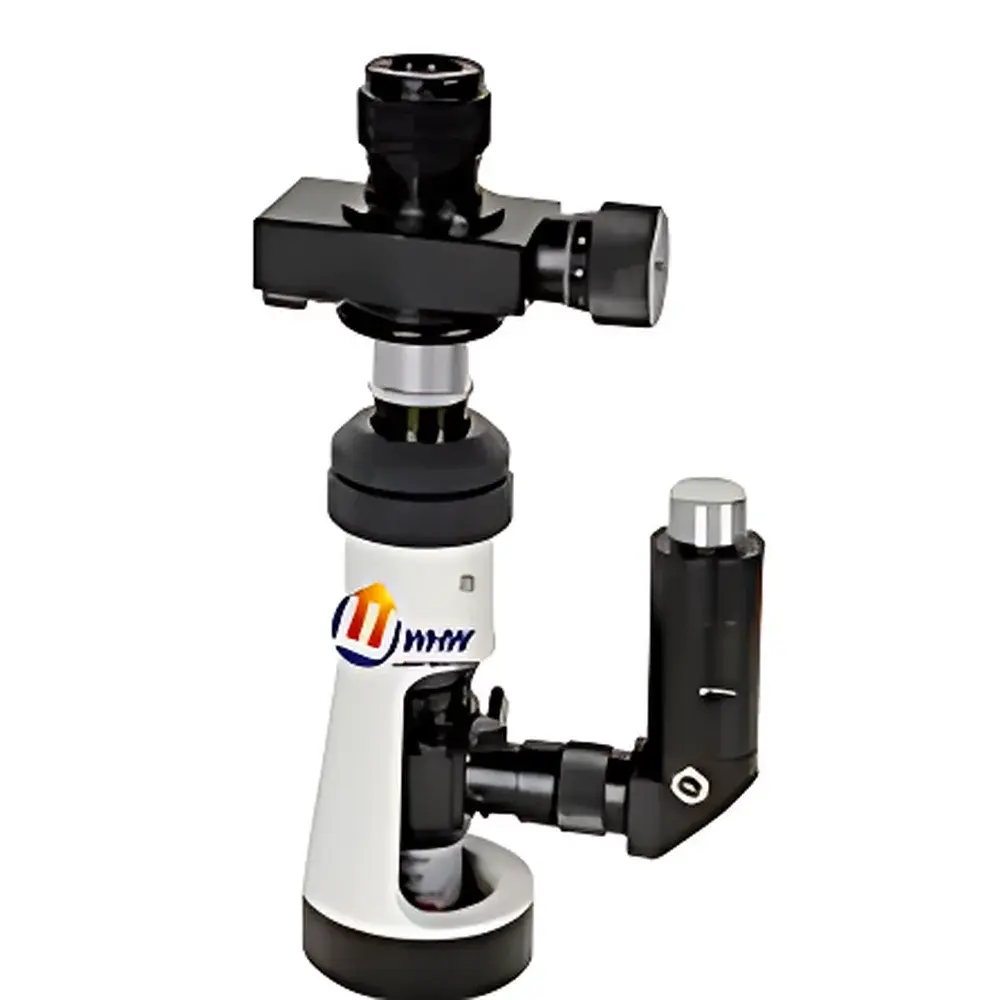
YANRUN HMM-240 Portable Metallurgical Microscope
| Brand | YANRUN |
|---|---|
| Origin | Shanghai, China |
| Manufacturer Type | Direct Manufacturer |
| Product Category | Upright Metallurgical Microscope |
| Model | HMM-240 |
| Optical Magnification Options | 20×, 50×, 100×, or 400× (user-selectable configuration) |
| Eyepiece | 10× wide-field (18 mm field number) |
| Objective Lenses | Single fixed objective from 2×, 5×, 10×, or 40× (pre-configured per unit) |
| Mechanical Tube Length | 160 mm |
| Focusing Range | 25 mm with coaxial coarse/fine focus mechanism |
| Illumination | Adjustable-intensity LED (DC 4.2 V) |
| Optional Accessories | Plan metallurgical objectives (4×, 20×, 50×), 5.6-inch external display module, digital eyepiece adapter, polarizing kit, magnetic XY translation stage |
Overview
The YANRUN HMM-240 Portable Metallurgical Microscope is an upright, manually operated optical instrument engineered for rapid in-situ microstructural examination of polished and etched metallic specimens. Designed around a finite-conjugate optical path with standardized 160 mm mechanical tube length, the HMM-240 delivers consistent image fidelity across its four discrete magnification configurations (20×, 50×, 100×, or 400×), each realized through a fixed combination of a 10× wide-field eyepiece (18 mm field number) and a single objective lens (2×, 5×, 10×, or 40×). Its compact, self-contained architecture—integrated LED illumination (DC 4.2 V, continuously adjustable brightness), robust focusing mechanism (25 mm travel with coaxial coarse/fine controls), and ergonomic handling—enables reliable use in quality control labs, foundry floors, field service environments, and educational settings where benchtop space or electrical infrastructure is constrained.
Key Features
- Upright optical configuration optimized for reflected-light observation of opaque, conductive samples—no immersion oil or cover slips required.
- Fixed-magnification modular design ensures mechanical stability and optical alignment integrity; eliminates parfocal drift associated with multi-objective turrets.
- LED-based Köhler-compatible illumination provides uniform, cool-white (≈5500 K) contrast without thermal loading on heat-sensitive specimens.
- Coaxial coarse/fine focusing system with 25 mm vertical travel range accommodates specimens up to 22 mm in height, including standard metallographic mounts and as-cast sections.
- Wide-field 10× eyepiece (18 mm field number) enables efficient scanning of large-area microstructures at lower magnifications (e.g., grain size assessment per ASTM E112).
- Modular accessory compatibility—including plan-corrected metallurgical objectives (4×, 20×, 50×), polarizing kits for phase identification, and magnetic translation stages—supports method expansion without platform replacement.
Sample Compatibility & Compliance
The HMM-240 is validated for routine examination of ferrous and non-ferrous alloys, sintered metals, weld zones, and coated substrates following standard metallographic preparation protocols (grinding, polishing, chemical/electrolytic etching). Its reflected-light geometry conforms to ISO 4967 (determination of inclusion content), ASTM E3 (preparation of metallographic specimens), and ASTM E407 (etching methods). While the base model does not include digital imaging hardware or regulatory-compliant software, optional digital eyepiece adapters and external 5.6-inch displays permit documentation under internal QA procedures. Units are CE-marked for EMC and low-voltage safety (2014/30/EU and 2014/35/EU); no FDA 21 CFR Part 11 or ISO 13485 certification applies, as the device is classified as a general-purpose laboratory instrument—not a medical or diagnostic device.
Software & Data Management
The HMM-240 operates as a standalone optical instrument with no embedded firmware or proprietary software. Image capture and analysis require third-party hardware (e.g., USB digital eyepiece) and commercially available image analysis packages (e.g., ImageJ, Olympus cellSens, or Thermo Scientific Amira). When equipped with optional digital components, users may implement audit-trail-capable workflows compliant with GLP principles—provided metadata logging (timestamp, operator ID, magnification, lighting settings) is externally managed. No native data export, calibration certificate generation, or electronic signature functionality is integrated into the microscope’s core architecture.
Applications
- Routine QC inspection of casting porosity, inclusion distribution, and heat-affected zone morphology in automotive and aerospace components.
- Grain size evaluation (ASTM E112) and phase quantification (e.g., ferrite/pearlite ratio in carbon steels) using manual point-count or comparison chart methods.
- Failure analysis support—identifying intergranular cracking, decarburization depth, or coating delamination on cross-sectioned parts.
- Educational demonstration of solidification structures, eutectic morphologies, and deformation twins in undergraduate metallurgy laboratories.
- Field verification of surface treatment integrity (e.g., nitriding case depth estimation via etch contrast) when paired with portable hardness testers.
FAQ
Is the HMM-240 suitable for quantitative image analysis?
No—the base configuration lacks a digital imaging subsystem. Quantitative analysis requires integration with a separately purchased digital eyepiece and compatible third-party software.
Can I upgrade magnification after purchase?
Not without replacing the objective lens assembly; the HMM-240 ships with one fixed objective. Optional plan objectives (4×, 20×, 50×) are available as field-installable accessories but require mechanical recalibration.
Does it support polarized light microscopy?
Yes—when equipped with the optional polarizing kit, the HMM-240 enables birefringence contrast for identifying carbide types, oxide phases, or stress-induced anisotropy.
What is the maximum specimen height clearance?
With the stage fully lowered, the working distance between the objective front lens and stage surface is 22 mm—sufficient for standard 1″ × 1″ metallographic mounts and larger cast section samples.
Is calibration traceable to national standards?
Magnification accuracy is verified against NIST-traceable stage micrometers during final assembly; however, no formal calibration certificate is included unless requested as a paid option.




