
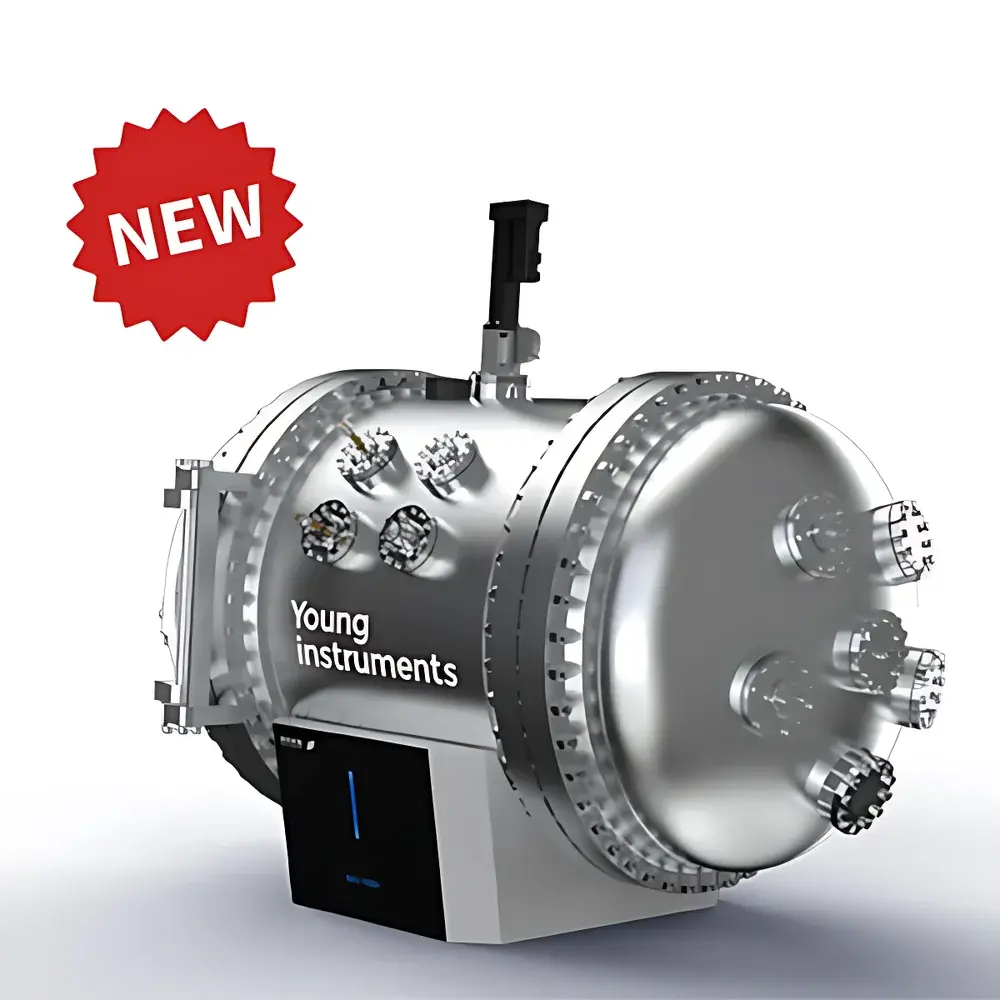
Young Instruments BAC-1000A Large-Scale Battery Adiabatic Calorimeter for Thermal Runaway and Gas Evolution Testing
| Brand | Young Instruments |
|---|---|
| Origin | Zhejiang, China |
| Manufacturer Type | Direct Manufacturer |
| Country of Origin | China |
| Model | BAC-1000A |
| Measurement Mode | Adiabatic Calorimetry |
| Instrument Type | Accelerating Rate Calorimeter (ARC) |
| Temperature Range | RT to 300 °C (–25 °C with optional low-temp module) |
| Adiabatic Chamber Dimensions | Ø420 mm × 520 mm depth |
| Self-Heating Detection Sensitivity | <0.02 °C/min |
| Wall-Sample Temperature Difference Control | 0.02–15 °C/min |
| Sealed Test Vessel Pressure Range | 0–2 MPa |
| Needle Penetration Stroke | Programmable |
| Current Capacity (Charge/Discharge Electrodes) | ±1000 A |
| Compliance Standards | GB/T 36276–2023, UL 9540A, SAE J2464–2009, ASTM E1981–98(2012), SN/T 3078.1–2012, UL 1973, SAND99-0497, FreedomCAR SAND2005-3123 |
Overview
The Young Instruments BAC-1000A is a large-scale adiabatic calorimeter engineered specifically for high-fidelity thermal safety evaluation of lithium-ion battery cells and small modules—particularly those with dimensions ranging from 100 mm to 1500 mm in length. Operating on the principle of adiabatic heat compensation, the instrument maintains near-zero heat exchange between the sample and its environment by dynamically adjusting the temperature of the surrounding thermal jacket to precisely match the sample’s instantaneous temperature rise. This enables true adiabatic conditions essential for quantifying intrinsic thermal runaway kinetics—including onset temperature (Tonset), maximum self-heating rate (dT/dt)max, adiabatic temperature rise (ΔTad), time-to-thermal-runaway (tTR), and total enthalpy release. The system integrates synchronized gas evolution measurement under sealed, pressure-monitored conditions—supporting quantitative analysis of gas volume, composition (when coupled with optional GC/MS or FTIR), and generation rate during exothermic decomposition.
Key Features
- High-sensitivity adiabatic control: Real-time thermal tracking with wall-sample differential maintained within ±0.02 °C/min across the full operational range (–25 °C to 300 °C), ensuring minimal deviation from ideal adiabatic behavior.
- Dual-mode thermal testing: Supports both classical accelerating rate calorimetry (ARC) and dedicated GB/T 36276–2023-compliant “adiabatic temperature rise characteristic” protocols for grid-scale energy storage batteries.
- Integrated electrochemical interface: Equipped with ±1000 A current-capable feedthroughs enabling simultaneous charge/discharge cycling and calorimetric monitoring—critical for evaluating low-temperature operational heat generation and specific heat capacity (Cp) under realistic duty cycles.
- Robust mechanical safety architecture: Includes rupture disc, pressure-relief valve, explosion-proof chamber lining, and multi-tiered alarm logic (pressure, temperature, voltage, gas accumulation) compliant with IEC 62619 and NFPA 855 risk mitigation requirements.
- Innovative thermo-gas coupling: Unique synchronized acquisition of temperature, pressure, and volumetric gas displacement data allows derivation of stoichiometric gas evolution profiles correlated directly with exothermic reaction stages.
Sample Compatibility & Compliance
The BAC-1000A accommodates prismatic, pouch, and cylindrical cells up to 1500 mm in length and supports modular testing of 2–8 cell configurations using standardized mounting fixtures. Its design adheres to international regulatory and industry-standard test methodologies including UL 9540A (for energy storage system hazard classification), SAE J2464 (electric vehicle battery safety), ASTM E1981 (accelerating rate calorimetry practice), and SN/T 3078.1 (chemical thermal stability assessment). All test sequences—including needle penetration, overcharge, external heating, and discharge-induced thermal propagation—are programmable and auditable per GLP/GMP-aligned data integrity frameworks. Full traceability is maintained through timestamped metadata, instrument calibration logs, and electronic signatures aligned with FDA 21 CFR Part 11 requirements.
Software & Data Management
The proprietary CALORIS™ v4.2 software provides real-time visualization of thermal, electrical, and pressure transients with configurable alarm thresholds and automated event tagging. Raw data streams are stored in HDF5 format with embedded metadata (sample ID, operator, ambient conditions, calibration certificates). Post-processing tools enable derivative analysis (dT/dt, dP/dt), Arrhenius parameter fitting, kinetic modeling (e.g., nth-order, autocatalytic), and comparative benchmarking against reference datasets. Export options include CSV, MATLAB .mat, and PDF reports pre-formatted to meet UL, CNAS, and TÜV documentation standards. Audit trails record all user actions—including method edits, data deletions, and report generation—with immutable timestamps and role-based access control.
Applications
- Thermal runaway propagation analysis in large-format LFP, NMC, and solid-state battery cells under abuse conditions (mechanical, electrical, thermal).
- Quantitative determination of specific heat capacity (Cp) and enthalpy of phase transitions at sub-zero temperatures—supporting cold-start performance validation for EV traction batteries.
- Gas evolution profiling for electrolyte decomposition pathway identification and SEI layer stability assessment.
- Validation of battery thermal management system (BTMS) design parameters, including minimum coolant flow rates and heater power requirements for low-temperature preconditioning.
- Regulatory submission support for UN 38.3, IEC 62133–2, and GB 38031–2020 certification testing.
FAQ
What battery formats can be tested in the BAC-1000A?
Standard configurations support single cells up to 1500 mm in length and small modules (2–8 cells) with custom fixture kits available for heterogeneous pack geometries.
Does the system comply with UL 9540A Section 7 (cell-level testing)?
Yes—the BAC-1000A implements the exact heating ramp profile, thermal isolation criteria, and data reporting structure specified in UL 9540A Annex A for cell-level thermal runaway characterization.
Can the instrument perform simultaneous charge/discharge while measuring heat flow?
Yes—integrated ±1000 A current feedthroughs and four-quadrant power conditioning allow dynamic cycling under active calorimetric monitoring without signal interference.
Is pressure data traceable to NIST standards?
All pressure transducers are factory-calibrated against NIST-traceable deadweight testers; calibration certificates are provided with each instrument and renewed annually per ISO/IEC 17025 procedures.
How is data integrity ensured during long-duration tests (e.g., >72 hours)?
Continuous checksum verification, redundant storage (SSD + network-attached backup), and automatic recovery from power interruption ensure zero data loss—even during multi-day adiabatic hold experiments.



