
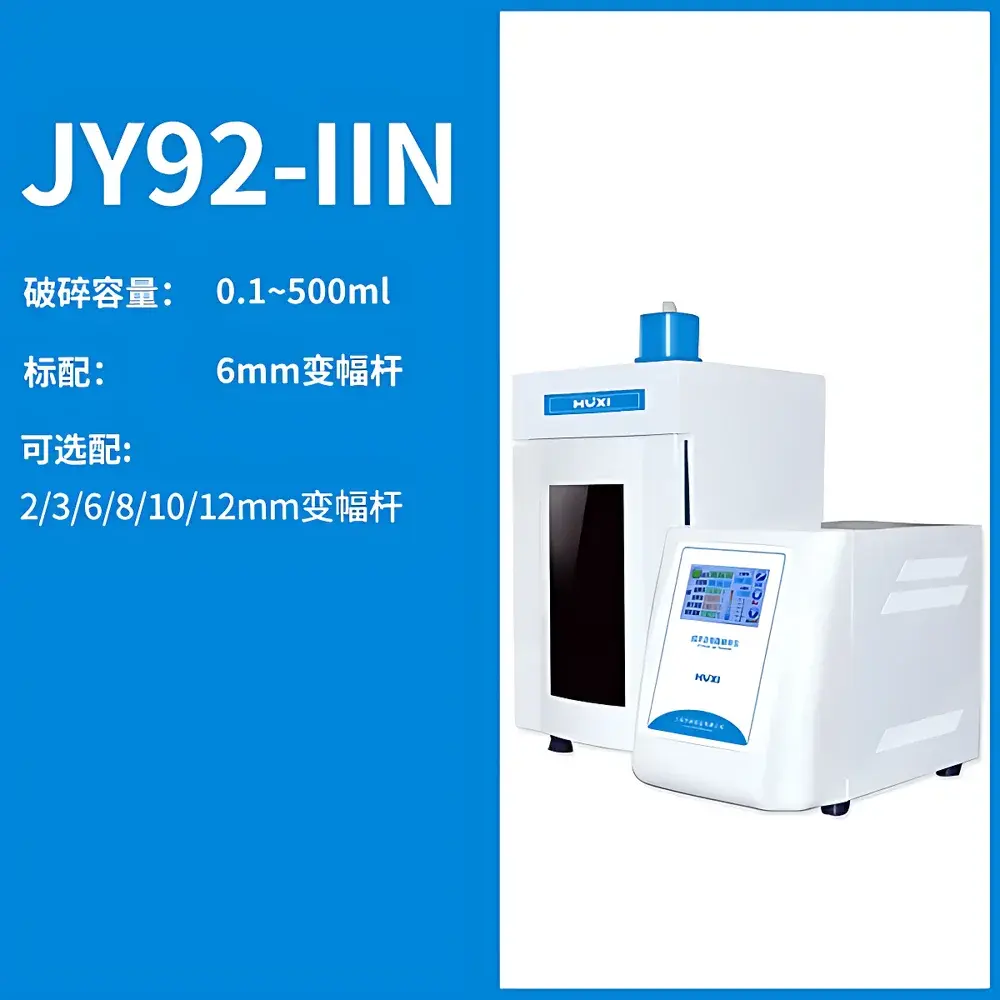
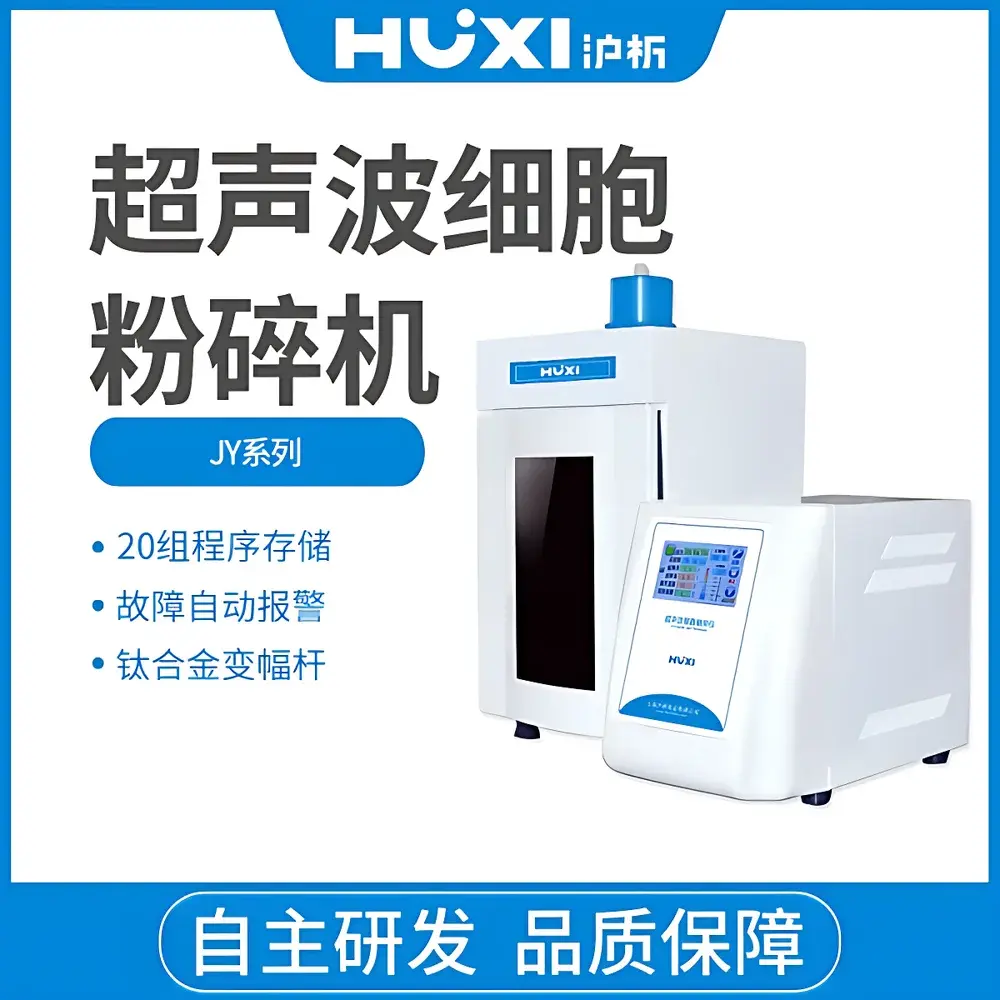
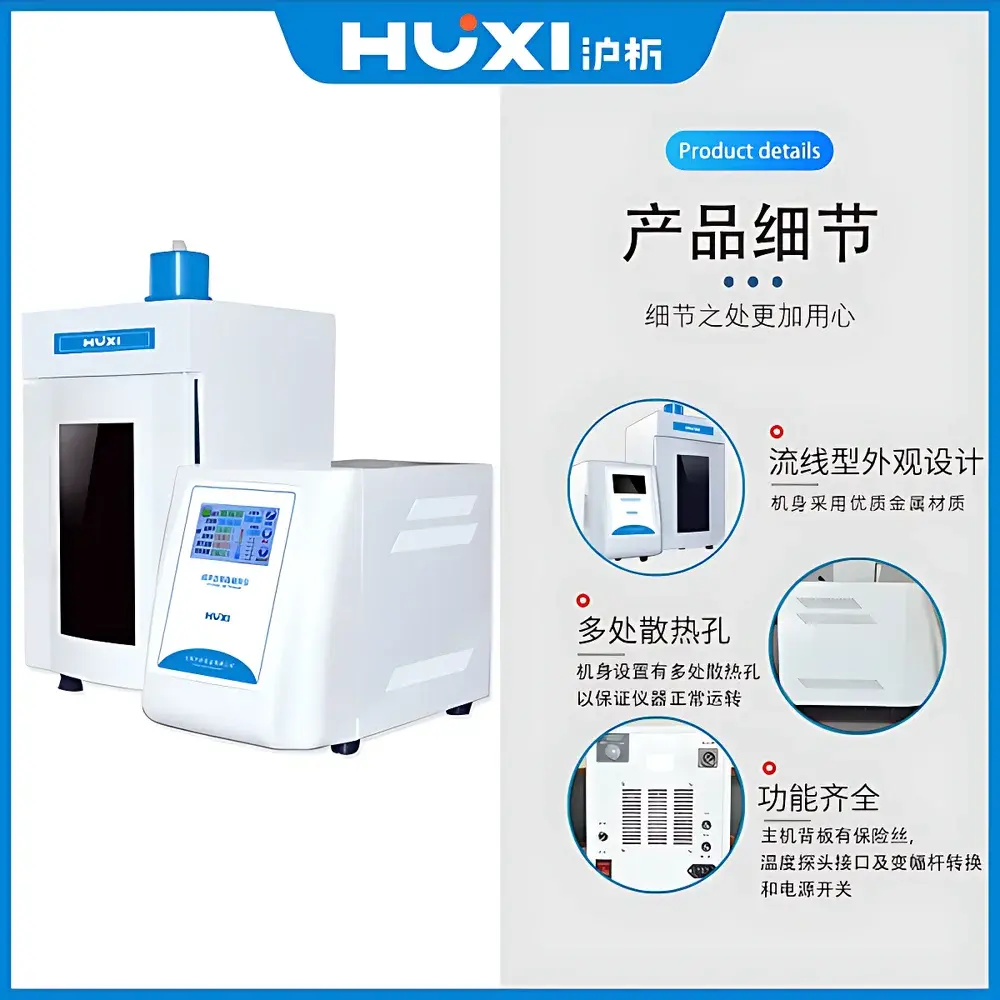
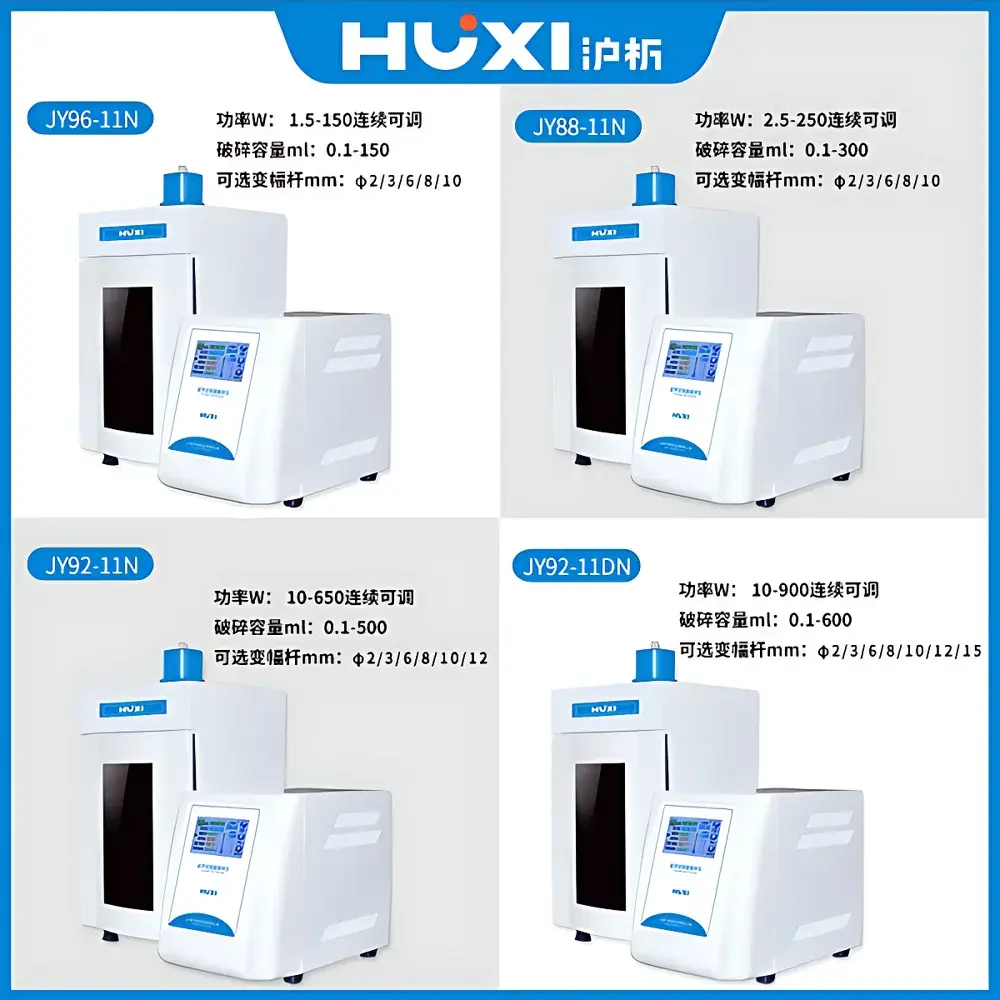
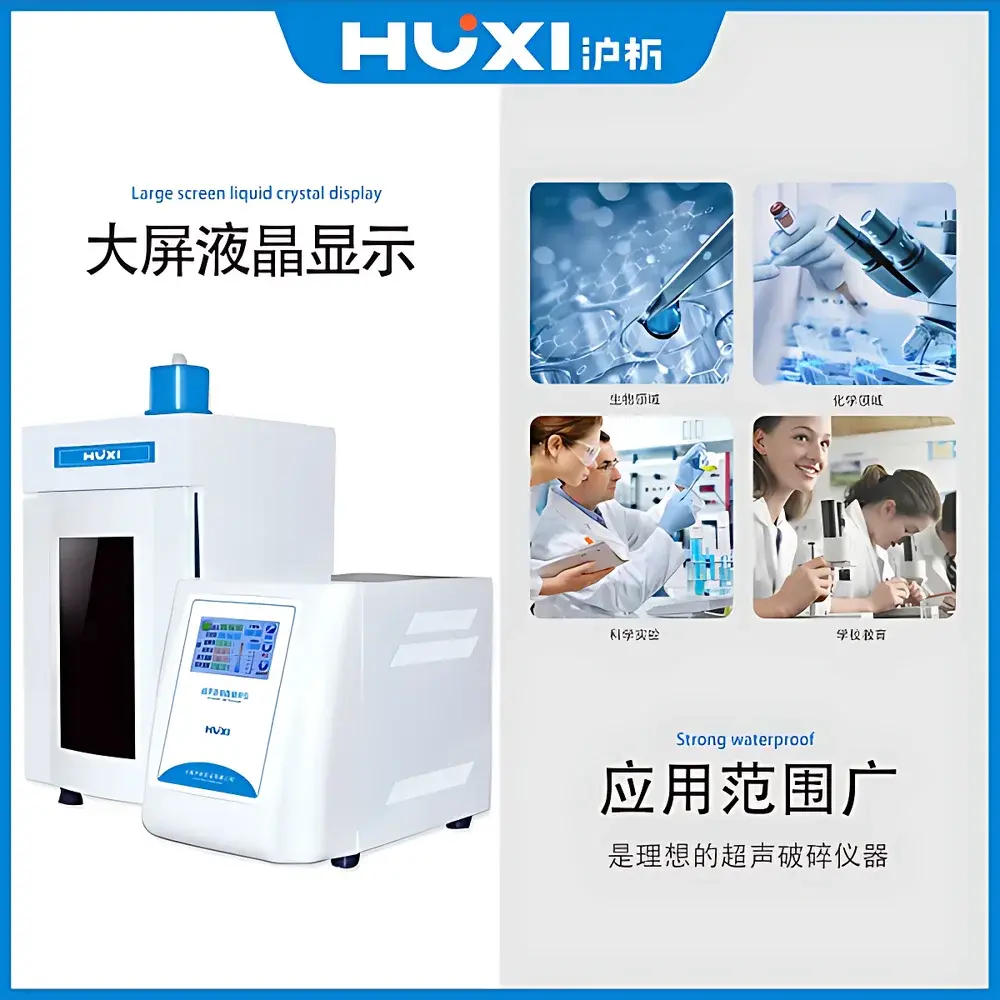
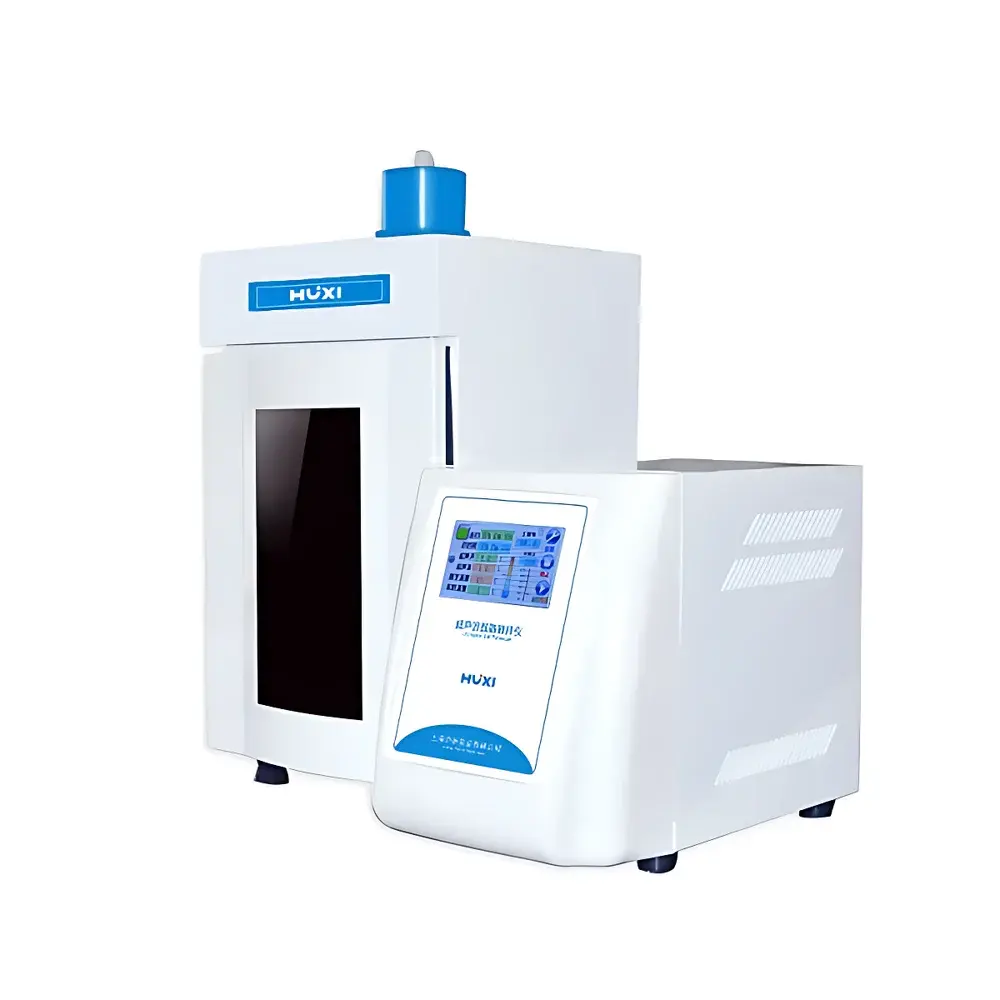
HUXI JY92-IIN Advanced Ultrasonic Cell Disruptor
| Brand | HUXI |
|---|---|
| Origin | Shanghai, China |
| Manufacturer Type | Direct Manufacturer |
| Product Category | Domestic |
| Model | JY92-IIN |
| Instrument Type | Ultrasonic Cell Disruptor |
| Ultrasonic Power Output | 10–650 W (continuously adjustable) |
| Operating Frequency | 20–25 kHz |
| Temperature Control Range | 0–100 °C (low-temperature circulator optional) |
| Sample Volume Capacity | 0.1–500 mL (requires compatible titanium alloy probe selection) |
| Sample Throughput | Single-sample processing per cycle |
| Display Interface | 4.3″ capacitive TFT touchscreen (7″ optional) |
| Ultrasound Pulse Duration | 0.1–99.9 s |
| Interval Duration | 0.1–99.9 s |
| Total Process Time | Up to 99 h 59 min 59 s |
| Duty Cycle | 0.1–99.9% |
| Probe Options | Φ2, Φ3, Φ6 (standard), Φ8, Φ10, Φ12 mm titanium alloy (Grade 5, ASTM B348) |
| Overload, No-Load, and Overtemperature Protection | Yes |
| Audible Alarm System | Integrated voice alerts for operational faults, temperature excursions, and probe immersion errors |
| Data Storage | 20 user-defined protocols |
| Communication Interface | RS232 or USB (optional PC connectivity & print export) |
| Power Supply | 220 V / 110 V, 50 / 60 Hz |
| Host Dimensions (D×W×H) | 410 × 225 × 290 mm |
| Host Net Weight | 12 kg |
| Host Gross Weight | 16 kg |
| Soundproof Enclosure Gross Weight | 10 kg |
| Enclosure Dimensions (L×W×H) | 350 × 350 × 550 mm |
| Noise Reduction | >70% (A-weighted dB reduction with enclosure) |
Overview
The HUXI JY92-IIN Advanced Ultrasonic Cell Disruptor is a precision-engineered benchtop instrument designed for controlled mechanical lysis of biological cells and subcellular structures via high-intensity ultrasonic cavitation. Operating within the 20–25 kHz frequency range, it generates transient microbubbles in liquid media whose rapid collapse imparts localized shear forces, hydrodynamic shockwaves, and extreme transient temperatures—mechanisms collectively responsible for membrane disruption, organelle release, and macromolecular solubilization. Unlike thermal or enzymatic lysis methods, ultrasonic disruption preserves native protein conformation and enzymatic activity when properly temperature-regulated, making it indispensable for preparing active lysates in structural biology, recombinant protein purification, nucleic acid extraction, and vaccine development workflows. The system’s architecture integrates a high-efficiency piezoelectric transducer (7075 aluminum alloy housing) coupled with medical-grade Grade 5 titanium alloy probes (ASTM B348 compliant), ensuring long-term acoustic transmission stability and corrosion resistance in aqueous and mildly acidic/basic buffers.
Key Features
- Microprocessor-controlled ultrasonic output with continuous 10–650 W power adjustment (±1% linearity) and real-time feedback regulation
- Intelligent frequency auto-tracking to maintain resonance stability across varying sample viscosity, temperature, and volume conditions
- Integrated Pt100 temperature sensor with digital display and programmable upper-limit cutoff (0–100 °C); optional recirculating chiller interface for cryo-lysis (−10 to +10 °C)
- Capacitive 4.3″ TFT touchscreen interface (7″ upgrade available) supporting multi-parameter protocol programming: pulse duration, duty cycle, total runtime, and probe-specific amplitude profiles
- Comprehensive hardware safety suite: automatic shutdown on no-load detection, overcurrent protection, thermal cutout (>65 °C internal transducer temp), and probe immersion verification
- Dual-stage acoustic isolation: factory-tuned sound-dampening enclosure reduces ambient noise to <65 dB(A) at 1 m distance—critical for shared lab environments and GLP-compliant facilities
- 20-user protocol memory with timestamped execution logs; optional RS232/USB interface enables audit-trail-capable data export compliant with FDA 21 CFR Part 11 requirements when paired with validated LIMS software
Sample Compatibility & Compliance
The JY92-IIN accommodates diverse biological matrices—including bacterial cultures (E. coli, Bacillus spp.), yeast (S. cerevisiae), mammalian cell suspensions (HEK293, CHO), plant tissue homogenates, and viral particles—with minimal cross-contamination risk due to single-use or rigorously sterilizable probe configurations. All titanium probes meet ISO 13485 biocompatibility prerequisites and are autoclavable (121 °C, 20 min). The instrument conforms to IEC 61000-6-3 (EMC emission limits) and IEC 61010-1 (safety requirements for laboratory equipment). Its design supports adherence to USP Analytical Instrument Qualification guidelines and facilitates IQ/OQ documentation for regulated QC laboratories in pharmaceutical and biotech manufacturing.
Software & Data Management
While the embedded firmware provides full local control, optional PC software (Windows-compatible) enables remote operation, real-time waveform monitoring, batch protocol deployment, and CSV-formatted export of time-stamped power, temperature, and cycle status data. Audit trails include operator ID, parameter changes, alarm events, and execution timestamps—enabling alignment with ALCOA+ data integrity principles. Exported datasets integrate natively with JMP, MATLAB, or Python-based analysis pipelines for statistical process control (SPC) of lysis efficiency metrics (e.g., % soluble protein yield, DNA fragment size distribution).
Applications
- Preparative-scale lysis for His-tagged protein purification under native conditions
- Chromatin shearing in ChIP-seq library preparation (with optimized low-duty-cycle protocols)
- Exosome isolation from cell culture supernatants and biofluids
- Enhancement of solid-phase peptide synthesis coupling efficiency via ultrasonic-assisted deprotection
- Rapid inactivation of biosafety level-2 (BSL-2) pathogens prior to downstream RNA extraction
- Dispersion of nanomaterials (e.g., graphene oxide, metal-organic frameworks) in aqueous carriers for toxicology studies
FAQ
What probe sizes are included standard, and how do I select the appropriate one for my sample volume?
Standard delivery includes a Φ6 mm titanium probe rated for 0.5–50 mL volumes. For low-volume applications (0.1–1 mL), Φ2 or Φ3 mm probes minimize energy dissipation and prevent overheating; for high-volume batches (100–500 mL), Φ10 or Φ12 mm probes ensure uniform energy distribution. Probe selection must align with both volume and viscosity—consult the HUXI Probe Selection Matrix (Document #JY92-PSM-2024) for ISO-compliant validation guidance.
Is the system compatible with Good Manufacturing Practice (GMP) environments?
Yes—the JY92-IIN supports GMP compliance through configurable electronic signatures, 21 CFR Part 11–ready data export, and full traceability of all critical process parameters. Optional IQ/OQ validation kits include calibration certificates traceable to NIST standards and test protocols aligned with Annex 15 of the EU GMP Guide.
Can I run continuous ultrasonication for more than 30 minutes without degradation?
Industrial-grade Grade 5 titanium probes (supplied standard) sustain uninterrupted operation for ≥60 minutes at ≤400 W with active cooling. For extended runs (>30 min), we recommend ≤30% duty cycle and integration with an external chiller set to 4 °C to maintain lysate integrity—validated per ISO/IEC 17025 methodology in HUXI Application Note AN-JY92-07.




