
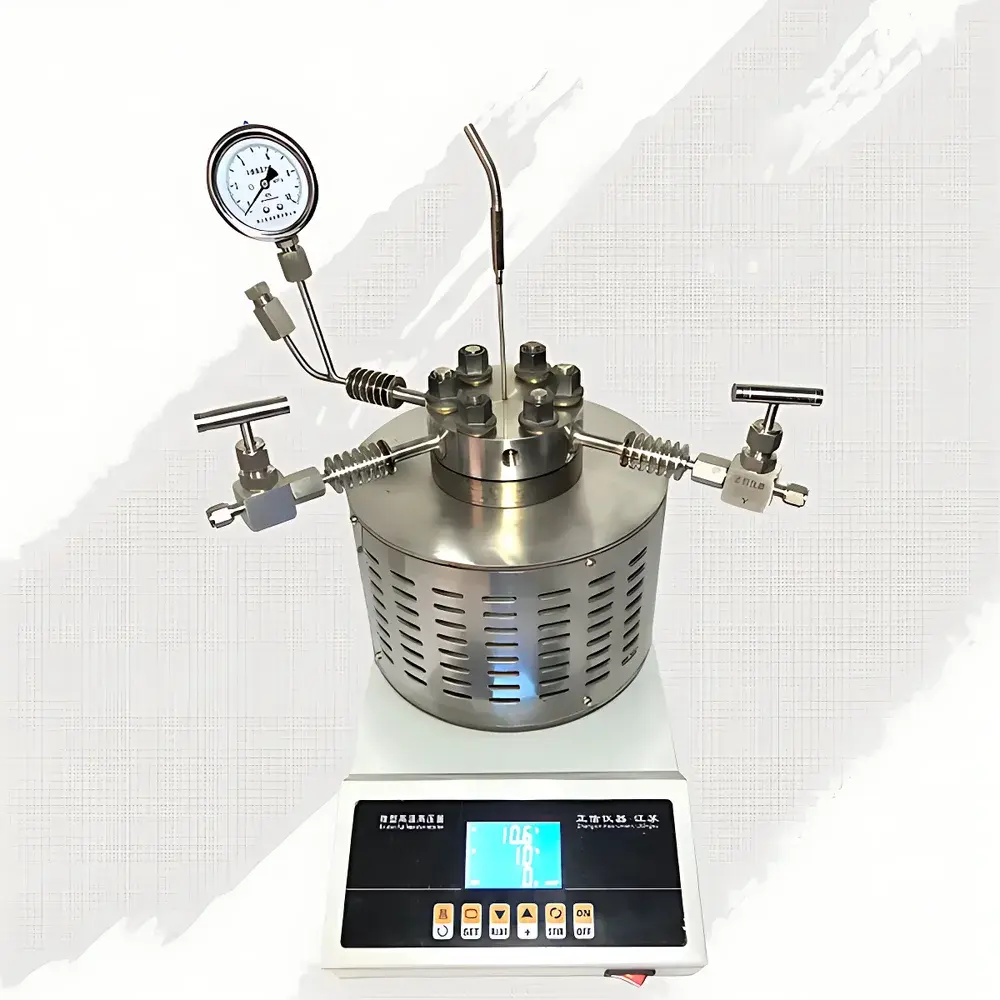
Suxin PSA2 High-Temperature & High-Pressure Batch Reactor
| Brand | Suxin |
|---|---|
| Origin | Jiangsu, China |
| Model | PSA2 |
| Vessel Capacity | 25–2000 mL |
| Construction Material | Stainless Steel (304/316L standard |
| Operating Temperature Range | 0–1000 °C |
| Operating Pressure Range | −0.1 to 70 MPa (vacuum to high pressure) |
| Heating Method | Integrated Modular Electric Heater (400–3500 W) |
| Temperature Control | LCD-display PID Controller with Auto-Tuning (AT), ±1 °C or ±0.1 °C accuracy, ramp rate ≤10 °C/min (adjustable) |
| Pressure Monitoring | Stainless Steel Bourdon-tube Pressure Gauge |
| Safety Systems | Spring-loaded rupture disc + pressure-relief valve |
| Gas Inlet/Outlet | 1/8″ and 1/4″ Swagelok-compatible needle valves |
| Cooling Option | External cooling jacket or coil |
| Vacuum Capability | ≤−0.1 MPa (absolute) |
| Optional Accessories | Sampling tube, thermocouple sheath, magnetic stirrer, data logging interface |
Overview
The Suxin PSA2 High-Temperature & High-Pressure Batch Reactor is an engineered platform for controlled chemical synthesis, catalytic testing, hydrothermal reactions, and materials processing under extreme thermal and mechanical conditions. Designed around Couette-type sealed-vessel architecture, it operates on the principle of static batch containment—where reactants are sealed within a mechanically robust pressure vessel, then subjected to precisely regulated temperature and pressure profiles. Its modular construction enables rapid configuration for gas–liquid, solid–liquid, or heterogeneous multiphase reactions. The reactor complies with fundamental design principles aligned with ASME BPVC Section VIII Div. 1 for pressure boundary integrity, and its operational envelope supports protocols referenced in ASTM E2071 (hydrothermal synthesis), ISO 14040 (life-cycle assessment of reaction systems), and USP (high-pressure reaction validation in pharmaceutical development).
Key Features
- Modular thermal management: Fixed-position electric heating modules ensure uniform axial and radial heat distribution; external stainless steel cladding provides structural rigidity and IP65-rated environmental protection.
- Intelligent temperature regulation: PID controller with auto-tuning (AT) algorithm delivers stable setpoint maintenance across full operating range (0–1000 °C); integrated timer and bidirectional stirring control support kinetic studies requiring precise temporal sequencing.
- High-fidelity process monitoring: K-type thermocouple (IEC 60584-compliant) embedded in vessel wall or immersed probe configuration; calibrated stainless steel pressure gauge (0–100 MPa full scale) with dual-scale reading (MPa/bar).
- Tool-free vessel disassembly: Quick-release flange system allows complete separation of heating mantle and reactor body—reducing cleaning time and minimizing cross-contamination risk between sequential experiments.
- Dual-function gas handling: Precision-machined needle valves (1/8″ and 1/4″ Swagelok®-compatible) serve both inert gas purging (pre-reaction vacuum evacuation via −0.1 MPa capability) and controlled venting (post-reaction depressurization).
- Passive safety redundancy: Primary overpressure protection via certified rupture disc (set point configurable per application); secondary mechanical relief valve with manual reset; finned aluminum heat sink mitigates localized thermal stress during rapid cooldown.
Sample Compatibility & Compliance
The PSA2 accommodates diverse sample matrices—including corrosive halogenated solvents, molten salts, supercritical CO₂ mixtures, and nanoparticle suspensions—through material-selectable construction. Standard vessels use ASTM A240 316L stainless steel; optional liners include fused quartz (for UV-transparent photochemical reactions), titanium Grade 2 (for chloride-rich media), and Hastelloy C-276 (for sulfuric/nitric acid environments). All configurations meet ISO 9001 manufacturing traceability requirements. Pressure vessel documentation includes hydrostatic test certification (1.5× design pressure), non-destructive examination (NDE) records, and material mill test reports (MTRs). For regulated environments, the system supports GLP-compliant audit trails when paired with optional RS485/Modbus-enabled data loggers.
Software & Data Management
While the base unit operates via standalone PID interface, optional digital integration enables compliance with FDA 21 CFR Part 11 through third-party SCADA platforms (e.g., LabVIEW™ or Ignition SCADA). The controller outputs analog 4–20 mA signals for temperature and pressure, plus digital relay status for safety interlocks. Timestamped CSV export is available via USB port for post-run analysis. Firmware supports user-defined recipe storage (up to 16 profiles), each with multi-segment ramp-soak cycles, stirring direction logic, and alarm threshold configuration. All calibration constants are password-protected and logged upon modification.
Applications
- Catalyst screening under industrially relevant conditions (e.g., Fischer–Tropsch, ammonia synthesis simulation)
- Hydrothermal synthesis of metal–organic frameworks (MOFs) and perovskite nanocrystals
- Supercritical fluid extraction method development (scCO₂, scH₂O)
- Thermal stability testing of battery electrolytes and solid-state electrolytes
- Corrosion kinetics studies in simulated geothermal brines
- Green chemistry route optimization (solvent-free esterification, transesterification)
FAQ
What materials are available for reactor vessel construction?
Standard options include ASTM A240 304 and 316L stainless steel. Optional alloys include Hastelloy C-276, commercially pure titanium (Grade 2), zirconium 702, and fused quartz liners—all supplied with full MTR documentation.
Can the PSA2 be validated for GMP environments?
Yes—when equipped with optional data-logging hardware and configured with electronic signature-capable software, the system meets ALCOA+ data integrity criteria and supports IQ/OQ/PQ protocol execution.
Is vacuum capability inherent or add-on?
Vacuum operation down to −0.1 MPa (absolute) is standard; no auxiliary pump is required for basic evacuation—only connection to an external vacuum source.
How is temperature uniformity verified across the reaction zone?
Uniformity is confirmed via ASTM E220-calibrated multi-point thermocouple mapping at three representative axial positions (top/mid/bottom) under steady-state conditions at 300 °C and 500 °C.
Does the system support automated pressure ramping?
Manual pressure control is standard via needle valves; programmable pressure control requires integration with external proportional pressure controllers (e.g., Parker IQ+ Series) via 4–20 mA interface.



