
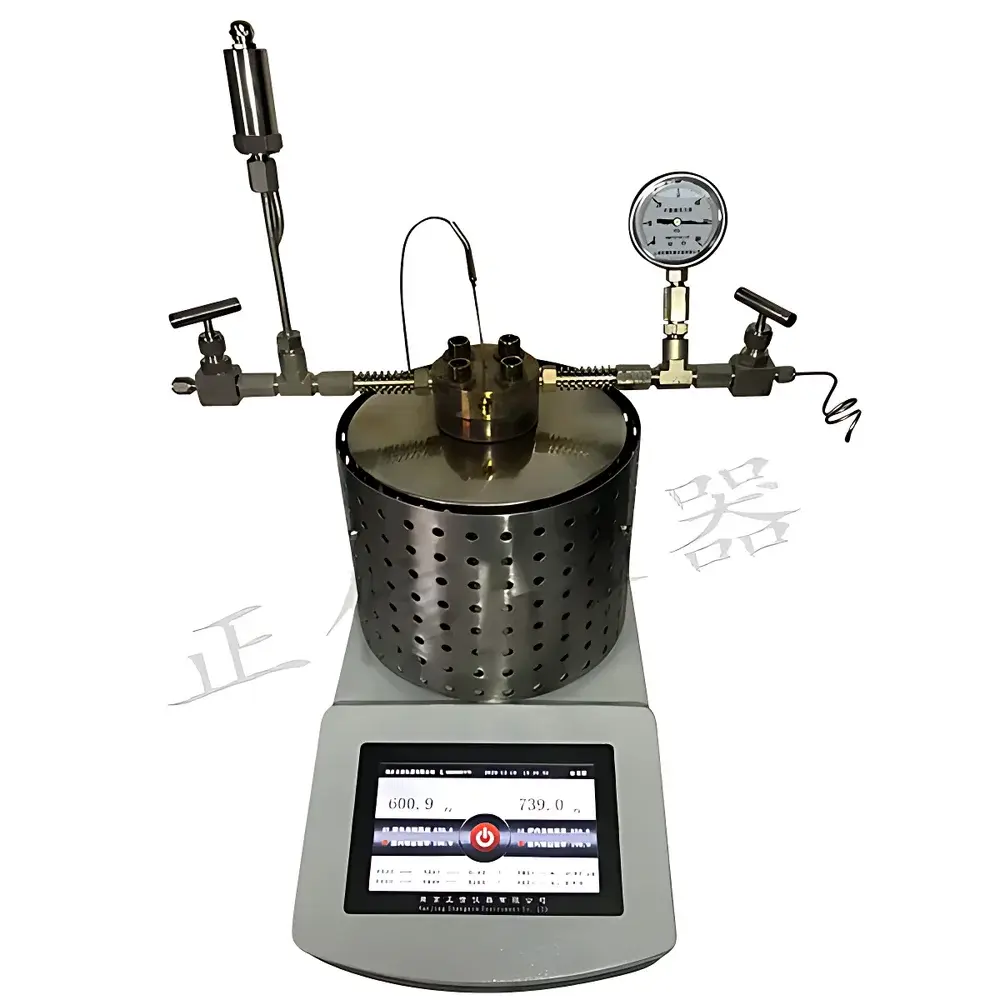
Zhengxin C-PSA-100ml High-Temperature/High-Pressure Laboratory Batch Reactor
| Brand | Zhengxin Instrument Factory (ZXYIQI) |
|---|---|
| Origin | Jiangsu, China |
| Model | C-PSA-100ml |
| Vessel Capacity | 100–500 mL |
| Construction Material | ASTM A240 S31603 (316L stainless steel) |
| Maximum Operating Temperature | ≤600 °C |
| Maximum Working Pressure | ≤60 MPa (gauge) |
| Sealing Type | Conical face metal-to-metal line seal with six high-strength alloy bolts |
| Heating Method | External electric heating mantle (800 W, 220 V AC) |
| Temperature Control | Digital PID programmable controller with internal micro-probe thermocouple (Type K, direct immersion) |
| Pressure Monitoring | Bourdon-tube pressure gauge with stainless steel housing and glycerin damping |
| Valve Configuration | High-pressure needle valve (SS316 body, PTFE-seated stem) |
| Vacuum Range | –0.1 to +50 MPa (dual-range capability) |
| Compliance | Designed per GB/T 150.1–2011 (Chinese pressure vessel standard), ASME BPVC Section VIII Div. 1 principles applied in structural safety assessment |
Overview
The Zhengxin C-PSA-100ml High-Temperature/High-Pressure Laboratory Batch Reactor is a compact, benchtop-scale pressure vessel engineered for controlled synthesis, hydrothermal crystallization, catalytic testing, and materials precursor decomposition under extreme thermal and mechanical conditions. It operates on the principle of sealed batch reaction—where reactants are loaded into a hermetically closed 316L stainless steel chamber, then subjected to precisely regulated temperature (up to 600 °C) and pressure (up to 60 MPa gauge) to accelerate reaction kinetics, stabilize metastable phases, or enable supercritical fluid chemistry. Its design adheres to fundamental pressure boundary integrity requirements defined in ASME BPVC Section VIII Division 1 and incorporates metallurgical enhancements—including hot-forged 316L billet construction—to ensure grain structure continuity, elevated yield strength at temperature, and resistance to chloride-induced stress corrosion cracking. The reactor is not intended for continuous operation or flow-through applications; it serves exclusively as a static, intermittent-use vessel for exploratory and quantitative laboratory-scale synthesis.
Key Features
- Forged 316L stainless steel pressure vessel body and lid, manufactured from solid billet stock (not cast or bar-stock machined) to maximize density, tensile strength, and fatigue life at elevated temperatures.
- Conical-face metal-to-metal line seal system with six high-tensile alloy bolts (grade ≥12.9), enabling repeatable, leak-tight closure without gasket degradation—even after repeated thermal cycling between ambient and 600 °C.
- Digital PID temperature controller with ramp-soak programming, ±1 °C setpoint accuracy, and real-time internal temperature feedback via a calibrated Type K thermocouple inserted directly into the reaction zone.
- Integrated high-pressure instrumentation suite: stainless steel Bourdon-tube pressure gauge (0–100 MPa full scale, glycerin-filled for vibration damping) and SS316 needle valve with PTFE stem sealing for precise venting and gas-phase sampling.
- Modular external heating architecture using an 800 W resistive heating mantle, allowing uniform thermal distribution while minimizing footprint and enabling synchronized multi-reactor thermal profiles in shared incubation environments.
- Vacuum-compatible design rated for service from –0.1 MPa (full vacuum) to +50 MPa, supporting degassing, inert-atmosphere purging, and subcritical/supercritical solvent processing.
Sample Compatibility & Compliance
The C-PSA-100ml reactor accommodates heterogeneous, homogeneous, and slurry-phase reactions involving organic solvents (e.g., ethanol, DMF, ethylene glycol), aqueous mineral acids (HCl, HNO₃, HF ≤10 wt%), alkaline media (NaOH/KOH ≤20 wt%), and gaseous reagents (H₂, O₂, NH₃, CO, CO₂) when used with appropriate inlet/outlet fittings. It is unsuitable for halogenated solvents above 200 °C or fluorinated acids beyond trace concentrations due to accelerated 316L corrosion. All pressure-bearing components conform to GB/T 150.1–2011 (China National Standard for Pressure Vessels), and design calculations include safety margins consistent with ASME BPVC Section VIII Div. 1 allowable stress values for SA-240 S31603 at 600 °C. Documentation includes material test reports (MTRs), hydrostatic test certification (1.5× MAWP), and dimensional inspection records—supporting GLP-compliant experimental traceability.
Software & Data Management
The reactor interfaces with standalone digital controllers only—no proprietary software or USB/RS485 connectivity is provided. Temperature and pressure data are recorded manually or via external data loggers connected to the thermocouple output and pressure transducer (optional upgrade). For regulatory environments requiring audit trails (e.g., ISO/IEC 17025-accredited labs or preclinical material synthesis under FDA 21 CFR Part 11 considerations), users must implement validated third-party logging systems. The controller supports time-stamped ramp/soak profiles, but does not store historical run data internally. Calibration certificates for the thermocouple and pressure gauge are supplied with initial delivery and recommend annual recalibration against NIST-traceable standards.
Applications
- Synthesis of metal–organic frameworks (MOFs), perovskites, and layered double hydroxides (LDHs) via solvothermal routes.
- Hydrothermal carbonization of biomass feedstocks for functional carbon material development.
- Catalyst screening under realistic operating conditions (e.g., Fischer–Tropsch, ammonia synthesis precursors).
- High-temperature polymerization of thermally stable monomers (e.g., polyimides, polybenzoxazoles).
- Geochemical simulation experiments replicating crustal/mantle fluid–rock interactions.
- Rapid digestion of refractory samples (silicates, ceramics, alloys) prior to elemental analysis by ICP-MS or XRF.
FAQ
What is the maximum recommended fill volume for safe operation?
For thermal expansion and headspace gas management, the recommended maximum liquid fill level is 70% of nominal capacity (e.g., ≤70 mL in the 100 mL configuration). Overfilling increases risk of pressure overshoot and mechanical stress during heating.
Can this reactor be used for hydrogenation reactions with H₂ gas?
Yes—provided the system is leak-tested with helium prior to introduction of H₂, and operated within the 60 MPa pressure limit. Use only SS316 fittings and avoid copper or aluminum components in the gas train.
Is the thermocouple probe replaceable, and what is its immersion depth specification?
The custom micro-probe (diameter ≤1.2 mm) is designed for full insertion to the geometric center of the reaction zone. Replacement probes are available as spare parts (P/N: ZXC-TC-K-MICRO); calibration drift should be verified every 50 thermal cycles.
Does the reactor include overpressure protection?
No integrated rupture disc or relief valve is factory-installed. Users must install an externally mounted, certified pressure relief device sized per ISO 4126-1 and set at ≤90% of MAWP (i.e., ≤54 MPa) when operating above 30 MPa.
What maintenance is required between runs?
After each use: inspect sealing surfaces for scratches or embedded particles; clean bolts and threads with non-chlorinated solvent; apply anti-seize compound (nickel-based) to bolt threads before reassembly; verify torque sequence (cross-pattern, incremental tightening to 120 N·m) using calibrated tooling.



