
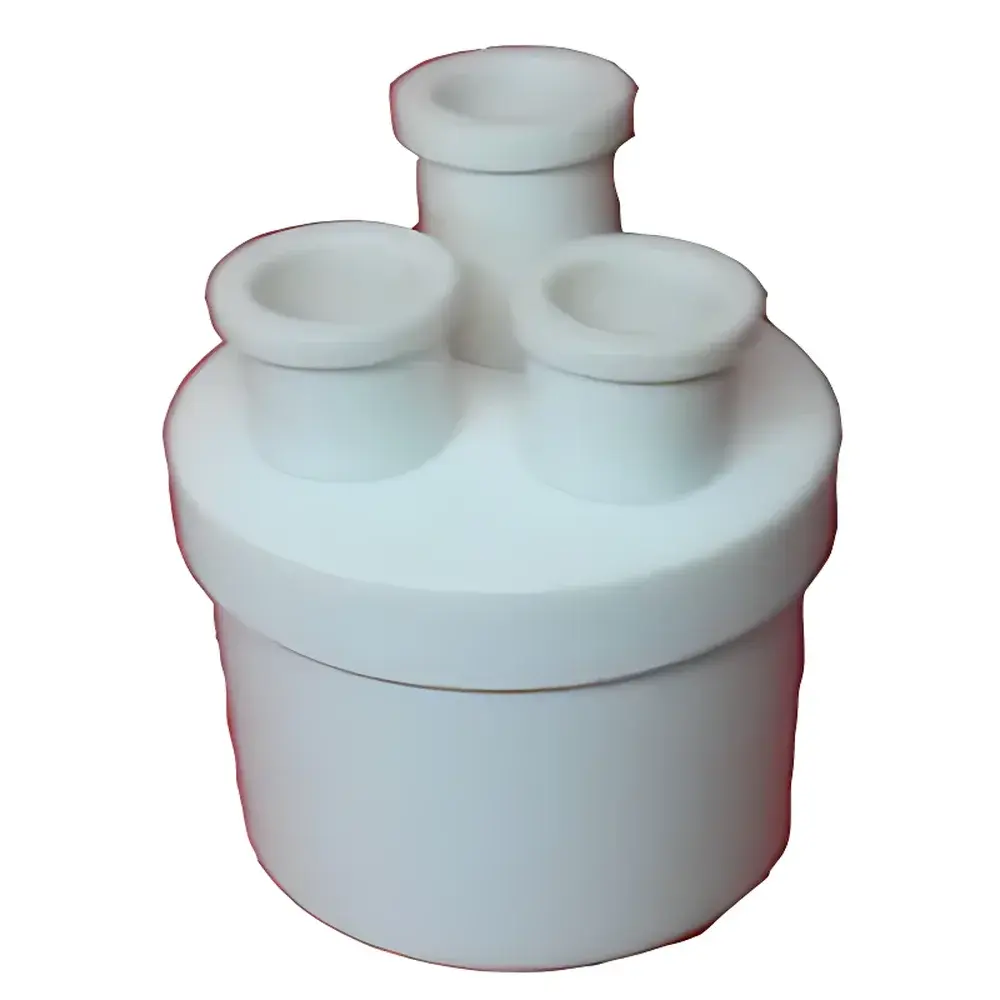
Zhenxin ZXYIQI F4-250mL Three-Neck Round-Bottom Flask
| Brand | Zhenxin Instrument Factory (ZXYIQI) |
|---|---|
| Origin | Jiangsu, China |
| Manufacturer Type | Authorized Distributor |
| Region of Origin | Domestic (PRC) |
| Model | F4-250mL |
| Price Range | USD 0.15–150.00 |
Overview
The Zhenxin ZXYIQI F4-250mL Three-Neck Round-Bottom Flask is a precision borosilicate glass (e.g., Pyrex-type 3.3 or equivalent) laboratory vessel engineered for controlled chemical synthesis, reflux, distillation, and multi-port reaction setup. Its defining structural feature—a spherical body with three standardized ground-glass joints (typically 14/20 or 19/22 taper, depending on configuration)—enables simultaneous integration of condensers, thermometers, dropping funnels, gas inlet/outlet adapters, or mechanical stirrers. The round-bottom geometry ensures uniform thermal distribution under heating mantles or oil baths, while the narrow necks minimize solvent evaporation and support secure, leak-resistant connections via PTFE sleeves or appropriate stopcocks. Designed in accordance with ISO 3585 (borosilicate glass for laboratory use) and compatible with standard DIN/ISO ground-glass joint specifications, this flask serves as a foundational component in both teaching laboratories and research-grade organic synthesis workflows.
Key Features
- Borosilicate 3.3 glass construction: High thermal shock resistance (up to 160°C ΔT), low coefficient of thermal expansion (~3.3 × 10⁻⁶ K⁻¹), and excellent chemical durability against acids, alkalis, and organic solvents.
- Three standardized conical ground-glass joints: Ensures interchangeability with common labware (e.g., Liebig condensers, Claisen adapters, vacuum take-off units); joints are fire-polished for smooth mating and minimal leakage risk.
- 250 mL nominal capacity with calibrated volume marking: Marked at 20°C per ISO 4787; tolerance ±2.5 mL (Class B), suitable for semi-quantitative reaction scaling.
- Stress-relieved annealing process: Eliminates internal strain, enhancing mechanical stability during prolonged heating or vacuum applications.
- Smooth, rounded base geometry: Optimized for even heat transfer and compatibility with magnetic stir plates when used with PTFE-coated stir bars.
Sample Compatibility & Compliance
This flask is compatible with liquid-phase reactions involving aqueous, protic, and aprotic media—including but not limited to ethanol, acetone, THF, DMF, concentrated HCl, and dilute NaOH—provided temperature and concentration remain within borosilicate glass limits. It is not recommended for hydrofluoric acid, hot concentrated phosphoric acid, or strong alkaline melts above 300°C. The product complies with ISO 3585:1991 for laboratory borosilicate glass and meets dimensional conformity requirements of ISO 8567 (ground-glass joints). While not individually certified for GLP/GMP environments, it is routinely employed in ISO/IEC 17025-accredited testing labs for method development and sample preparation where equipment traceability is maintained per internal SOPs.
Software & Data Management
As a passive glass vessel, the F4-250mL three-neck flask does not incorporate embedded electronics, firmware, or digital interfaces. Its operational integrity relies entirely on mechanical compatibility and procedural documentation. When integrated into automated reaction systems (e.g., ChemSpeed, Uniqsis, or Vapourtec platforms), it functions as a user-defined reactor module; all parameter logging (temperature, pressure, addition rate) is handled externally by the host system’s control software. No proprietary drivers, calibration files, or audit trail functionality are associated with the flask itself. Users must maintain manual logbooks or electronic lab notebooks (ELNs) compliant with 21 CFR Part 11 if used in regulated pharmaceutical or clinical trial settings.
Applications
- Multi-step organic synthesis requiring inert atmosphere (N₂/Ar) purging via one neck, reagent addition via second, and reflux condensation via third.
- Distillation setups using a Claisen adapter and Vigreux column, where one neck accommodates thermometer placement for precise boiling point monitoring.
- Gas evolution experiments (e.g., H₂ from NaBH₄ reduction, CO₂ from carbonate decomposition), with dedicated gas outlet and scrubber connection ports.
- Photochemical reactions when paired with quartz-jacketed cooling condensers and UV-transparent light sources.
- Teaching laboratories for demonstrating Le Chatelier’s principle, equilibrium shifts, or kinetic studies under controlled reflux conditions.
FAQ
What ground-glass joint sizes are available for the F4 series?
Standard configurations include 14/20 (small-scale) and 19/22 (general-purpose); custom joint combinations can be ordered directly through Zhenxin’s authorized distribution network.
Can this flask be used under vacuum or pressure?
Yes—when properly assembled with vacuum-rated grease and appropriate clamps, it is rated for operation from 1 mbar to ~2 bar (gauge), provided thermal gradients remain within safe limits.
Is autoclaving supported?
No—autoclaving (121°C saturated steam) induces microfractures in borosilicate glass due to rapid moisture-induced stress; dry heat sterilization (<180°C, 2 h) is permissible only if no ground-glass joints are engaged.
Does Zhenxin provide test certificates for individual flasks?
Batch-level compliance documentation (material certification, joint tolerance reports) is available upon request; individual unit traceability requires advance specification at time of order.



