
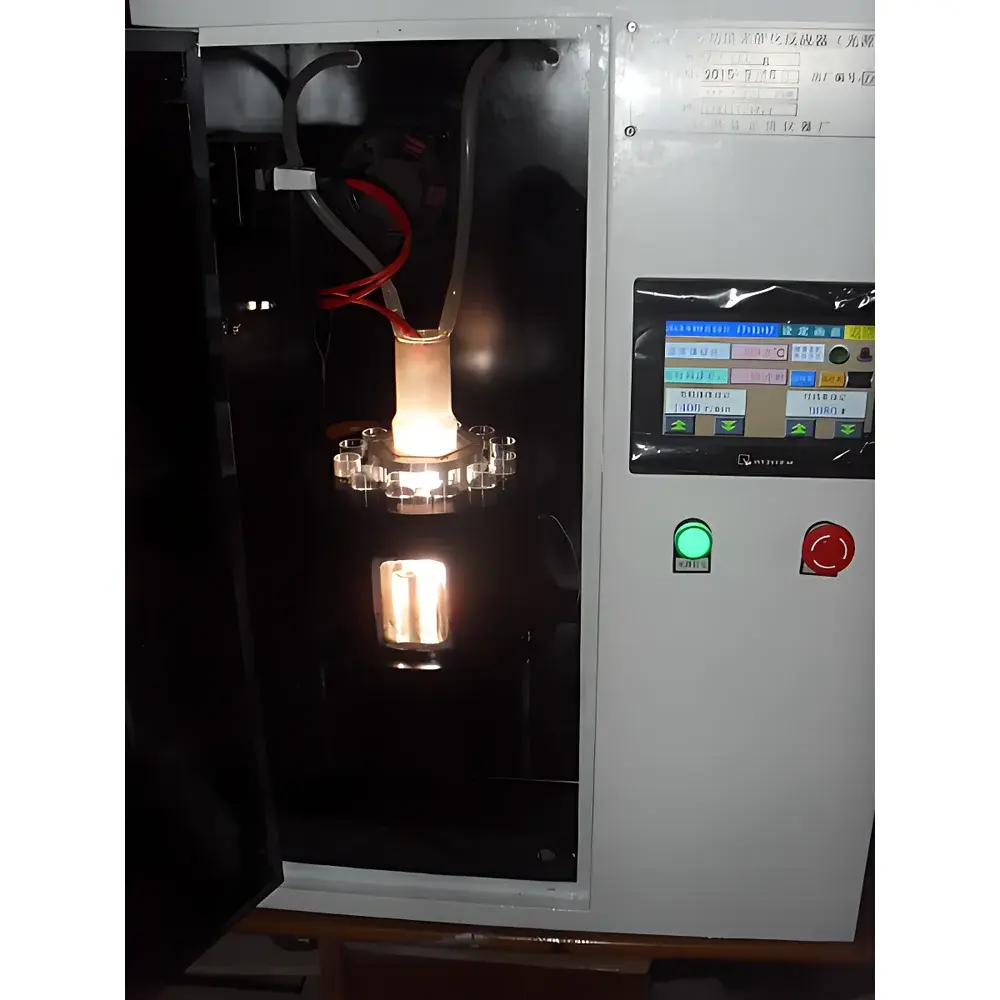
Zhengxin ZXF-LCA-6 Sixth-Generation Photocatalytic Reactor with Mercury Lamp Light Source
| Brand | Zhengxin Instrument Factory / zxyiqi |
|---|---|
| Origin | Jiangsu, China |
| Manufacturer Type | General Distributor |
| Product Origin | Domestic (China) |
| Model | ZXF-LCA-6 |
| Price | USD 5,000 (approx.) |
| Light Source Type | Mercury Lamp |
| Irradiation Mode | Internal Illumination |
| Control System | PLC with 7-inch Touchscreen Interface |
| Power Adjustment Range | 100–1000 W |
| Sample Vessel Capacity | 12 × 30 mL / 50 mL Quartz Tubes |
| Cooling | Dual Circulating Water System (Quartz Cold Trap + Dual Fan Cooling) |
| Compliance | Designed for ISO/IEC 17025-compliant lab environments |
Overview
The Zhengxin ZXF-LCA-6 Sixth-Generation Photocatalytic Reactor is an engineered laboratory-scale system designed for controlled, reproducible photochemical degradation and redox transformation of aqueous contaminants under simulated UV and near-UV irradiation. It operates on the principle of heterogeneous photocatalysis—where photons from a high-intensity mercury lamp (254 nm and 365 nm primary emission lines) excite semiconductor catalysts (e.g., TiO₂, g-C₃N₄, or doped metal oxides), generating electron–hole pairs that drive oxidative mineralization or reductive dehalogenation of target analytes. Unlike open-batch photoreactors, the ZXF-LCA-6 integrates internal illumination geometry, precise thermal management via quartz cold trap and dual-loop water cooling, and programmable irradiation kinetics—enabling rigorous kinetic modeling (e.g., pseudo-first-order rate constants, quantum yield estimation) in compliance with ASTM D7842-19 (Standard Practice for Determining Photocatalytic Activity of Materials) and ISO 10678:2010 (Water Quality — Determination of Photocatalytic Activity).
Key Features
- PLC-based control architecture with intuitive 7-inch industrial touchscreen HMI—supporting multi-step program sequencing (irradiation time, power ramping, temperature setpoint, stirring speed, rotation interval)
- Adjustable mercury lamp output (100–1000 W) with real-time voltage/current monitoring and cumulative operational hour logging
- Integrated multi-tube rotational platform: 12-position quartz tube carousel rotates synchronously around the central light source to ensure uniform photon flux distribution (±5% spatial irradiance variation per IEC 62471)
- Dual-cooling design: quartz cold trap isolates UV radiation while enabling efficient heat dissipation; independent power and lamp cooling fans prevent thermal drift during extended runs (>8 h)
- Safety-engineered enclosure with UV-blocking borosilicate observation window, emergency stop circuit, and interlocked access door
- Modular optical interface: standardized filter mount (25.4 mm diameter) accommodates bandpass, longpass, or cutoff filters for wavelength-selective experiments (e.g., UVC-only vs. UVA+UVB)
Sample Compatibility & Compliance
The ZXF-LCA-6 accommodates standard 30 mL and 50 mL quartz reaction tubes (supplied with 12 pairs), compatible with powdered, immobilized film, spherical, hollow, or mesoporous catalyst configurations. It supports liquid-phase reactions involving H₂O₂, O₃, KMnO₄, or persulfate as co-oxidants—enabling advanced oxidation process (AOP) validation per US EPA Method 8099. The reactor’s sealed chamber and water-cooled configuration meet Class 3B laser safety principles (IEC 60825-1) for UV containment. All electronic subsystems comply with CE electromagnetic compatibility (EMC) directives and are traceable to NIST-traceable calibration protocols for power and temperature sensors. Data logs—including irradiance duration, setpoint deviations, and alarm events—are timestamped and exportable for 21 CFR Part 11–compliant audit trails when paired with validated third-party LIMS integration.
Software & Data Management
While the ZXF-LCA-6 operates autonomously via embedded PLC firmware, its RS-485 and USB-C interfaces support optional SCADA-level data acquisition using Modbus RTU or custom Python-based polling scripts. Each run generates a structured CSV log containing: timestamp, lamp power (% rated), actual voltage/current, set/actual temperature (±0.5 °C), magnetic stir speed (rpm), rotation cycle count, and cumulative runtime. Alarm codes (e.g., “E03: Coolant Flow Failure”, “E07: Overtemperature Lockout”) are logged with millisecond-resolution timestamps. For GLP-regulated labs, external software (e.g., LabArchives ELN or Thermo Fisher SampleManager) can ingest these logs directly—enabling full chain-of-custody documentation and deviation reporting aligned with ISO/IEC 17025 Clause 7.7.
Applications
- Photocatalytic removal of Cr(VI), Cd(II), Pb(II), and Zn(II) via reduction to less soluble metallic or lower-valence states
- Oxidative degradation of recalcitrant organics: antibiotics (ciprofloxacin, sulfamethoxazole), pesticides (diuron, atrazine), surfactants (LAS), dyes (methylene blue, rhodamine B), PAHs (pyrene, benzo[a]pyrene), and halogenated compounds (chloroform, PCB-126)
- Comparative AOP benchmarking: Hg-lamp/TiO₂ vs. Xe-lamp/g-C₃N₄ vs. LED-assisted Fenton systems
- Kinetic parameter derivation: apparent rate constants (kobs), Langmuir–Hinshelwood adsorption coefficients, and quantum efficiency (Φ) under controlled photon flux (measured via calibrated UV radiometer)
- Drinking water treatment simulation: pilot-scale validation of UV-driven contaminant abatement prior to membrane or GAC polishing
FAQ
What lamp types are supported beyond the standard mercury lamp?
The ZXF-LCA-6 accepts interchangeable 500 W mercury and xenon lamps (sold separately); custom socket adapters enable retrofitting of UVC-LED arrays (265 nm, 275 nm) or filtered halogen sources upon request.
Is quartz tube alignment automated or manual?
Tube insertion is manual, but once loaded, the rotational motor and magnetic stirrer operate automatically per programmed sequence—no operator intervention required during irradiation.
How is temperature stability maintained during prolonged runs?
A closed-loop water chiller (user-supplied, 15–25 °C output) circulates through both the quartz cold trap and rear-mounted heat exchangers; internal PT100 sensor feedback modulates fan speed to hold bath temperature within ±1.0 °C over 12-hour cycles.
Can this system be integrated into an automated lab workflow?
Yes—via Modbus TCP/IP gateway (optional add-on), the reactor communicates lamp status, error flags, and run completion signals to central orchestration platforms such as Opentrons Flex or LabVantage.
Does the unit include calibration certificates for optical output?
No factory-issued radiometric calibration is included; however, the system features standardized mounting points for NIST-traceable UV-A/UV-C radiometers (e.g., International Light ILT2400), and calibration procedures are documented in the user manual per ISO/IEC 17025 Section 6.5.





