
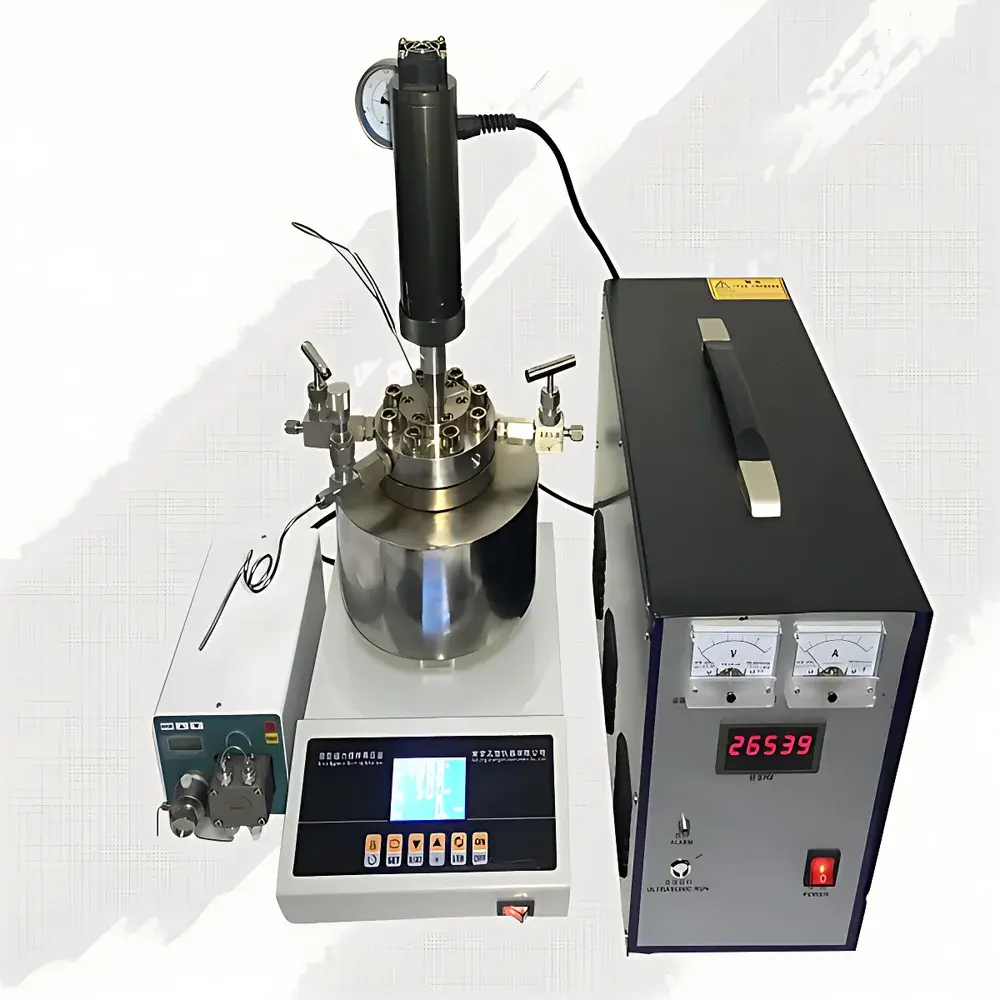
Zhenxin U-KPS-100ML Ultrasonic Electrode High-Pressure Autoclave Reactor
| Brand | Zhenxin Instrument Factory (ZXYIQI) |
|---|---|
| Origin | Jiangsu, China |
| Model | U-KPS-100ML |
| Vessel Capacity | 100–1000 mL |
| Construction Material | Stainless Steel (304/316L standard) |
| Operating Pressure Range | –0.1 to 40 MPa (vacuum to high pressure) |
| Temperature Range | 0–300 °C |
| Ultrasonic Power Output | 150–1000 W |
| Ultrasonic Frequency | 15–40 kHz |
| Stirring Speed | 0–1500 rpm |
| Heating Power | 400–1800 W |
| Safety Features | Integrated rupture disc, pressure relief valve, and overpressure auto-shutdown |
| Optional Electrodes | Pt, Ag, or custom-configured |
| Internal Lining Options | PTFE, PPL, quartz, or metal alloys |
| Control System | LCD-based PID temperature controller with dual-mode timing (hold-time / run-time, 0–999 min/h) |
| Vacuum Capability | ≤ –0.1 MPa (absolute) |
| Electrical Interface | Standard 220 V / 50 Hz industrial supply |
| Compliance | Designed per GB/T 150.1–2011 (Chinese pressure vessel standard) |
Overview
The Zhenxin U-KPS-100ML Ultrasonic Electrode High-Pressure Autoclave Reactor is an integrated laboratory-scale reaction system engineered for controlled high-pressure, high-temperature synthesis under simultaneous ultrasonic irradiation and electrochemical stimulation. It operates on the principle of coupled physical–chemical activation: ultrasonic cavitation enhances mass transfer and nucleation kinetics, while precisely positioned electrodes enable in situ electrochemical modulation—ideal for catalytic hydrogenation, electrosynthesis, sonoelectrochemical deposition, and mechano-electrochemical coupling studies. The reactor’s modular architecture supports rapid configuration changes between standard thermal–mechanical, sonicated, and sonoelectrochemical modes. Its stainless steel (304/316L) pressure vessel complies with GB/T 150.1–2011 for Class I pressure equipment, and its pressure containment design accommodates up to 40 MPa working pressure with vacuum capability down to –0.1 MPa absolute—enabling both inert gas purging and solvent-free supercritical reactions.
Key Features
- Modular ultrasonic transducer integration (15–40 kHz, 150–1000 W), compatible with external water-cooling systems for sustained duty-cycle operation.
- Dual-function electrode ports accommodating Pt, Ag, or user-supplied electrocatalysts; electrical feedthroughs rated for ≥300 °C and sealed against pressure leakage.
- Quick-disconnect heated jacket design: furnace and reactor body separate without tools, minimizing thermal inertia and enabling rapid sample exchange.
- High-fidelity process monitoring: embedded Pt100 RTD probe (±0.3 °C accuracy) and calibrated stainless steel Bourdon-tube pressure gauge (0–40 MPa, class 1.6).
- Redundant safety architecture: mechanical rupture disc (set at 110% MAWP), spring-loaded pressure relief valve, and electronic overpressure cutoff via PID controller logic.
- Full-coverage internal linings available (PTFE, PPL, quartz, or alloy-clad), supporting aggressive reagents including HF, molten salts, and halogenated solvents.
- Intelligent control interface: LCD PID controller with dual timing modes (temperature-hold and runtime), programmable ramp/soak profiles, and real-time parameter logging via RS485 output.
Sample Compatibility & Compliance
The U-KPS-100ML accommodates heterogeneous, homogeneous, and multiphase reaction systems—including slurries, gaseous reactants (H₂, CO, NH₃), supercritical fluids (scCO₂), and viscous ionic liquids. Its sealing system employs dual-cone metal gaskets (Inconel 718 optional) rated for cyclic thermal–pressure loading. All wetted surfaces meet ASME BPE surface finish standards (Ra ≤ 0.8 µm) when specified with electropolished 316L. The system conforms to ISO 4775 (laboratory pressure reactors), ASTM E2892–13 (safety requirements for high-pressure chemical reactors), and supports GLP-compliant data traceability when paired with optional USB data logger firmware. No proprietary software lock-in: raw sensor outputs are accessible via Modbus RTU for integration into LabVIEW, MATLAB, or SCADA environments.
Software & Data Management
While the base unit features standalone PID control, optional firmware upgrades enable time-stamped CSV export of temperature, pressure, stir speed, and ultrasonic power via USB or RS485. Audit trails include operator ID input, parameter change logs, and alarm event timestamps—fully compliant with FDA 21 CFR Part 11 when deployed with validated electronic signature modules. Calibration certificates for pressure and temperature sensors are provided with NIST-traceable documentation. Firmware supports configurable alarm thresholds (e.g., ΔP/dt > 0.5 MPa/min triggers immediate venting), and all critical setpoints require dual-key confirmation to prevent accidental override.
Applications
- Sonoelectrochemical synthesis of nanomaterials (e.g., Pt–Ni bimetallic catalysts for PEMFC anodes)
- High-pressure hydrogenation of unsaturated organics under ultrasound-assisted mass transfer enhancement
- In situ Raman/EIS-compatible electrochemical studies in pressurized non-aqueous electrolytes
- Supercritical water oxidation (SCWO) of persistent organic pollutants with real-time pH and redox monitoring
- Hydrothermal synthesis of MOFs and perovskites under controlled p–T–E conditions
- Accelerated aging tests of battery electrode materials under combined thermal–electrochemical stress
FAQ
Can the U-KPS-100ML be operated under vacuum prior to pressurization?
Yes. The integrated exhaust valve and high-vacuum-rated sealing system support evacuation to ≤ –0.1 MPa (absolute) for degassing or inert atmosphere establishment.
Is third-party calibration support available for pressure and temperature sensors?
Yes. Zhenxin provides factory calibration reports traceable to CNAS-accredited labs; field recalibration services are available globally through authorized service partners.
What electrode materials are certified for use above 200 °C in acidic media?
Platinum and titanium-substrate dimensionally stable anodes (DSA®) are validated for continuous operation at 250 °C in 6 M HCl; custom Hastelloy C-276 electrodes can be supplied upon request.
Does the system meet explosion-proof requirements for Class I, Division 1 environments?
The base unit is not intrinsically safe; however, explosion-proof motor enclosures (Ex d IIB T4) and purge-and-pressurization kits (IEC 60079-2) are available as OEM options.
Can the ultrasonic transducer be synchronized with potentiostat voltage sweeps?
Yes. External TTL trigger input allows phase-locked ultrasonic burst mode (1–100 ms pulse width) synchronized with electrochemical waveform generators.



