
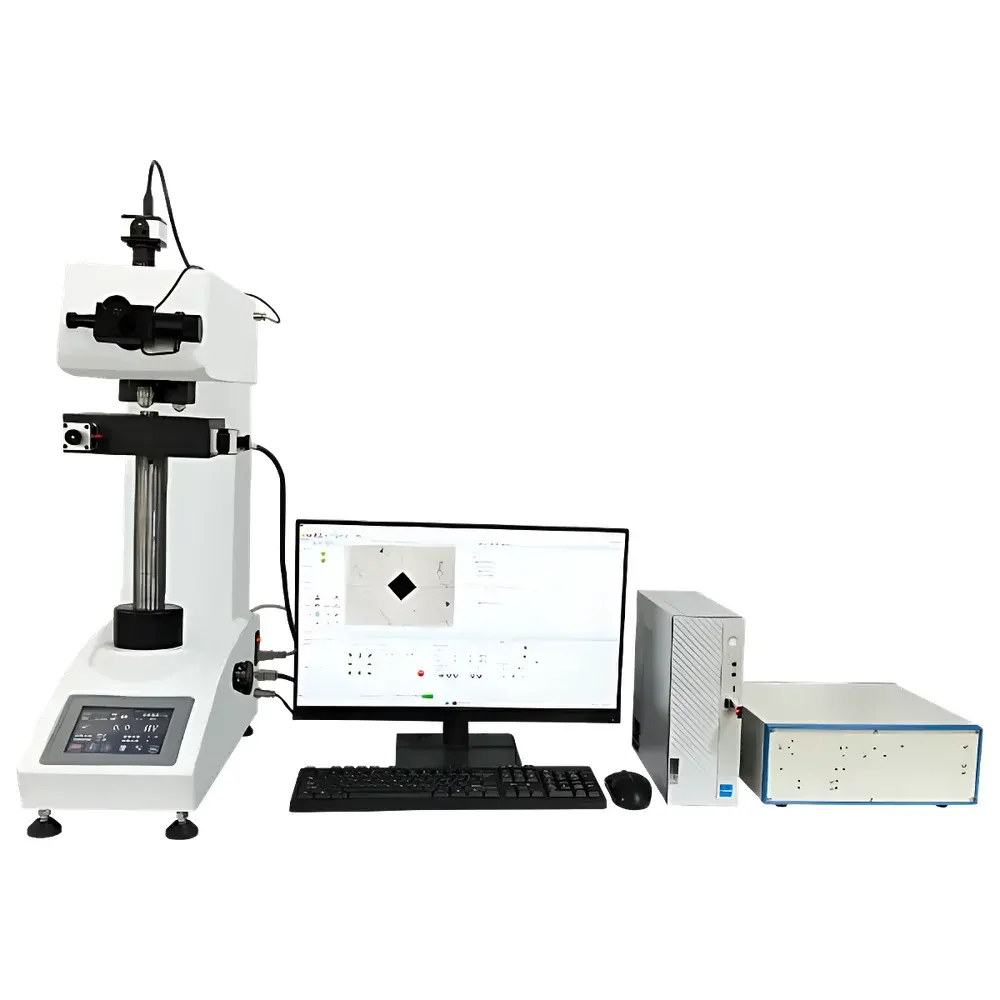
YANRUN HMAS-D5/10/30/50MZA Intelligent Vickers Hardness Testing & Analysis System
| Brand | YANRUN |
|---|---|
| Origin | Shanghai, China |
| Manufacturer Type | Manufacturer |
| Product Category | Domestic |
| Model | HMAS-D5/10/30/50MZA |
| Instrument Type | Vickers Hardness Tester |
| Measurement Range | 8–3000 HV |
| Turret Control | Motorized, PC-controlled |
| Test Force Options | 0.2–50 kgf (6–12 selectable loads per capacity tier) |
| Load Application | Fully Automated (loading/holding/unloading) |
| Standards Compliance | GB/T 4340, ISO 6507 |
| XY Stage Travel | 25 × 25 mm (optional 50 × 50 mm) |
| Minimum Resolution | 0.06 µm (at 20× objective) |
| Dwell Time | 1–60 s (1 s increments) |
| Max Specimen Height | 60 mm |
| Depth from Indenter to Chamber Wall | 130 mm |
| Power Supply | AC 220 V / 50 Hz |
| Dimensions (L×W×H) | 570 × 220 × 680 mm |
| Net Weight | 50.0 kg |
Overview
The YANRUN HMAS-D5/10/30/50MZA is an intelligent, fully automated Vickers hardness testing and analysis system engineered for precision metrology in metallurgical laboratories, quality control departments, and materials R&D facilities. Based on the standardized Vickers indentation principle—where a diamond pyramid indenter (136° apex angle) is applied under controlled static load to produce a geometrically defined impression—the system delivers traceable, repeatable hardness values expressed in HV (Vickers Hardness Number). Unlike conventional analog or semi-automated testers, the HMAS-D5/10/30/50MZA integrates motorized turret positioning, programmable load selection, closed-loop force application, and high-resolution digital imaging into a unified platform. Its dual-path measurement architecture supports both standalone operation via integrated touchscreen interface and full PC-based control and analysis, enabling seamless integration into GLP/GMP-compliant workflows.
Key Features
- Fully motorized, software-driven turret with automatic objective and indenter switching—eliminates manual alignment errors and ensures consistent optical path geometry across test loads.
- Multi-tier programmable test force capability: four calibrated force ranges (5 kgf, 10 kgf, 30 kgf, 50 kgf), each offering up to 12 discrete load options (e.g., 0.2–5 kgf for low-load microhardness; 1–50 kgf for macro-scale evaluation), compliant with ASTM E384 and ISO 6507-1 requirements.
- High-precision XY motorized stage (25 × 25 mm standard travel; optional 50 × 50 mm) with sub-micron positional repeatability, enabling automated multi-point hardness mapping, cross-sectional hardness profiling (e.g., case depth analysis), and coordinated microstructural correlation with metallographic imaging.
- Dual optical path configuration: 10× digital eyepiece for rapid visual survey; interchangeable 10× (observation) and 20× (measurement) objectives yielding 100×/200× total magnification (5/10 kgf models) or 100× (30/50 kgf models), optimized for accurate diagonal measurement at minimum resolution of 0.06 µm.
- Automated indentation cycle: precise loading ramp, user-defined dwell time (1–60 s in 1 s steps), and controlled unloading—all executed without operator intervention, minimizing thermal drift and mechanical hysteresis effects.
- Integrated calibration verification routine supporting reference block traceability to NIST-traceable standards and internal verification per ISO 6507-2 Annex A.
Sample Compatibility & Compliance
The HMAS-D5/10/30/50MZA accommodates specimens up to 60 mm in height and 130 mm from indenter center to chamber interior wall—suitable for bulk metals, heat-treated components, thin coatings (with appropriate load selection), and cross-sectioned samples mounted on standard metallographic holders. It conforms to national and international standards including GB/T 4340.1–2012 (Chinese national standard equivalent to ISO 6507-1), ISO 6507-2 (verification of hardness testers), and ISO 6507-4 (table of hardness values). The system supports audit-ready documentation generation required for ISO/IEC 17025-accredited labs and FDA 21 CFR Part 11-compliant environments when paired with validated software configurations.
Software & Data Management
The proprietary HMAS analysis software provides real-time instrument control, image acquisition, automated diagonal detection (with manual override), hardness calculation, statistical reporting (mean, SD, CV%, min/max), and customizable report templates exportable as PDF, CSV, or XML. All measurement events—including load selection, dwell time, stage coordinates, image timestamps, and operator ID—are logged with immutable audit trail functionality. Data files are structured for long-term archival and interoperability with LIMS platforms. Software validation documentation (IQ/OQ protocols) is available upon request to support regulated industry deployment.
Applications
- Case depth and carburized layer characterization in gear steels and bearing alloys.
- Thin-film and PVD/CVD coating hardness evaluation (using ≤1 kgf loads).
- Weldment HAZ (heat-affected zone) hardness gradient mapping.
- Quality assurance of aerospace aluminum alloys, titanium grades, and superalloys.
- Research-grade microstructure–property correlation studies (e.g., grain boundary hardening, precipitate strengthening).
- Failure analysis involving localized embrittlement or decarburization assessment.
FAQ
Does the system support ASTM E384 for microhardness testing?
Yes—when configured with 0.2–1 kgf test forces and 20× objective, the system meets all instrumentation and procedure requirements specified in ASTM E384-22 for microhardness measurement.
Can hardness data be exported to third-party statistical analysis tools?
Yes—CSV and XML exports include raw pixel measurements, calculated HV values, load/dwell metadata, and coordinate positions, ensuring compatibility with Minitab, JMP, and Python-based analytics pipelines.
Is remote diagnostics and firmware update capability available?
The system includes Ethernet connectivity and supports secure remote access via authenticated VNC sessions for technical support; firmware updates are delivered as signed packages with version-controlled release notes.
What maintenance intervals are recommended for long-term accuracy?
Annual verification using certified reference blocks per ISO 6507-2 is required; biannual cleaning and calibration of the XY stage encoder and load cell are advised for high-throughput environments.
How is traceability to national standards ensured?
Each unit ships with a factory calibration certificate referencing NIST-traceable hardness reference blocks (e.g., Wilson 900 series); users may perform in-house verification using accredited secondary standards.



