
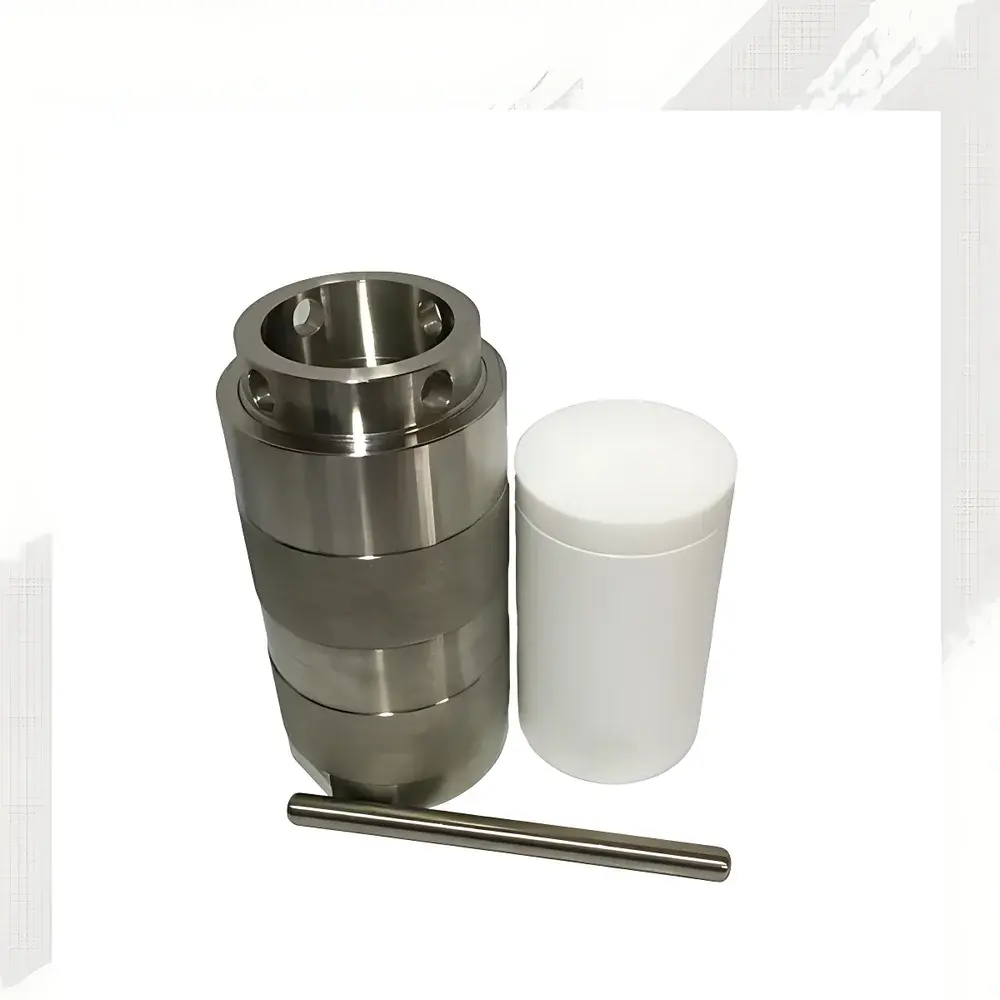
Zhengxin Instruments PF Series Hydrothermal Synthesis Reactor
| Brand | Zhengxin Instruments |
|---|---|
| Origin | Jiangsu, China |
| Manufacturer Type | Authorized Distributor |
| Country of Origin | China |
| Model | PF-200 mL |
| Capacity | 200 mL |
| Vessel Material | Forged 304 Stainless Steel |
| Liner Material | PTFE (F4) or PPL |
| Maximum Operating Pressure | ≤6 MPa |
| Maximum Temperature | 240 °C (PTFE), 280 °C (PPL) |
| Sealing Type | Circular Tenon-Groove with Manual Spiral Tightening |
| Vacuum Integrity | Rated for vacuum service (specify vacuum level per application) |
| Safety Features | Integrated pressure-relief burst disc (anti-explosion port) |
Overview
The Zhengxin Instruments PF Series Hydrothermal Synthesis Reactor is a precision-engineered benchtop pressure vessel designed for controlled high-temperature, high-pressure chemical synthesis and sample digestion under inert or reactive atmospheres. Based on the principle of hydrothermal reaction kinetics—where elevated temperature and autogenous pressure accelerate dissolution, crystallization, and phase transformation—the PF reactor enables reproducible, closed-system processing of refractory materials, trace-element standards, and sensitive organometallic precursors. Its robust construction meets fundamental safety requirements for laboratory-scale solvothermal synthesis, acid digestion, and geochemical sample preparation. Unlike open-vessel digestion methods, the sealed design minimizes reagent loss, prevents volatile element escape (e.g., As, Hg, Se), and ensures quantitative recovery for ICP-MS, AAS, and ICP-OES analysis. The reactor operates within defined thermodynamic boundaries—maximum 6 MPa and up to 240 °C with PTFE liners or 280 °C with PPL liners—making it suitable for applications governed by ISO 17025-compliant sample preparation workflows.
Key Features
- Forged 304 stainless steel body with precision-machined circular tenon-groove sealing interface, delivering high mechanical integrity and long-term corrosion resistance in acidic and alkaline environments.
- Removable liner options: chemically inert polytetrafluoroethylene (PTFE/F4) or high-performance polyphenylene sulfide (PPL), each certified for ultra-low elemental blank values (Pb < 10−11 g/mL; U < 10−12 g/mL).
- Integrated pressure-relief burst disc (anti-explosion port) engineered to activate at predetermined overpressure thresholds, complying with general laboratory safety guidelines for Class I pressure vessels.
- Manual spiral-tightening closure mechanism with torque-consistent design ensures repeatable seal compression and eliminates cross-threading risk during routine operation.
- Optimized thermal mass distribution and uniform wall thickness support controlled heating/cooling ramp rates—critical for preventing thermal shock and maintaining liner dimensional stability.
- Compatible with standard laboratory ovens, muffle furnaces, and heating mantles; no external pressure control or gas supply required due to autogenous pressure generation.
Sample Compatibility & Compliance
The PF reactor accommodates a broad spectrum of sample matrices including geological sediments, biological tissues, pharmaceutical excipients, rare-earth oxides, foodstuffs, wastewater sludge, and polymer composites. It supports digestion protocols aligned with EPA Method 3050B, ASTM D5688, and ISO 11885 for heavy metal extraction, as well as USP and ICH Q3D for elemental impurity testing. When used with PTFE liners, it satisfies GLP/GMP requirements for low-background trace analysis—particularly for Al2O3-based reference materials where platinum crucible contamination must be avoided. All components are non-pyrogenic and physiologically inert per ISO 10993-5, enabling compatibility with biomedical sample workflows. No lubricants or adhesives are used in assembly, ensuring analytical-grade purity.
Software & Data Management
As a passive, manually operated reactor, the PF series does not incorporate embedded electronics or digital interfaces. However, its operational parameters integrate seamlessly into validated laboratory information management systems (LIMS) and electronic lab notebooks (ELN) via standardized SOP documentation. Users may log batch-specific metadata—including liner type, fill ratio (recommended 1/3–2/3 volume), heating profile, dwell time, and cooldown rate—to support audit trails compliant with FDA 21 CFR Part 11 when paired with secure ELN platforms. Calibration records for associated ovens or temperature controllers should be maintained separately per ISO/IEC 17025 Clause 6.4.
Applications
- Hydrothermal synthesis of metal–organic frameworks (MOFs), perovskites, and nanocrystalline oxides (e.g., TiO2, ZnO, Fe3O4) under controlled stoichiometric and kinetic conditions.
- Acid digestion of silicate-rich soils, fly ash, and ceramic powders using HNO3/HF/HCl mixtures at sub-boiling temperatures to preserve volatile analytes.
- Trace-element solubilization for environmental monitoring—especially for mercury speciation studies requiring closed-vessel reduction without atmospheric interference.
- Preparation of high-purity calibration standards for multi-element ICP analysis, minimizing memory effects and inter-element contamination.
- Inert-atmosphere crystallization of air-sensitive precursors (e.g., alkyl lithium compounds) when purged with N2 or Ar prior to sealing.
FAQ
What is the maximum recommended fill volume for safe operation?
The internal liner should be filled to no more than 66% (2/3) of its total capacity to allow sufficient headspace for pressure development and thermal expansion.
Can the reactor be used under vacuum prior to heating?
Yes—the forged 304 body and PTFE/PPL liners are rated for vacuum service down to 10−2 mbar; however, vacuum integrity must be verified using a calibrated gauge before pressurization.
Is cleaning validation required between uses?
Yes—residue removal from the sealing groove and liner surface is mandatory. Use ultrapure water followed by 10% v/v nitric acid rinse, then dry in a Class 100 laminar flow hood to prevent particulate carryover.
How often should the sealing gasket be replaced?
The PTFE or elastomeric sealing ring should be inspected before each use and replaced after 20–30 thermal cycles or immediately upon visible deformation, cracking, or compression set.
Does the reactor comply with PED 2014/68/EU or ASME BPVC Section VIII?
No—it is classified as a non-certified laboratory pressure accessory under Directive 2014/68/EU Annex I, intended solely for research-grade use under institutional safety oversight, not industrial process deployment.



