
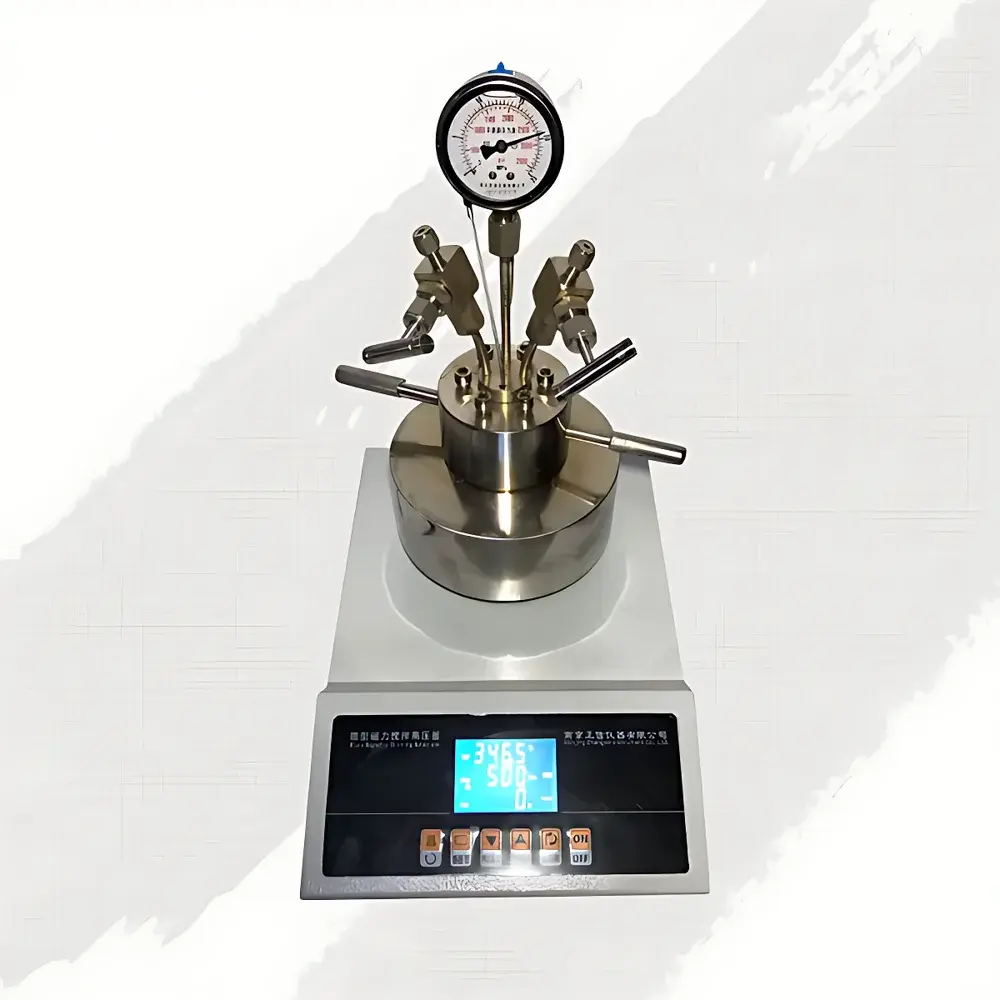
ZXYIQI PSK-50mL High-Pressure Magnetic Stirring Reactor
| Brand | ZXYIQI |
|---|---|
| Origin | Jiangsu, China |
| Manufacturer Type | Authorized Distributor |
| Country of Origin | China |
| Model | PSK-50mL |
| Capacity | 50 mL |
| Vessel Material | Stainless Steel (304/316L standard) |
| Operating Pressure Range | 0–25 MPa (optional flanged configuration up to 100 MPa) |
| Vacuum Capability | –0.1 MPa |
| Temperature Range | 0–350 °C |
| Heating Method | Embedded Modular Heater |
| Temperature Control | PID-based Dual-Channel Intelligent Control |
| Control Accuracy | ±1 °C |
| Stirring Mechanism | Rare-Earth Permanent Magnet Coupling |
| Stirring Speed | 0–1000 rpm |
| Sealing System | Dual Soft/Hard Seal (PTFE + Metal-to-Metal) |
| Safety Features | Automatic Overtemperature/Overpressure Alarm, Rupture Disc (Hastelloy) |
| Optional Accessories | PTFE-Lined Lid, Quartz Liner, External Condenser, Sampling Tube, Thermocouple (K-Type, 316L Sheath, Φ2.0 mm) |
| Power Supply | 220 V / 110 V AC |
Overview
The ZXYIQI PSK-50mL High-Pressure Magnetic Stirring Reactor is an engineered solution for controlled, reproducible chemical synthesis under elevated temperature and pressure conditions in academic and industrial research laboratories. Designed on the principles of Couette flow dynamics and sealed pressure vessel mechanics, the PSK series leverages magnetic coupling to transmit rotational torque across a hermetic barrier—eliminating mechanical shaft penetration and ensuring zero leakage during operation. Its monolithic stainless steel (304 or 316L standard) vessel is CNC-machined from solid bar stock, minimizing grain boundary discontinuities and enhancing structural integrity under cyclic thermal and pressure loading. The reactor operates within a validated range of –0.1 MPa (vacuum) to 25 MPa (standard), with optional flanged configurations rated to 100 MPa for specialized applications such as supercritical fluid chemistry or high-pressure catalysis. Temperature is maintained via a fully embedded, thermally optimized heating module coupled with dual-channel PID control—providing stable thermal profiles essential for kinetic studies, polymerization initiation, and heterogeneous catalytic screening.
Key Features
- Monolithic vessel construction from forged stainless steel billet—no weld seams, improved fatigue resistance, and compliance with ASME BPVC Section VIII Div. 1 design philosophy for small-scale pressure equipment.
- Flange-type closure system secured with 4/6/10 precision-torqued bolts—enabling rapid, repeatable assembly/disassembly while maintaining uniform gasket compression and leak-tight integrity.
- Dual-seal architecture combining elastomeric (PTFE or Kalrez®) primary sealing with secondary metal-to-metal backup—validated for use with aggressive solvents, H₂, CO, NH₃, and halogenated reagents.
- Intelligent safety interlock: real-time monitoring of internal temperature and pressure; automatic acoustic/visual alarm activation upon deviation beyond user-defined thresholds; integrated Hastelloy C-276 rupture disc for fail-safe overpressure relief.
- Brushless DC motor-driven magnetic drive with rare-earth NdFeB coupling—delivering consistent torque transmission up to 1000 rpm, silent operation, and >10,000-hour service life without maintenance.
- Modular thermal management: heater and reactor body are mechanically decoupled—allowing independent calibration, replacement, and thermal isolation during cooling phases.
Sample Compatibility & Compliance
The PSK-50mL reactor supports a broad spectrum of sample chemistries, including but not limited to hydrogenation precatalysts, organometallic intermediates, hydrothermal nanomaterials precursors, and pharmaceutical APIs under inert or reducing atmospheres. Vessel liners (quartz, PTFE, PPL) and customizable inlet/outlet ports accommodate corrosive media (e.g., HF, fuming HNO₃) and particulate-laden slurries. All pressure-bearing components conform to GB/T 150.1–2011 (Chinese equivalent of ISO 13485-aligned pressure equipment standards). Documentation includes material traceability certificates (MTRs), dimensional inspection reports, and factory hydrostatic test records at 1.5× MAWP. Optional configurations meet ASTM E2913-20 requirements for reaction calorimetry validation and support GLP-compliant audit trails when paired with compliant data acquisition systems.
Software & Data Management
While the base PSK-50mL operates via front-panel LCD interface with manual parameter entry, it is compatible with optional RS485/Modbus RTU or USB-C communication modules for integration into centralized lab automation platforms. Third-party SCADA or LabVIEW-based control environments can log time-stamped temperature, pressure, stirring speed, and alarm status—enabling alignment with FDA 21 CFR Part 11 requirements when deployed with electronic signature-capable software and audit-trail-enabled storage. Firmware supports programmable ramp-soak profiles (up to 10 segments), event-triggered data capture, and configurable alarm hysteresis—facilitating method transfer across R&D, pilot, and QC labs.
Applications
- Catalytic hydrogenation and hydrodeoxygenation studies under H₂ pressures up to 10 MPa.
- High-temperature/pressure polymerization of polyesters, polyimides, and conductive polymers.
- Supercritical CO₂-mediated extractions and reactions requiring precise density tuning.
- Hydrothermal synthesis of MOFs, perovskites, and quantum dot precursors at 200–300 °C.
- Corrosion-resistant testing of alloy candidates in simulated sour gas (H₂S/CO₂) environments.
- Small-volume kinetic profiling (≤50 mL) for reaction mechanism elucidation using in situ FTIR or Raman sampling ports (customizable).
FAQ
What materials are available for the reactor body and liner?
Standard vessel material is ASTM A240 304 or 316L stainless steel. Optional alloys include 310S, 904L, Hastelloy C-276, and Grade 2 titanium. Liners are offered in PTFE, quartz, and PPL—each selected based on thermal stability, chemical resistance, and optical transparency requirements.
Can the PSK-50mL be used for exothermic reactions requiring active cooling?
Yes—external jacketed cooling coils or cryogenic probe inserts (e.g., liquid N₂-cooled thermowells) can be integrated via custom port configurations. The modular heater design permits simultaneous heating/cooling zone separation.
Is third-party calibration certification available?
Factory calibration certificates for pressure transducers (±0.25% FS) and K-type thermocouples (±1.5 °C) are provided. NIST-traceable recalibration services are available through authorized metrology partners.
How is data integrity ensured during long-duration experiments?
All alarm events and parameter deviations are timestamped and stored in non-volatile memory. When connected to compliant software, full audit trails—including operator ID, parameter changes, and system state logs—are generated in accordance with ALCOA+ principles.
What regulatory documentation accompanies shipment?
Each unit ships with a Declaration of Conformity (DoC), Material Test Reports (MTRs), hydrostatic test report, dimensional inspection record, and CE-marked electrical safety certificate (EN 61010-1).



