
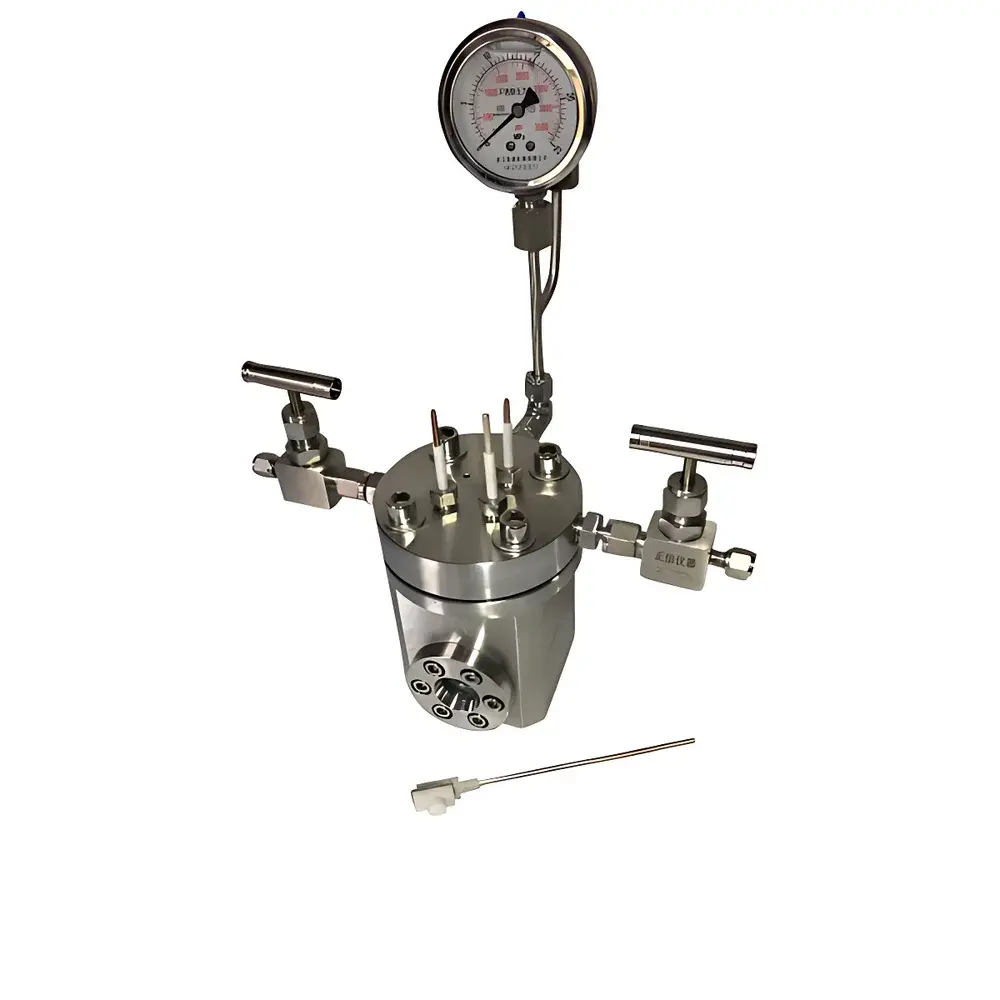
Zhengxin WEP-50ML Split-View Electrochemical Reactor with Dual-Port Quartz Sight Glass
| Brand | Zhengxin Instrument Factory (ZXYIQI) |
|---|---|
| Origin | Jiangsu, China |
| Model | WEP-50ML |
| Vessel Capacity | 50 mL |
| Construction Material | 304/316L Stainless Steel |
| Operating Pressure Range | –0.1 to 70 MPa |
| Temperature Range | 0–1000 °C |
| View Window Material | Fused Quartz or Sapphire |
| Electrode Configuration | 1–4 customizable electrodes (Pt, Ag, Ti, or user-specified) |
| Heating Method | Integrated modular electric heater (400–1500 W) |
| Temperature Control | LCD PID controller with auto-tuning (AT), ±1 °C accuracy, ≤10 °C/min ramp rate |
| Pressure Monitoring | Stainless steel analog pressure gauge |
| Safety Systems | Spring-loaded pressure relief valve, explosion-proof design |
| Optional Accessories | Gas inlet/outlet needle valves (1/8″ & 1/4″ Swagelok®-compatible), cooling coil, liquid sampling tube, ceramic or quartz liner |
Overview
The Zhengxin WEP-50ML Split-View Electrochemical Reactor is a precision-engineered benchtop pressure reactor designed for controlled electrochemical synthesis, catalytic studies, and high-temperature/pressure reaction monitoring under inert or reactive atmospheres. Its defining feature is the dual-port fused quartz or sapphire sight glass assembly—mechanically isolated from the main vessel body—enabling real-time visual observation of electrode interfaces, bubble dynamics, phase separation, and precipitate formation without compromising structural integrity or pressure containment. The reactor operates on a Couette-type sealed architecture with torque-rated flanged joints and metal-sealed gaskets, compliant with ASME B16.5 Class 150 rating principles for low-to-medium pressure applications. It supports both galvanostatic and potentiostatic configurations via externally mounted electrode feedthroughs, and is compatible with standard potentiostat/galvanostat systems (e.g., BioLogic SP-300, Gamry Interface 5000E) through hermetic SMA or LEMO connectors.
Key Features
- Modular split-body design: Reactor vessel and heating module are fully separable, enabling rapid disassembly for electrode replacement, cleaning, or liner exchange without tool-intensive re-torquing.
- Dual optical access ports: Two diametrically opposed quartz/sapphire windows (standard Ø25 mm, optional Ø35 mm) provide unobstructed stereoscopic viewing and support in situ Raman or UV-Vis fiber-optic coupling.
- Electrode flexibility: Four standardized M4 threaded feedthroughs accommodate Pt wire, Ag/AgCl reference, Ti mesh counter, or custom-configured working electrodes; electrical isolation rated to 1 kV DC.
- Robust thermal management: Internal cartridge heaters deliver uniform axial temperature gradients (<±2 °C over 50 mm length); external aluminum finned heat sink ensures stable operation up to 400 °C ambient.
- Gas handling interface: Dual Swagelok®-compatible needle valves (1/8″ and 1/4″ compression fittings) allow sequential vacuum evacuation (≤10⁻² mbar), gas purging (N₂, Ar, H₂, O₂), and controlled pressurization.
- Integrated safety architecture: Pressure-actuated spring relief valve (setpoint adjustable 0.5–70 MPa), rupture disc option, and redundant overtemperature cutoff (hardware-based thermocouple trip at 105 % max setpoint).
Sample Compatibility & Compliance
The WEP-50ML accommodates heterogeneous, homogeneous, and electrocatalytic reaction systems—including aqueous electrolytes, molten salts, supercritical CO₂ media, and corrosive halide-based melts—when configured with appropriate liner materials (e.g., quartz, Hastelloy C-276, or zirconium). Vessel wall thickness and flange geometry conform to GB/T 150.1–2011 (Chinese equivalent of ASME VIII Div. 1) for design pressures up to 70 MPa. All wetted surfaces meet ASTM A240/A240M specifications for stainless steel grades 304 and 316L. Optional quartz liners comply with ISO 3585 for hydrolytic resistance (Class 1). For regulated environments, the PID controller supports audit-trail logging (via RS485 Modbus RTU) and can be validated per GLP/GMP Annex 11 requirements when paired with compliant SCADA software.
Software & Data Management
While the base unit features standalone LCD PID control, optional digital integration enables full process data acquisition via USB or Ethernet. The included Zhengxin LabControl Suite (v3.2+) supports synchronized logging of temperature (K-type thermocouple), pressure (0.25 % FS accuracy), and electrode potential/current (when interfaced with third-party potentiostats). Data export formats include CSV, TDMS, and HDF5; time-stamped records include operator ID, method name, and calibration metadata. System firmware complies with IEC 62443-3-3 for industrial cybersecurity baseline, and audit trails satisfy FDA 21 CFR Part 11 requirements for electronic signatures and record retention.
Applications
- In situ electrochemical impedance spectroscopy (EIS) of battery electrode materials under elevated temperature and pressure.
- Catalytic hydrogenation kinetics in continuous-flow microreactor screening platforms.
- Corrosion behavior studies of alloy electrodes in simulated geothermal brines (pH 2–12, Cl⁻ ≤ 5 mol/L, T ≤ 350 °C).
- Hydrothermal synthesis of MOFs and perovskite nanocrystals with real-time nucleation monitoring.
- Photoelectrochemical water splitting using integrated quartz-window photoanodes under AM1.5G illumination.
- Supercritical fluid-assisted electropolymerization of conductive polymers (e.g., PEDOT:PSS).
FAQ
What electrode materials are supported, and how are they electrically isolated?
Standard configurations include Pt wire (99.99 %), Ag/AgCl (3 M KCl), and Ti mesh; custom electrodes (IrO₂, NiOOH, doped SnO₂) are available. Each feedthrough uses ceramic-insulated M4 studs with PTFE sealing washers, rated for ≥1 kV DC dielectric strength.
Can the reactor be used under vacuum prior to pressurization?
Yes—the dual needle-valve manifold allows sequential rough vacuum (via external pump), leak-checking (helium mass spec compatible), and controlled backfilling with inert or reactive gases to ≤10⁻³ mbar base pressure.
Is the quartz sight glass resistant to HF or molten alkali exposure?
Fused quartz is incompatible with hydrofluoric acid or hot concentrated alkalis; for such media, sapphire windows (Al₂O₃, Mohs 9) or Hastelloy C-276 liners with sapphire inserts are recommended.
Does the system support automated reaction sequencing?
When equipped with the optional LabControl Suite and pneumatic valve module, users can program multi-step protocols including temperature ramps, gas switching, potential sweeps, and timed sampling—all with full event logging and fault recovery.
What validation documentation is provided for GxP environments?
Factory calibration certificates (temperature, pressure), material test reports (MTRs) per EN 10204 3.1, and IQ/OQ templates aligned with ASTM E2500-13 are supplied upon request.



