
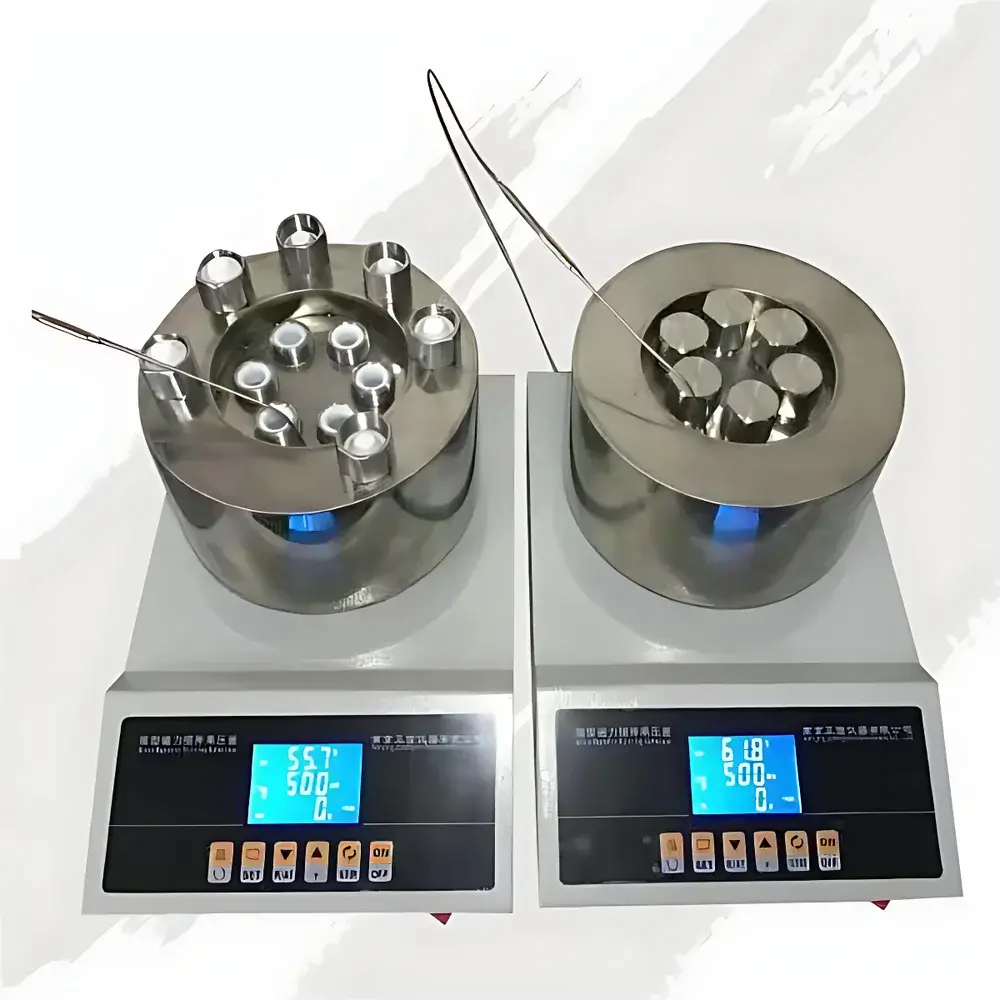
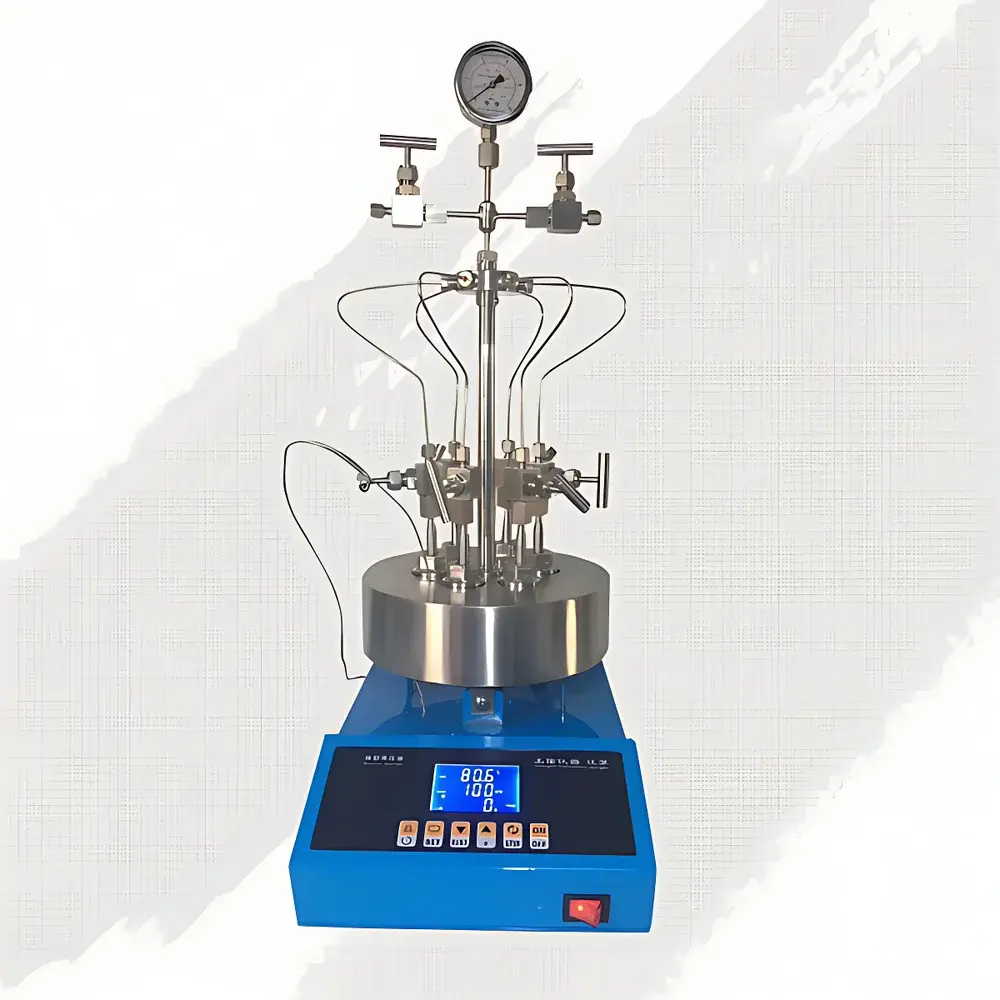
Zhengxin Instrument SX-PSK Six-Station Parallel High-Pressure Micro-Reactor System
| Brand | Zhengxin Instrument |
|---|---|
| Origin | Jiangsu, China |
| Manufacturer Type | Authorized Distributor |
| Country of Origin | China |
| Model | SX-PSK |
| Price | USD 5,200 (FOB Jiangsu) |
| Usable Volume per Vessel | 0.05–25 mL |
| Vessel Material | 304/316L/310S/904L Stainless Steel, Hastelloy C-276, Titanium |
| Max Operating Pressure | 30 MPa |
| Min Vacuum Level | –0.1 MPa (10 mbar absolute) |
| Temperature Range | Ambient to 500 °C |
| Heating Method | Embedded Modular PID-Controlled Resistive Heating |
| Stirring | Magnetic suspension coupling, 0–1000 rpm |
| Temperature Sensor | K-type thermocouple (316L sheath, Φ2.0 mm) |
| Pressure Gauge | Analog or digital, optional with pressure transducer |
| Safety Features | Dual-stage overpressure relief (Hastelloy burst disc), overtemperature/time alarm, auto-shutdown |
| Compliance | Designed per ISO 4871, ASME BPVC Section VIII Div. 1 guidelines for laboratory-scale pressure equipment |
Overview
The Zhengxin Instrument SX-PSK Six-Station Parallel High-Pressure Micro-Reactor System is an engineered platform for simultaneous, independently monitored high-temperature and high-pressure reaction screening under controlled thermal, mechanical, and chemical conditions. Based on the Couette flow principle in sealed batch reactors, it enables reproducible kinetic studies, catalyst evaluation, and process parameter optimization across six identical reaction vessels—each operating under identical setpoints for temperature, pressure, stirring speed, and reaction time. Unlike conventional single-vessel systems, the SX-PSK maintains inter-vessel thermal uniformity via integrated aluminum block heating with embedded resistance modules and dual-loop PID control, minimizing thermal lag and cross-contamination risk. Its design adheres to fundamental safety principles for small-scale pressurized systems, including pressure containment integrity, fail-safe venting, and redundant thermal monitoring—making it suitable for academic research labs, R&D centers in fine chemicals, and pre-pilot development in pharmaceutical and petrochemical sectors.
Key Features
- Parallel operation of six independent micro-reactors (0.05–25 mL usable volume per vessel) with synchronized temperature, pressure, and agitation control.
- Modular heating architecture: fully enclosed stainless steel heater blocks with rapid thermal response (<15 min to 300 °C), embedded K-type thermocouples (316L-sheathed, Φ2.0 mm) for real-time feedback.
- Dual-loop PID temperature control with ±1 °C accuracy; programmable ramp-soak profiles available as optional firmware upgrade.
- Magnetic suspension stirring system using rare-earth permanent magnets and brushless DC motor—ensuring silent, maintenance-free operation from 0 to 1000 rpm with bidirectional control.
- Multi-material vessel compatibility: standard 304 SS construction; optional upgrades to 316L, 310S, 904L, Hastelloy C-276, or Grade 2 titanium for aggressive media (e.g., HF, hot chlorides, H₂S).
- Integrated safety subsystems: certified Hastelloy burst disc (rated ≤30 MPa), automatic overtemperature/overpressure shutdown, audible + visual alarm triggers, and real-time LCD status display.
- Quick-release flange interface with dual-seal configuration—combining elastomeric O-rings (FKM/Viton®) and metal-to-metal face seals for vacuum integrity down to –0.1 MPa and leak-tight performance at elevated pressures.
Sample Compatibility & Compliance
The SX-PSK supports heterogeneous catalysis, hydrogenation, oxidation, hydrothermal synthesis, supercritical fluid reactions, and corrosion testing across liquid-phase, gas–liquid, and slurry systems. Vessels accept PTFE, quartz, or PPL liners for acid-resistant or optically transparent applications. All pressure-bearing components conform to dimensional tolerances specified in ISO 286-2 (ISO tolerance class IT7) and are traceably documented per ASME BPVC Section VIII Div. 1 Appendix 4 requirements for laboratory-scale pressure equipment. The system is compatible with GLP-compliant workflows when paired with external data loggers supporting 21 CFR Part 11 audit trails. It meets general laboratory safety standards per IEC 61010-1:2010 and carries CE marking for electromagnetic compatibility (EMC Directive 2014/30/EU).
Software & Data Management
While the base unit operates via front-panel LCD interface with manual parameter entry, optional RS485/Modbus RTU connectivity enables integration into centralized lab automation networks. Third-party SCADA or LabVIEW-based acquisition systems can poll real-time temperature, pressure, RPM, and elapsed time from each station at user-defined intervals (1–60 s). Data export formats include CSV and XML; timestamped logs support retrospective analysis for DOE (Design of Experiments) validation. Firmware updates are delivered via USB flash drive, ensuring long-term maintainability without proprietary software lock-in.
Applications
- Catalyst screening and lifetime assessment under realistic process conditions (e.g., hydrodesulfurization, Fischer–Tropsch synthesis).
- Reaction kinetics modeling for API intermediate synthesis under elevated H₂ pressure (≤10 MPa) and temperatures up to 350 °C.
- Material stability testing of battery electrolytes, MOFs, and nanocatalysts in inert or reactive atmospheres.
- Corrosion rate quantification of alloy candidates in simulated sour-gas environments (CO₂/H₂S/H₂O mixtures).
- Optimization of green chemistry protocols—including solvent-free esterifications and enzymatic transesterifications—in sub-5 mL volumes.
- Method development for USP and ASTM D7462-compliant oxidation stability testing of lubricants and biofuels.
FAQ
What materials are available for reactor vessels and liners?
Standard vessels are fabricated from ASTM A240 304 stainless steel. Optional alloys include 316L, 310S, 904L, UNS N10276 (Hastelloy C-276), and Grade 2 titanium. Liners are available in PTFE, fused quartz, and polyphenylsulfone (PPL).
Is the system compliant with FDA 21 CFR Part 11 for electronic records?
The base controller does not include Part 11 features. However, when connected to validated third-party data acquisition software with electronic signature, audit trail, and role-based access controls, full compliance is achievable.
Can the SX-PSK be used under vacuum conditions?
Yes—it achieves a minimum absolute pressure of 10 mbar (–0.09 MPa gauge) with standard sealing and calibrated vacuum-rated valves.
What is the maximum recommended working pressure for long-term cyclic operation?
For >10,000 cycles, Zhengxin recommends limiting sustained pressure to ≤20 MPa at temperatures ≤300 °C to ensure fatigue life of the Hastelloy burst disc and flange gasket interfaces.
Does the system support automated gas dosing or mass flow control?
Not natively—but standardized 1/8″ Swagelok® ports on each vessel allow integration with external MFCs, pressure controllers, and gas chromatography sampling loops via user-supplied tubing and fittings.



