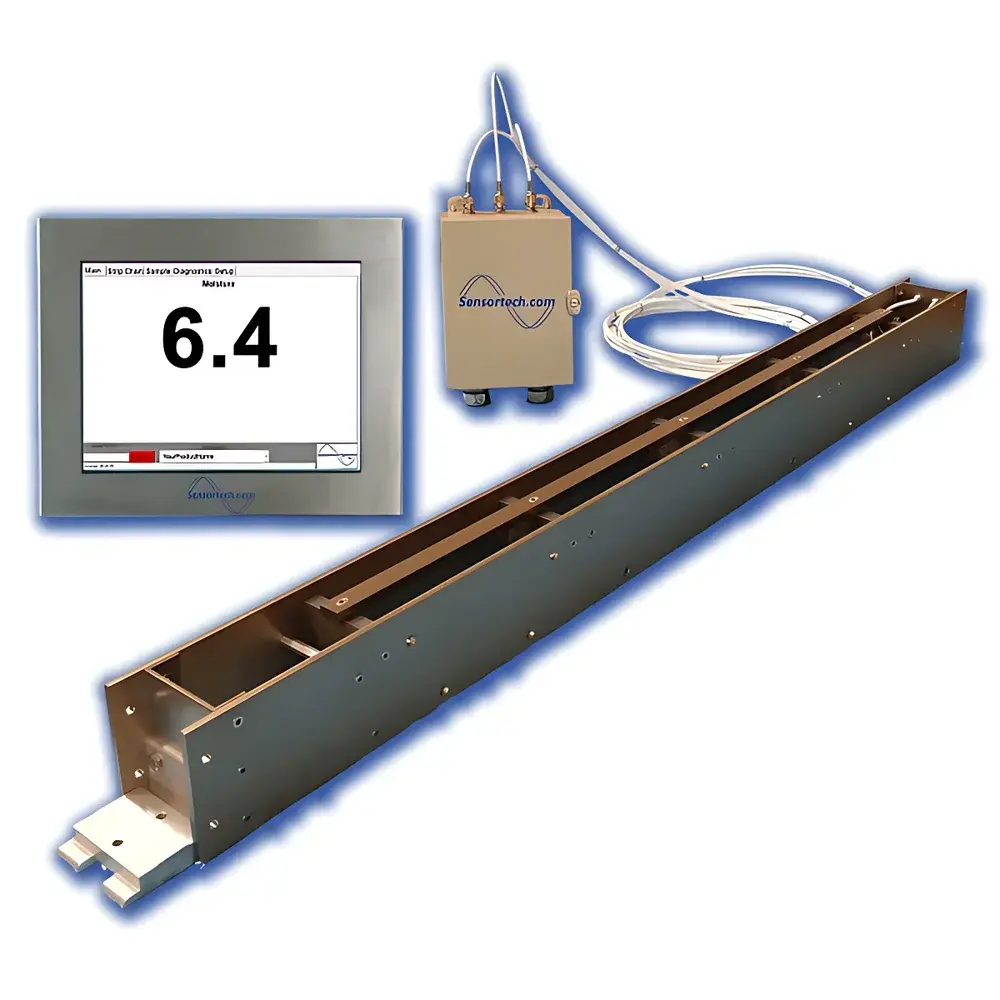
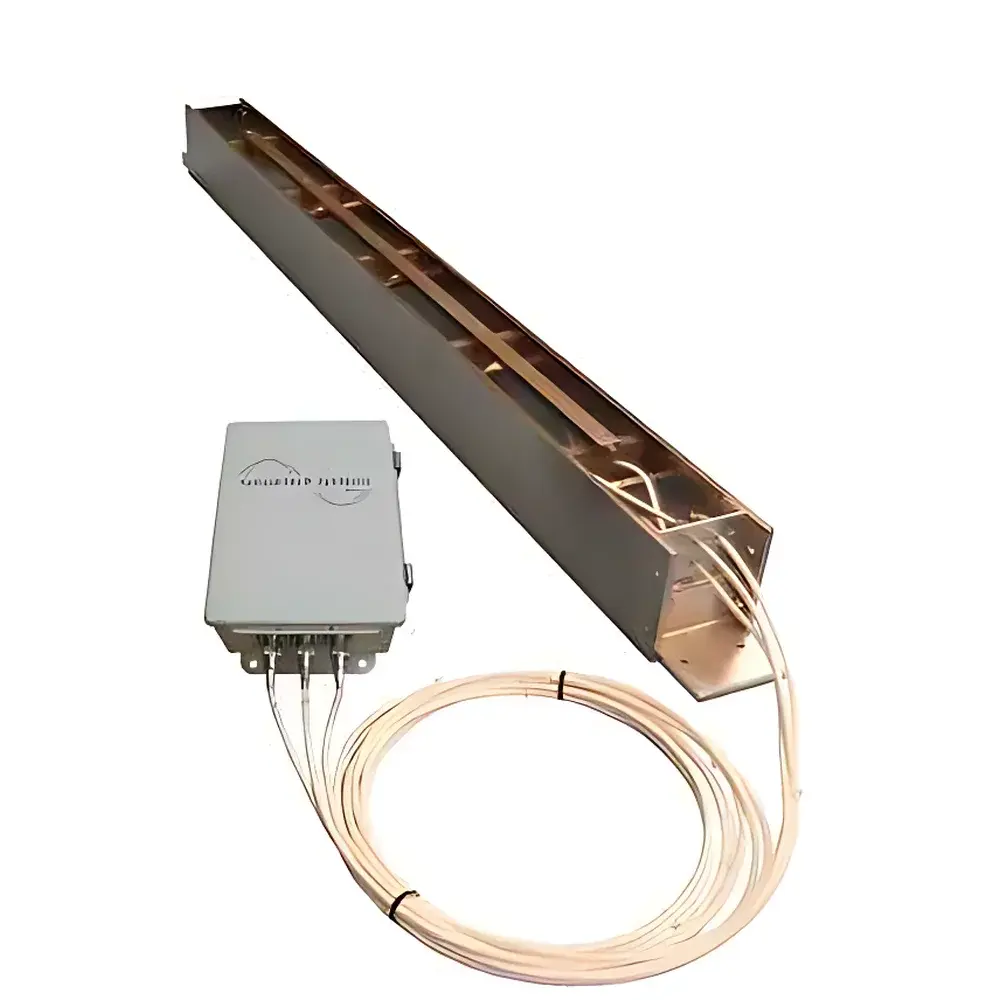
ST-3300 Online RF Moisture Analyzer for Wood, Building Materials, Textiles & Paper Products
| Brand | KPM Sensortech |
|---|---|
| Origin | USA |
| Model | ST-3300 |
| Operating Temperature Range | 0–60°C (32–140°F) standard |
| Measurement Principle | Patented digital closed-loop radiofrequency dielectric sensing |
| Output Interface | 4–20 mA, RS-485, Ethernet (Modbus TCP), optional Profibus/FOUNDATION Fieldbus |
| Compliance | Designed for industrial environments per IEC 61000-6-2/6-4, NEMA 4X/IP66 enclosure rating, ATEX/IECEx Zone 2 optional |
Overview
The ST-3300 Online RF Moisture Analyzer is a high-stability, industrial-grade process analyzer engineered for continuous, non-contact moisture measurement in bulk solid and sheet-based materials. It employs KPM Sensortech’s proprietary closed-loop radiofrequency (RF) dielectric measurement principle—based on the frequency-dependent permittivity contrast between water molecules and dry matrix components. Unlike capacitive or near-infrared methods, this technique delivers robust performance across wide density variations, surface irregularities, and ambient temperature fluctuations (0–60°C standard; extended to 540°C with high-temperature probe variants). The analyzer operates without physical contact or sample extraction, making it suitable for real-time feedback control in continuous manufacturing lines. Its fully digital signal architecture eliminates analog drift, enabling long-term calibration stability and sub-0.1% absolute moisture resolution in optimized applications.
Key Features
- Patented digital closed-loop RF dielectric sensing with adaptive signal conditioning—engineered to suppress noise from vibration, EMI, and thermal transients
- Integrated transmitter electronics with embedded signal processing—no external signal conditioner required
- Multi-protocol digital output support: Modbus TCP over Ethernet, RS-485 (Modbus RTU), and configurable 4–20 mA analog output with HART option
- Field-configurable operating modes: single-point, two-point ratio measurement (to compensate for bulk density effects), and internal reference standard switching for drift correction
- NEMA 4X / IP66-rated stainless-steel housing with optional ATEX/IECEx Zone 2 certification for hazardous locations
- Temperature-compensated measurement algorithms validated across material-specific dielectric response curves
Sample Compatibility & Compliance
The ST-3300 is validated for use across heterogeneous industrial streams including wood-derived materials (sawdust, veneer, plywood, biomass pellets, bagasse), construction products (gypsum board, cementitious slurries, clay bricks, lime plaster), tobacco (flue-cured leaf, expanded stem, cut filler), textiles (woven fabrics, nonwovens, technical textiles), and paper products (pulp slurry, linerboard, corrugated medium, recycled fiber stock). It complies with electromagnetic compatibility standards IEC 61000-6-2 (immunity) and IEC 61000-6-4 (emissions), and meets mechanical robustness requirements per IEC 60068-2 for shock and vibration. While not a medical or pharmaceutical device, its data integrity architecture supports traceability frameworks aligned with GLP and GMP principles—including audit-trail-enabled configuration logging and user-access tiering.
Software & Data Management
The ST-3300 is managed via KPM Sensortech’s Windows-based Configuration Software Suite, providing secure, role-based access: engineers configure sensor parameters (e.g., frequency sweep range, gain settings, compensation coefficients) using password-protected administrator mode; operators access runtime dashboards with real-time moisture trend plots, historical data export (CSV/Excel-compatible), and diagnostic status indicators. Up to 50 preloaded product-specific calibration models (“product codes”) can be stored and recalled remotely. The software includes an integrated calibration utility that automates slope/offset calculation from lab-reference moisture data, and a standardization wizard that guides users through in-situ zero/span verification using certified reference standards. All configuration changes are timestamped and logged with user ID, supporting 21 CFR Part 11–compatible record retention when deployed with validated IT infrastructure.
Applications
The analyzer serves as a critical control node in moisture-sensitive unit operations: optimizing kiln drying profiles in lumber mills; stabilizing binder consistency in particleboard and MDF production; ensuring consistent caliper and tensile strength in paper machine press sections; maintaining target moisture in tobacco re-drying and casing lines; verifying homogeneity in textile dyeing and finishing baths; and controlling feedstock quality in cement raw meal blending and coal pulverization. Its ability to operate under high-dust, high-humidity, and thermally variable conditions makes it particularly suited for integration into PLC-driven SPC (Statistical Process Control) loops and MES-level quality dashboards.
FAQ
What materials require density compensation—and how does the two-point ratio mode work?
Materials with significant bulk density variation (e.g., shredded wood chips, loose granular fertilizers) benefit from two-point ratio measurement, which uses dual-frequency RF excitation to decouple moisture-induced permittivity shifts from density-related capacitance changes.
Can the ST-3300 replace offline oven-dry testing in QC labs?
It is not intended as a standalone replacement for ASTM D4442 or ISO 4469 reference methods but serves as a statistically representative, high-frequency proxy for trending and closed-loop control—reducing reliance on manual sampling.
Is field recalibration possible without sending the unit to a service center?
Yes—using the included Configuration Software and certified reference standards, end users can perform full calibration and standardization in situ with traceable documentation.
How is sensor alignment maintained during installation on vibrating conveyors or rotating drums?
Mechanical mounting kits include adjustable brackets with damping isolators; RF field geometry is designed to tolerate ±5° angular misalignment without measurable accuracy loss.
Does the system support predictive maintenance alerts?
Diagnostic screens monitor signal-to-noise ratio, probe impedance drift, and thermal gradient anomalies—flagging potential fouling or electronic degradation before measurement deviation exceeds specification limits.